MISTAKE: Mimi is at Sunday Four on JUNE 28.
Sorry, I haven't had a chance to blog the brunch yet. Good food, excellent poetry. Next year we are NOT doing it in National Poetry Month. Too much competition.
Paul has taken 1st prize in the All Arts Matter contest and will be accepting his prize on May 17. Congratulations, hope some of you can go to the presentation (in Greene County), gang.
I am featured at the Gay/Lesbian center on May 13 at 7 pm, I guess. I need directions. I've been there but...
Alan is planning Will Christman reading on June 1 at Smitty's - 8 pm. Let him know if you are going to attend/read.
Get ready for the art show! I planned the art reception for June 18 from 6 - 8 pm.
I seem to have lost track of time and missed Sunday Four. Mimi will be the feature on May 24.
Some of Us

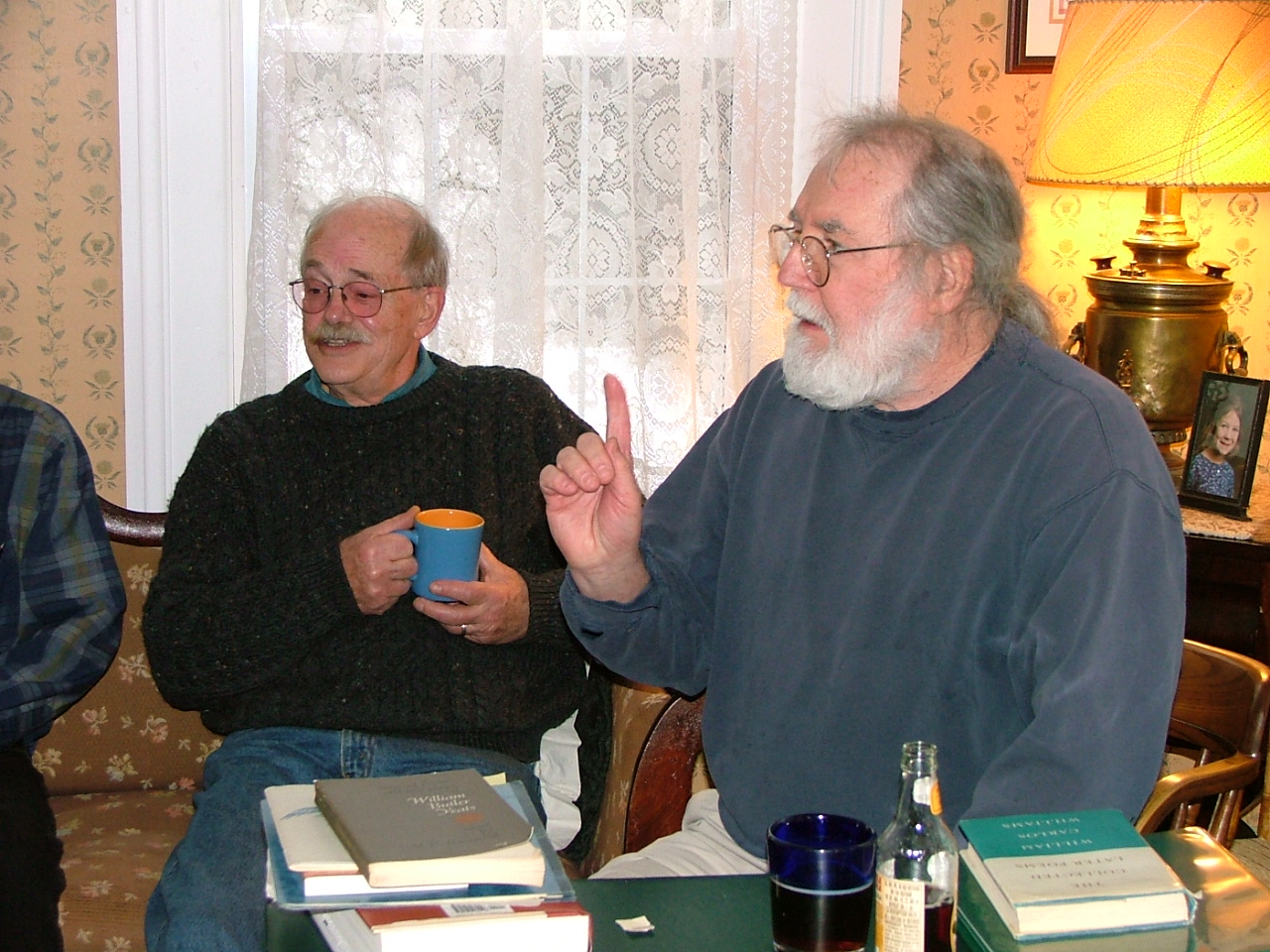
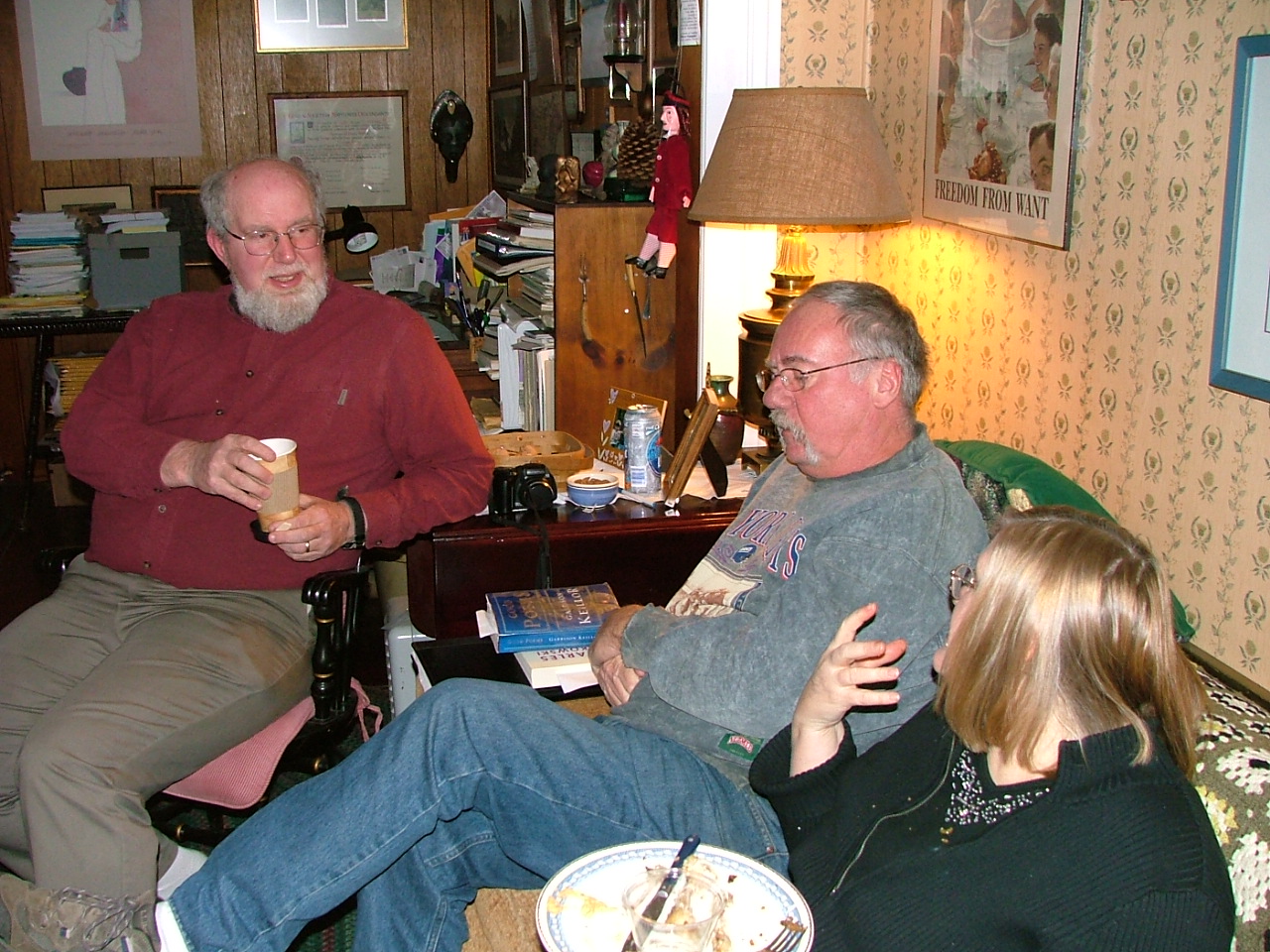
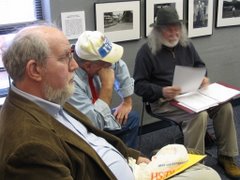
Dennis Sullivan, Beverly Osborne, Tom Corrado, Edie Abrams, Art Willis, Alan Casline (all seated); Paul Amidon, Mike Burke, Tim Verhaegen, Mark O'Brien, Barbara Vink, Philomena Moriarty
Wednesday, May 6, 2009


Sunday, April 26, 2009
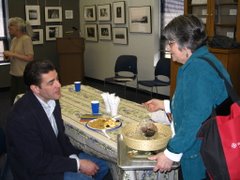
Chatting with Grandma W. & Adolph K.
No big fanfare tonight, no rockets into the sky, just the usual pack of poets quietly casting off to sail the waters of imagination. We were not disappointed.
Alan’s “Modest Journey Through” took us through a series of images of mother earth in the peace of a warm night. The peaceful, soothing tone rose above contentious specifics of philosophy to conclude “balanced on the fullness of a heart.”
Rachael presented “At the Farm Stand; Grandma W. Talks about a Customer with Her Daughter,” a poem with obvious merit as a performance piece. It succeeds admirably in what it sets out to do: bring Grandma W. to life on the printed page through a monologue in Grandma’s heavily-accented American English. Accented from the standpoint of someone from the northeast, that is. It sounds like Grandma W. could be from anywhere between Arkansas or Oklahoma to Appalachian Virginia. The proof that the accent is captured on the page was that the second reader read it as effectively as Rachael’s first reading. The poem, as Dan and Art pointed out, reads like part of a script, but stands as a poem.
A review of any written work should, I believe, be done by someone other than the author of that work. Novelists don’t write reviews of their own novels; artists don’t write reviews of their own exhibitions. I am not the one to review “Seeing The Light,” my poem about a kid getting bombed on a cup of communion wine at church. Anyone else that attended the meeting is welcome to review it. This blog gives readers the option of submitting comments, an option that is little used. Use it. It’s a free country.
Kathy McCabe’s “The Wrong Side” did a good job stating its theme of social status being influenced by where you live. Comments centered around how to improve its poetic qualities without losing the message. Alan noted the first two verses leaned toward a prose style, while several people offered ideas to strengthen the last verse. After the initial muse arrives, as it has in this case, the revision muses often take their own sweet time coming around, and we never know what comment will spark the arrival of one in the poet’s mind.
A poem that elicits no comments is usually one that is excellent or one that fails to communicate. When a poem gets a lot of comments, the poet can safely conclude he or she is on to something. Dan’s “The Power Within” generated much discussion, ranging from genetics to use of the passive voice. Barbara felt this poem was too instructional, that it should have more of a personal touch. Alan thought voice was the key, and its use needed more consistency. Well supplied with musings on science and thought-provoking questions, this work succeeds in stimulating the mind, but for me would benefit from sounding less objective and scientific. Content was not the question here, delivery of the idea was.
Coincidence worked to the advantage of all who attended this meeting. It is the only way to explain the appearance of Grandma W. and Adolph K. on the same Thursday night, but that’s exactly what happened. Art’s “Homage to A Chest Thumper,” a two and a half page poem about a Polish immigrant, relied heavily on the technique of the man telling his own story in heavily-accented English. Enhanced by a skilled theatrical reading from the author, it could have been ten pages and held my interest. Adolph, who lived a life most people only read about in novels, escaped from the Nazis, then the Soviets, before arriving in the United States. Crammed with interesting details that bring out his personality, the poem leaves the reader or listener wanting to know more about a man who was born to succeed in life. This poem was a hit; with any luck those who missed it will hear Art read it sometime in the future. Catch Art and Rachael reading tonight’s poems at the same open mic and you’ll be doubly lucky.
Tim likes to put his poems in the crucible of criticism very soon after getting them on paper. He did it again with “The Last Time I Saw Kookie,” a poem about his cat. It wasn’t at all clear it was about a cat, or even an animal, until we combed the verses for the few clues given about the subject’s identity. Mimi thought it was vague, lacking in vitality. The fact that many of us couldn’t identify the subject cat with certainty demonstrates the need for more clarity. With more specific references this poem will improve considerably; it already has a strong ending. Much of what Tim was alluding to came to light after his explanatory comments, but as Lawrence Ferlinghetti once said: “Like a bowl of roses, a poem should not have to be explained.”
Mimi brought “Man, 44, Announces Engagement,” a piece that effectively showcases both her happiness and annoyance when she received the news of the engagement. I would be annoyed too if someone close to me delivered a heavyweight piece of news through the commonplace, often tacky medium of email, rather than calling to tell me personally. An apparently unintended hard edge crept into the poem with the reference to his handing over “our mother’s ring” to his fiancé. Nearly everybody picked up on this, so obvious was it, but Mimi said no, there was no such hard feeling. Maybe there’s something subconscious going on here, to have such an effective miscommunication appear in a poem. My opinion is to leave it in. It makes a better poem. We’re not dealing in court testimony here. Bend the truth if a better poem results.
Cathy Anderson’s “Anniversary” is a meditative reflection on the sadness of anniversaries that can no longer be celebrated with the joy of former days because someone who figures prominently in the memories is gone. This poem, as Barbara said, has much feeling, and says a lot in a few lines. Comments centered on the third verse, which Mimi felt tended too much toward prose after the poetic first two verses. What stays with me about this piece was the static Cathy took for using “ribbon of blue” as a description of the Hudson River. Several people criticized its use as too much of a cliché, while “wrong side of the tracks” in Kathy’s poem drew no comments about clichés at all. My feeling is that criticism of the “ribbon of blue” was overdone. I agree with Samuel Goldwyn, who said: “Let’s have some new clichés,” but many of the old ones still have their place.
Jim got the whole group talking with an untitled piece of concrete poetry, a type of poetry which has to be seen to appreciate its artistic merits. Reactions varied considerably. Alan, Rachael, and Tim didn’t warm to the art form, while Barbara found it “utterly fascinating. There’s more here than meets the eye.” There is nothing here that meets the ear, as it can’t be read without making the reader sound like a babbling idiot, but that’s the nature of this type of artistry. Mimi observed that it “has a better chance of being published in a literary journal than anything else presented tonight.” Art is art, but art that sells is published. Sounds real to me.
There are five Thursdays in April this year. We hold a fifth Thursday meeting every so often, and one next week is a possibility. Watch this blog, email too, for a final decision. If it happens, I’ll be there. Be there or be square. Be there and be square. Either way, we don’t care. As long as it happens, as long as you’re there.
Post by Paul
Alan’s “Modest Journey Through” took us through a series of images of mother earth in the peace of a warm night. The peaceful, soothing tone rose above contentious specifics of philosophy to conclude “balanced on the fullness of a heart.”
Rachael presented “At the Farm Stand; Grandma W. Talks about a Customer with Her Daughter,” a poem with obvious merit as a performance piece. It succeeds admirably in what it sets out to do: bring Grandma W. to life on the printed page through a monologue in Grandma’s heavily-accented American English. Accented from the standpoint of someone from the northeast, that is. It sounds like Grandma W. could be from anywhere between Arkansas or Oklahoma to Appalachian Virginia. The proof that the accent is captured on the page was that the second reader read it as effectively as Rachael’s first reading. The poem, as Dan and Art pointed out, reads like part of a script, but stands as a poem.
A review of any written work should, I believe, be done by someone other than the author of that work. Novelists don’t write reviews of their own novels; artists don’t write reviews of their own exhibitions. I am not the one to review “Seeing The Light,” my poem about a kid getting bombed on a cup of communion wine at church. Anyone else that attended the meeting is welcome to review it. This blog gives readers the option of submitting comments, an option that is little used. Use it. It’s a free country.
Kathy McCabe’s “The Wrong Side” did a good job stating its theme of social status being influenced by where you live. Comments centered around how to improve its poetic qualities without losing the message. Alan noted the first two verses leaned toward a prose style, while several people offered ideas to strengthen the last verse. After the initial muse arrives, as it has in this case, the revision muses often take their own sweet time coming around, and we never know what comment will spark the arrival of one in the poet’s mind.
A poem that elicits no comments is usually one that is excellent or one that fails to communicate. When a poem gets a lot of comments, the poet can safely conclude he or she is on to something. Dan’s “The Power Within” generated much discussion, ranging from genetics to use of the passive voice. Barbara felt this poem was too instructional, that it should have more of a personal touch. Alan thought voice was the key, and its use needed more consistency. Well supplied with musings on science and thought-provoking questions, this work succeeds in stimulating the mind, but for me would benefit from sounding less objective and scientific. Content was not the question here, delivery of the idea was.
Coincidence worked to the advantage of all who attended this meeting. It is the only way to explain the appearance of Grandma W. and Adolph K. on the same Thursday night, but that’s exactly what happened. Art’s “Homage to A Chest Thumper,” a two and a half page poem about a Polish immigrant, relied heavily on the technique of the man telling his own story in heavily-accented English. Enhanced by a skilled theatrical reading from the author, it could have been ten pages and held my interest. Adolph, who lived a life most people only read about in novels, escaped from the Nazis, then the Soviets, before arriving in the United States. Crammed with interesting details that bring out his personality, the poem leaves the reader or listener wanting to know more about a man who was born to succeed in life. This poem was a hit; with any luck those who missed it will hear Art read it sometime in the future. Catch Art and Rachael reading tonight’s poems at the same open mic and you’ll be doubly lucky.
Tim likes to put his poems in the crucible of criticism very soon after getting them on paper. He did it again with “The Last Time I Saw Kookie,” a poem about his cat. It wasn’t at all clear it was about a cat, or even an animal, until we combed the verses for the few clues given about the subject’s identity. Mimi thought it was vague, lacking in vitality. The fact that many of us couldn’t identify the subject cat with certainty demonstrates the need for more clarity. With more specific references this poem will improve considerably; it already has a strong ending. Much of what Tim was alluding to came to light after his explanatory comments, but as Lawrence Ferlinghetti once said: “Like a bowl of roses, a poem should not have to be explained.”
Mimi brought “Man, 44, Announces Engagement,” a piece that effectively showcases both her happiness and annoyance when she received the news of the engagement. I would be annoyed too if someone close to me delivered a heavyweight piece of news through the commonplace, often tacky medium of email, rather than calling to tell me personally. An apparently unintended hard edge crept into the poem with the reference to his handing over “our mother’s ring” to his fiancé. Nearly everybody picked up on this, so obvious was it, but Mimi said no, there was no such hard feeling. Maybe there’s something subconscious going on here, to have such an effective miscommunication appear in a poem. My opinion is to leave it in. It makes a better poem. We’re not dealing in court testimony here. Bend the truth if a better poem results.
Cathy Anderson’s “Anniversary” is a meditative reflection on the sadness of anniversaries that can no longer be celebrated with the joy of former days because someone who figures prominently in the memories is gone. This poem, as Barbara said, has much feeling, and says a lot in a few lines. Comments centered on the third verse, which Mimi felt tended too much toward prose after the poetic first two verses. What stays with me about this piece was the static Cathy took for using “ribbon of blue” as a description of the Hudson River. Several people criticized its use as too much of a cliché, while “wrong side of the tracks” in Kathy’s poem drew no comments about clichés at all. My feeling is that criticism of the “ribbon of blue” was overdone. I agree with Samuel Goldwyn, who said: “Let’s have some new clichés,” but many of the old ones still have their place.
Jim got the whole group talking with an untitled piece of concrete poetry, a type of poetry which has to be seen to appreciate its artistic merits. Reactions varied considerably. Alan, Rachael, and Tim didn’t warm to the art form, while Barbara found it “utterly fascinating. There’s more here than meets the eye.” There is nothing here that meets the ear, as it can’t be read without making the reader sound like a babbling idiot, but that’s the nature of this type of artistry. Mimi observed that it “has a better chance of being published in a literary journal than anything else presented tonight.” Art is art, but art that sells is published. Sounds real to me.
There are five Thursdays in April this year. We hold a fifth Thursday meeting every so often, and one next week is a possibility. Watch this blog, email too, for a final decision. If it happens, I’ll be there. Be there or be square. Be there and be square. Either way, we don’t care. As long as it happens, as long as you’re there.
Post by Paul
Tuesday, April 14, 2009
Things You Might Want to Know
April 25 BRUNCH
anticipated timeline:
10:30 set up, help appreciated
We have a new audio system which I may need assistance with
11 a.m. Poets arrive with food
If you need suggestions about simple food, bring juice or soda, or fresh strawberries or brown'n'serve sausage we can cook here
11:15 a.m. EATING BEGINS!
NOON-ish - Poetry begins when eating diminishes and ends sometime before 4:30 so we can clean up. Help needed here, too.
Notes:
There will be a signup sheet for the open mic on the desk in the hall.
If you can bring an electric frypan, we need one or more.
Roaming photographers are encouraged.
Musical performances also welcome.
Spouses and friends should be encouraged to come.
Bring poems we can read to each other if no one else shows up.
PS - Brunch is not in Cincinnati.
JUNE ART SHOW
I am expecting everyone to contribute something. The show will be hung by Tom, Obee and me on Sunday, May 31.
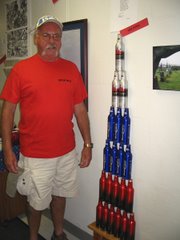
Your work must be ready for hanging when you bring it, when means it MUST have hooks or holes or some other arrangement to be suspended on the wall. If you are doing a sculpture or found art piece, let me know ahead of time so I can find a spot for it. (Mike Burke's beer can sculpture is an example of this.)
If you are not a serious artist, you are encouraged to be imaginative and unusual - fingerpainting and collages are easy. If you can incorporate one of your poems into your work, that is great.
The earliest convenient time available for a reception is Thursday, June 18 from 6 - 8 p.m. (The FOL Booksale has taken a whole week out of the June schedule and the library will be closed on Sundays for the summer.) Mark your calendars and invite your friends.
See you all I hope on April 23.
anticipated timeline:
10:30 set up, help appreciated
We have a new audio system which I may need assistance with
11 a.m. Poets arrive with food
If you need suggestions about simple food, bring juice or soda, or fresh strawberries or brown'n'serve sausage we can cook here
11:15 a.m. EATING BEGINS!
NOON-ish - Poetry begins when eating diminishes and ends sometime before 4:30 so we can clean up. Help needed here, too.
Notes:
There will be a signup sheet for the open mic on the desk in the hall.
If you can bring an electric frypan, we need one or more.
Roaming photographers are encouraged.
Musical performances also welcome.
Spouses and friends should be encouraged to come.
Bring poems we can read to each other if no one else shows up.
PS - Brunch is not in Cincinnati.
JUNE ART SHOW
I am expecting everyone to contribute something. The show will be hung by Tom, Obee and me on Sunday, May 31.
Your work must be ready for hanging when you bring it, when means it MUST have hooks or holes or some other arrangement to be suspended on the wall. If you are doing a sculpture or found art piece, let me know ahead of time so I can find a spot for it. (Mike Burke's beer can sculpture is an example of this.)
If you are not a serious artist, you are encouraged to be imaginative and unusual - fingerpainting and collages are easy. If you can incorporate one of your poems into your work, that is great.
The earliest convenient time available for a reception is Thursday, June 18 from 6 - 8 p.m. (The FOL Booksale has taken a whole week out of the June schedule and the library will be closed on Sundays for the summer.) Mark your calendars and invite your friends.
See you all I hope on April 23.
Friday, April 10, 2009
War Stories
The math genius me had everyone scratching their heads with eleven people in the room and only ten on the list. Baffled everyone for a while, especially me. Everything was a little bizarre tonight. The setup team left a gaping chasm (is that redundant?) in between the tables for an unknown reason and I wanted Ron to crawl under the tables and pop up in the middle. Looking his normal GQ self, he declined.
Cathy got a little testy with me when I criticized her spelling - I still think I'm right - but we don't hold grudges. It was nice to see her after her hiatus. Her poem was a childhood memory of fearing the hiss of the vaporizer. We had to explain what "croup" was to the younger folks.
Paul shocked and dismayed me with his variation from pattern. No nostalgia for him this time, but a piece called Half Truth which I say was droning. Ron said it "will become a poem eventually". Others leapt to Paul's defense, saying his change in direction was Fresh and current. Tom liked the imagery and metaphors. I like it when he tells a story.
Ron chastised his own Camera Obscura, saying his third stanza- well, I'd won't print what he actually said, but it means was not up to his high standards. Tom called it Charles Simic-ian, if that's a word. We all agree the first stanza with "memory dialing its shady accountant to balance the books" was the best.
Art found Tom's poem very kinetic, into movement, into imagination. It was a well constructed effort with a good exit strategy and left both readers rather breathless with its pace. I particularly enjoyed "dear departed Winnie - comes clomping in". Good stuff.
Tim was Too Perfect for Sex. The 41/21 business confused most people, as well as the end. I found it very emotional - men hunting in smoky darkness, crazed, enslaved. Paul wants you to lose the "tippy-toes".
I learned something from Art, as I often do: a comma in a poem counts for one beat and a dash is used to represent at least two beats, so the use of them contributes to the timing of the poem. His Counterpoint was concise and staccato. Mimi mentioned the success of the assonance. Tom pointed out it was bereft of transitionals, to its benefit.
Dan presented I Walk Among the Stars, a heavenly kind of poem, with very effective spacing on the page. It was rather existential and quoted both Nietzche and Conrad. Tim didn't like the quotes. BTW, when you are doing this...use only three dots unless it is the end of a sentence, in which case, use four. One is the period.
Mimi tackled a great subject - middle aged people reflecting on their teen years. I enjoy almost anything that mentions Buddy Holly and the Big Bopper, but I didn't get the part that they were watching impersonators instead of the real deal. Other people got it, I think. I also liked the repetition...the break, the break, last night, last night.
Our first-timer Kevin Duffy, who is a renegade from Larry's philosophy group, attempted to read two poems, but we ungraciously wouldn't allow him to break the rules, even if he was a guest. His poem would have benefited from a better format which would have clarified a big misconception regarding the word "first" which we all made. I wanted it neater. Then Mimi lectured him on the importance of titles. Hope he didn't think we were too rude to come back.
REFRIGERATOR POEM ALERT! This was the poem of the night, which the author Jim Williams insisted was not as good as we thought it was. He said we were influenced by the subject matter, which was anarchy, rebellion against authority, hatred of the establishment, etc. He may be right. But we totally loved the poem anyway. Mimi and I were cheering.
Tom and Jim and Cathy and Just Me had pleasant conversation at the Tavern.
Afterthought: Write out the numbers one - ten, then use numerals for higher.
There is one more meeting before the brunch. See you in Cincinnati.
Cathy got a little testy with me when I criticized her spelling - I still think I'm right - but we don't hold grudges. It was nice to see her after her hiatus. Her poem was a childhood memory of fearing the hiss of the vaporizer. We had to explain what "croup" was to the younger folks.
Paul shocked and dismayed me with his variation from pattern. No nostalgia for him this time, but a piece called Half Truth which I say was droning. Ron said it "will become a poem eventually". Others leapt to Paul's defense, saying his change in direction was Fresh and current. Tom liked the imagery and metaphors. I like it when he tells a story.
Ron chastised his own Camera Obscura, saying his third stanza- well, I'd won't print what he actually said, but it means was not up to his high standards. Tom called it Charles Simic-ian, if that's a word. We all agree the first stanza with "memory dialing its shady accountant to balance the books" was the best.
Art found Tom's poem very kinetic, into movement, into imagination. It was a well constructed effort with a good exit strategy and left both readers rather breathless with its pace. I particularly enjoyed "dear departed Winnie - comes clomping in". Good stuff.
Tim was Too Perfect for Sex. The 41/21 business confused most people, as well as the end. I found it very emotional - men hunting in smoky darkness, crazed, enslaved. Paul wants you to lose the "tippy-toes".
I learned something from Art, as I often do: a comma in a poem counts for one beat and a dash is used to represent at least two beats, so the use of them contributes to the timing of the poem. His Counterpoint was concise and staccato. Mimi mentioned the success of the assonance. Tom pointed out it was bereft of transitionals, to its benefit.
Dan presented I Walk Among the Stars, a heavenly kind of poem, with very effective spacing on the page. It was rather existential and quoted both Nietzche and Conrad. Tim didn't like the quotes. BTW, when you are doing this...use only three dots unless it is the end of a sentence, in which case, use four. One is the period.
Mimi tackled a great subject - middle aged people reflecting on their teen years. I enjoy almost anything that mentions Buddy Holly and the Big Bopper, but I didn't get the part that they were watching impersonators instead of the real deal. Other people got it, I think. I also liked the repetition...the break, the break, last night, last night.
Our first-timer Kevin Duffy, who is a renegade from Larry's philosophy group, attempted to read two poems, but we ungraciously wouldn't allow him to break the rules, even if he was a guest. His poem would have benefited from a better format which would have clarified a big misconception regarding the word "first" which we all made. I wanted it neater. Then Mimi lectured him on the importance of titles. Hope he didn't think we were too rude to come back.
REFRIGERATOR POEM ALERT! This was the poem of the night, which the author Jim Williams insisted was not as good as we thought it was. He said we were influenced by the subject matter, which was anarchy, rebellion against authority, hatred of the establishment, etc. He may be right. But we totally loved the poem anyway. Mimi and I were cheering.
Tom and Jim and Cathy and Just Me had pleasant conversation at the Tavern.
Afterthought: Write out the numbers one - ten, then use numerals for higher.
There is one more meeting before the brunch. See you in Cincinnati.
Saturday, March 28, 2009
An Analgesic Night
With the captain halfway to the tropics and the ship about to sail, one might expect the crew to hold together on precedent alone, but wait, is that a whiff of mutiny in the air? Maybe not; once under sail the night’s voyage was normal, even quieter than usual in some quarters. Once back in port, the usual tars headed out on the straight-line road to grog, and a drink to go with it. In a realm where bands of poets sail the dark hours, the shoals of boredom are especially dreaded.
Alan brought something different from many of his recent poems. “To Comprehend A Gaze Outward” turned our attention inward with a meditative musing set in the early morning hours. Comments were limited, which is often the case with a poem best savored slowly, allowed to steep like a cup of tea in the mind.
Jim Williams, a poet who strikes me as someone who belongs in our group, gave us “Love-feast,” a statement about love in the “shadow of self-interest” that ended up centering discussion on one line: “agape stuff.” That’s agape with an accent on the e, a Greek word. I’ve forgotten what it means. By his own admission it’s a line he has given much thought to already; more might be needed. It said what it wanted to say, but seemed out of sync with the poetic smoothness of the other lines. Also lurking at the edge of this is the concept of using foreign words in English poetry, an idea we’ve taken up more than once.
Reminiscent of Alan’s style in many of his poems, wherein he writes with few articles, is the beginning of Rachael Ikins’ “As Spring Approaches the First Year, The Tribe.” It then starts including more articles as it takes us along to share the comradarie of two poets. With good poetic images and a scenario local poets can picture easily, it did, as Philomena said, let us “be part of the experience of the poem.” Mimi pointed out the punctuation was inconsistent, but I’m not jumping off the punctuation cliff today. As we all know, anything goes in the punctuation of poetry (all, some, or none), but whichever choice you make, be consistent about it.
Dennis did it again, gave us a beautiful poem, thoughtful, filled with the sensitivity of a genuine poet, and polluted it near the end with one word like a cup of toxic waste in a mountain lake. Mimi voiced my sentiments, and probably those of others, when she landed with both feet on “analgesic,” a word that belongs on medicine bottles, not in poems. Change that one line and “Beware” is a winner of a poem. Still, I shouldn’t complain too much. “Analgesic” isn’t as bad as “hendecasyllabically,” a seven-syllable eyesore parked on a line of his previous poem like a toad on the dinner table. This, from the poet who won the Rip Van Winkle Poetry Competition last year. (Hendecasyllable --- a metrical line of eleven syllables)
Mark’s “Matchmaking” successfully captures the flavor of a group of local gossips gathering and spreading news and rumors. This too is a winner. His presentation and layout on the printed page is excellent. If a chapbook consisted of a single poem on a single sheet of paper, this would be it.
Anyone who has seen a few of his other poems would read “The Final Exit” and say: “This is a Mike Burke poem.” As is often the case with Mike, the ending puts the poem over the top with a wham—bang wrap-up. I loved it. As good as it is, though, Rachael had a few suggestions to make it even better. Don’t stay away so long next time, Mike.
Kathy McCabe’s “This Memory” is a touching, sympathetic tribute to a woman who suffered much in the hard school of her life. Alan made the comment that the poem gives little glimpses that make you want to know more about the woman, a comment right on the money. Mimi, who had a lot of good observations this evening, noted the last eight lines were iambic but not the rest, and suggested making the whole poem iambic. Either way, the poem works.
Dan gave us new lyrics to the religious standard “You’ll Never Walk Alone,” lyrics he has sung to a congregational audience. Parody songs are often light, humorous, or ridiculous, but this is none of those. It is a straight-out religious rewrite, skillfully done, that probably was very well received when he sang it. I wish I had been there.
Some people love squirrels and some people, particularly those who want to feed birds only, can’t stand the fat gray freeloaders. All right, so now you know where I stand, but Mimi sees it differently and says so in “On My Deck.” This poem is so effective it makes me feel sorry for the squirrel crying on her deck, but I know if I saw it wrapped around a bird feeder, munching away, my sympathy would melt. A change of person might improve the last verse, but only if the ideas and imagery it currently has are retained.
Philomena’s “Drowning,” described by Mimi as “poignant and sympathetic,” is a strong poem that will be stronger if the intent is made clearer and the speakers better identified. That the intent was not clear enough came through to me when Philomena made her own comments. Tom came to life on this poem, suggesting several of the line rearrangements he is locally famous for. I’m not a fan of repetition, but here the repetition of the lines “underneath, the silent plea, help me” adds to the poem’s power, driving home the idea that the bottom line of all that goes on in this poem is to help people. I hope we get to see this one again.
Last but never least, Tom continued in his collage-of-images style with “Ezra in Exile.” Fans of Ezra Pound’s poetry will especially like this, indeed, a lot of it will no doubt be lost on those who know little of Pound, as a knowledge of his life is necessary to fully appreciate this poem. It is another of those poems that gives you glimpses and leaves you wanting to know more.
Do YOU want to know more? Show up at the next meeting, April 9.
With the captain halfway to the tropics and the ship about to sail, one might expect the crew to hold together on precedent alone, but wait, is that a whiff of mutiny in the air? Maybe not; once under sail the night’s voyage was normal, even quieter than usual in some quarters. Once back in port, the usual tars headed out on the straight-line road to grog, and a drink to go with it. In a realm where bands of poets sail the dark hours, the shoals of boredom are especially dreaded.
Alan brought something different from many of his recent poems. “To Comprehend A Gaze Outward” turned our attention inward with a meditative musing set in the early morning hours. Comments were limited, which is often the case with a poem best savored slowly, allowed to steep like a cup of tea in the mind.
Jim Williams, a poet who strikes me as someone who belongs in our group, gave us “Love-feast,” a statement about love in the “shadow of self-interest” that ended up centering discussion on one line: “agape stuff.” That’s agape with an accent on the e, a Greek word. I’ve forgotten what it means. By his own admission it’s a line he has given much thought to already; more might be needed. It said what it wanted to say, but seemed out of sync with the poetic smoothness of the other lines. Also lurking at the edge of this is the concept of using foreign words in English poetry, an idea we’ve taken up more than once.
Reminiscent of Alan’s style in many of his poems, wherein he writes with few articles, is the beginning of Rachael Ikins’ “As Spring Approaches the First Year, The Tribe.” It then starts including more articles as it takes us along to share the comradarie of two poets. With good poetic images and a scenario local poets can picture easily, it did, as Philomena said, let us “be part of the experience of the poem.” Mimi pointed out the punctuation was inconsistent, but I’m not jumping off the punctuation cliff today. As we all know, anything goes in the punctuation of poetry (all, some, or none), but whichever choice you make, be consistent about it.
Dennis did it again, gave us a beautiful poem, thoughtful, filled with the sensitivity of a genuine poet, and polluted it near the end with one word like a cup of toxic waste in a mountain lake. Mimi voiced my sentiments, and probably those of others, when she landed with both feet on “analgesic,” a word that belongs on medicine bottles, not in poems. Change that one line and “Beware” is a winner of a poem. Still, I shouldn’t complain too much. “Analgesic” isn’t as bad as “hendecasyllabically,” a seven-syllable eyesore parked on a line of his previous poem like a toad on the dinner table. This, from the poet who won the Rip Van Winkle Poetry Competition last year. (Hendecasyllable --- a metrical line of eleven syllables)
Mark’s “Matchmaking” successfully captures the flavor of a group of local gossips gathering and spreading news and rumors. This too is a winner. His presentation and layout on the printed page is excellent. If a chapbook consisted of a single poem on a single sheet of paper, this would be it.
Anyone who has seen a few of his other poems would read “The Final Exit” and say: “This is a Mike Burke poem.” As is often the case with Mike, the ending puts the poem over the top with a wham—bang wrap-up. I loved it. As good as it is, though, Rachael had a few suggestions to make it even better. Don’t stay away so long next time, Mike.
Kathy McCabe’s “This Memory” is a touching, sympathetic tribute to a woman who suffered much in the hard school of her life. Alan made the comment that the poem gives little glimpses that make you want to know more about the woman, a comment right on the money. Mimi, who had a lot of good observations this evening, noted the last eight lines were iambic but not the rest, and suggested making the whole poem iambic. Either way, the poem works.
Dan gave us new lyrics to the religious standard “You’ll Never Walk Alone,” lyrics he has sung to a congregational audience. Parody songs are often light, humorous, or ridiculous, but this is none of those. It is a straight-out religious rewrite, skillfully done, that probably was very well received when he sang it. I wish I had been there.
Some people love squirrels and some people, particularly those who want to feed birds only, can’t stand the fat gray freeloaders. All right, so now you know where I stand, but Mimi sees it differently and says so in “On My Deck.” This poem is so effective it makes me feel sorry for the squirrel crying on her deck, but I know if I saw it wrapped around a bird feeder, munching away, my sympathy would melt. A change of person might improve the last verse, but only if the ideas and imagery it currently has are retained.
Philomena’s “Drowning,” described by Mimi as “poignant and sympathetic,” is a strong poem that will be stronger if the intent is made clearer and the speakers better identified. That the intent was not clear enough came through to me when Philomena made her own comments. Tom came to life on this poem, suggesting several of the line rearrangements he is locally famous for. I’m not a fan of repetition, but here the repetition of the lines “underneath, the silent plea, help me” adds to the poem’s power, driving home the idea that the bottom line of all that goes on in this poem is to help people. I hope we get to see this one again.
Last but never least, Tom continued in his collage-of-images style with “Ezra in Exile.” Fans of Ezra Pound’s poetry will especially like this, indeed, a lot of it will no doubt be lost on those who know little of Pound, as a knowledge of his life is necessary to fully appreciate this poem. It is another of those poems that gives you glimpses and leaves you wanting to know more.
Do YOU want to know more? Show up at the next meeting, April 9.
Post by Paul
Friday, March 13, 2009
Eating An Elephant
Tom came with a masterpiece which everyone liked. It exhibited Tom's usual cleverness and wry sense of humor throughout, but also flowed in a cohesive sequence and intensified as it moved along. Art coined an appropriate phrase about it - "diddling with your digital" which described the act of having your computer plundered for personal informaton. Very relatable.
BTW, Dr. Willis dropped the remark that he was once a paramedic at a rock festival and I look forward to quizzing him more on that topic. His poem Overlap was a quiet success, striking a chord about youngsters in Africa being kidnapped and sold for profit.
Kathy McCabe mainly needed to reformat, and the conversation focused on how she could redo the lines to strengthen the tale of twins, who chose between death and therapy.
I got a couple of suggestions for Trying to Sleep (with Satan yammering in your head). The idea had been floating around for a couple of months and I finally got it down on paper in a conversational tone which someone called "a beautiful way of sitting with your sins".
Alan wants to do a broadside of Paul's Stock Car Racer which was near perfect in Paul's inimitable style, recounting the happiness of a man flying around the race track.
Dan Lawlor is back from Florida with a rhyming poem about nameless Longings in a cemetery. Poem needed some details to make it "grounded". General impression was that it was too "otherworldly."
Mark was also a winner tonight with one Tim picked as his favorite of the evening. Art called it musical, Tom suggested a list near the end and switching two stanzas at the top, both of which were good ideas. I mentioned how much I prefered it when Mark did not write in dialect.
Tim and Linda was a great triumph according to to Art, and I wholeheartedly agreed. It was accompanied by a picture of studly Verhaegen around the time of his high school prom and the poem was a heartstopper. It led to a discussion of centering poetry on the page and why you should not do it (it makes it look Hallmarkian). And amateurish. Tim's great line - "you've come to the calm now".
Barbara's Rant of the Night was unleashed on Dennis whose truly lyric and lovely Evening Prayer with lines like "oh pearl white egg of night" was utterly discombobulated by the intrusion of hendecasyllabically. Beats me what he was thinking and he wouldn't tell us.
For a more exciting ride, we suggested that Philomena take out the qualifiers in her work about the horrors of high cholesterol - "we are all on this Titanic together".
Jim Williams made a return visit in a sunny yellow shirt with a poem about a woman in a park feeding the pigeons. It reminded me of a poem I had written years ago after seeing a woman in Central Park with pigeons perched all over her. (As Dan remarked, "there is nothing new under the sun".) There is nothing you can say or think that has not been done before. We can only strive to say it in new and better way. Jim had an unusual rhyme scheme which needed a little work.
I met Rachael Ikins who had been to a meeting that I missed. She is from Menands and rides here with Alan. She brought a prose poem which of course inspired questions about prose poetry. Group liked the wording of the poem - "He lay with his breath in his mouth wishing it hers"- lovely-but it seemed to lend itself more to a regular form.
Bringing up the end is Alan, dear Alan, who, I opine, has suddenly brought back his inner poet with an emotional offering about a tree in Crack Alley. He also chose to rib me with some Google statistics about historic, scientific and romantic poetry, but that was of no consequence compared to his personal revival.
I had a great time last night, lots of good and some outstanding poems.
Dennis is organizing a group for WordFest on April 17, with dinner prior to 7 pm reading. Contact him to sign up. I have contact info for Rachel and Jim if anyone needs it.
Remember also Sunday Four is March 22, with Mary Panza featured. Mary is a little too colorful for some, but I enjoy her. And, she is a great massage therapist! I hope I'll see you there before I leave for Florida on the 23rd. Paul is taking charge of the next meeting.
I passed out invitations to the potluck brunch on April 25. Everyone should be thinking about their artwork for the June show. Obie is taking donations for his art fund.
BTW, Dr. Willis dropped the remark that he was once a paramedic at a rock festival and I look forward to quizzing him more on that topic. His poem Overlap was a quiet success, striking a chord about youngsters in Africa being kidnapped and sold for profit.
Kathy McCabe mainly needed to reformat, and the conversation focused on how she could redo the lines to strengthen the tale of twins, who chose between death and therapy.
I got a couple of suggestions for Trying to Sleep (with Satan yammering in your head). The idea had been floating around for a couple of months and I finally got it down on paper in a conversational tone which someone called "a beautiful way of sitting with your sins".
Alan wants to do a broadside of Paul's Stock Car Racer which was near perfect in Paul's inimitable style, recounting the happiness of a man flying around the race track.
Dan Lawlor is back from Florida with a rhyming poem about nameless Longings in a cemetery. Poem needed some details to make it "grounded". General impression was that it was too "otherworldly."
Mark was also a winner tonight with one Tim picked as his favorite of the evening. Art called it musical, Tom suggested a list near the end and switching two stanzas at the top, both of which were good ideas. I mentioned how much I prefered it when Mark did not write in dialect.
Tim and Linda was a great triumph according to to Art, and I wholeheartedly agreed. It was accompanied by a picture of studly Verhaegen around the time of his high school prom and the poem was a heartstopper. It led to a discussion of centering poetry on the page and why you should not do it (it makes it look Hallmarkian). And amateurish. Tim's great line - "you've come to the calm now".
Barbara's Rant of the Night was unleashed on Dennis whose truly lyric and lovely Evening Prayer with lines like "oh pearl white egg of night" was utterly discombobulated by the intrusion of hendecasyllabically. Beats me what he was thinking and he wouldn't tell us.
For a more exciting ride, we suggested that Philomena take out the qualifiers in her work about the horrors of high cholesterol - "we are all on this Titanic together".
Jim Williams made a return visit in a sunny yellow shirt with a poem about a woman in a park feeding the pigeons. It reminded me of a poem I had written years ago after seeing a woman in Central Park with pigeons perched all over her. (As Dan remarked, "there is nothing new under the sun".) There is nothing you can say or think that has not been done before. We can only strive to say it in new and better way. Jim had an unusual rhyme scheme which needed a little work.
I met Rachael Ikins who had been to a meeting that I missed. She is from Menands and rides here with Alan. She brought a prose poem which of course inspired questions about prose poetry. Group liked the wording of the poem - "He lay with his breath in his mouth wishing it hers"- lovely-but it seemed to lend itself more to a regular form.
Bringing up the end is Alan, dear Alan, who, I opine, has suddenly brought back his inner poet with an emotional offering about a tree in Crack Alley. He also chose to rib me with some Google statistics about historic, scientific and romantic poetry, but that was of no consequence compared to his personal revival.
I had a great time last night, lots of good and some outstanding poems.
Dennis is organizing a group for WordFest on April 17, with dinner prior to 7 pm reading. Contact him to sign up. I have contact info for Rachel and Jim if anyone needs it.
Remember also Sunday Four is March 22, with Mary Panza featured. Mary is a little too colorful for some, but I enjoy her. And, she is a great massage therapist! I hope I'll see you there before I leave for Florida on the 23rd. Paul is taking charge of the next meeting.
I passed out invitations to the potluck brunch on April 25. Everyone should be thinking about their artwork for the June show. Obie is taking donations for his art fund.
Friday, February 27, 2009
DUTCH TREAT
The two Moriartys were the opening acts last night. Philomena wrote I only know exceptional people, the title being a line from a conversation with her husband. Suggestion: revise to 3-line stanzas. We all like the cast-iron skillet. Mimi was on point, both with her own poem Crying Baby and with her critiques. There were different interpretations of the meaning of "crimson age". Everybody agreed about the effectiveness of "Crap." Standing tall and proud.
Obeedude produced one of his finest, reflecting on lost childhood, complete with an elementary school photo of himself as a blond (!) necktied sweetie. "...was your life left at the bottom of a shoebox filled with Kodachrome and light?" Aren't we all there?
What is a poem? Benevolent Bird inspired yet more talk about what poetry is with Tyman Bouwensen, Dutch Soldier 1626 - an historical piece about the hostilities between the Dutch and the two indian tribes near Fort Amsterdam. Tim V. kicked off the discussion by pointing our that the "poem" read like a news release, with an aura of detachment between the event and author. Mark said it had no beautiful language and Mimi said the clunky lines needed air.
Bird's style to me (and I am only speaking for myself here) usually presents more as a science or history lecture than a poem. Very factual, very straightforward. Very prose. Leaving me with this question - if a writer presents something as a poem, should we just accept it as a poem even if we don't think it is? I dunno. How can anyone offer helpful commentary when they are coming from such opposing viewpoints? I guess I can't. The consensus seemed to be that this Dutch piece was a good story, but had no music to it that would make it poetic. Mimi's final suggestion was to make it a ballad with a refrain. There's an idea.
Alan sometimes has great rushes of inspired writing. I have a snippet from one of his poems tacked on my bulletin board. "...I imagined I was a poet writing you a poem made of wind when I'm the wind." That touched me. That's poetry.
Two, not one, but two, newcomers sat through and contributed to our brutal observations. Timothy Lake and Jim Williams joined us, both bravely bringing a poem to share. We now have a Tim, Tim and Jim, if we haven't frightened the new guys away.
TL picked a wonderful subject for his work - the demolition of an old house. It made me want to write about the same thing, which is always good. He had one phrase that I loved: "ample space for urban ghosts". The advice we gave was that he clean it up, take out unneccessary adjectives and substitute more descriptive words for less specific ones such as "part" and "form".
Jim got a resounding thumbs up for Arrivals---Departures, a terse two column snapshot of a middle-aged couple at an airport,
bags weighing them
d
o
w
n.
Looked like he knew what he was doing.
More visual aids from Tim V. (hey, we could have a TeeVee and a TeeEll). Tim brought photos he had taken of a mystery 17th century cemetery he found on his travels. It was accompanied by a rather haunting poem, for which only minor suggestions for change were offered. I am a fan of old cemeteries and was particularly intrigued.
Another winner from Mister Willis, brief snapshots of an American high school girl and an elderly Russian peasant woman. Either stanza could have been a complete poem in itself, but meshed admirably through the idea of men being jerks. (Art said that, not me!)
Paul produced another flawless effort about a small boy and a lost coin, which Mimi observed was "wonderful before we started messing with it".
I did have a poem, about Eli and I visiting a house where no one answered the door. I thought my best line was the dog "yellowing the snow with impatience". Art pronounced it the "prologue to a novella".
I actually think that we are becoming quite adept at our critiques, and I am becoming an advocate of not pussyfooting around with our comments. (See New Year's Resolution.)
On to business: brunch date is Saturday, April 25, I'll go over details when it gets closer.
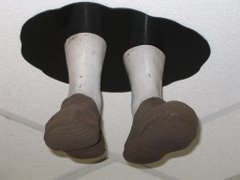
Remember the June art show! Bring your pieces to the regular meeting on May 28 and we will hang the show that night or the next day. Anything goes as long as you excercise reasonably good taste. Sculpture, collage, found art, painting or drawings (must be framed for hanging). Outre is in - evidence Mark's shoes descending from the hall ceiling. I just had an epiphany - how about a tromphe l'oeil in the hallway? We'll talk...
Obeedude produced one of his finest, reflecting on lost childhood, complete with an elementary school photo of himself as a blond (!) necktied sweetie. "...was your life left at the bottom of a shoebox filled with Kodachrome and light?" Aren't we all there?
What is a poem? Benevolent Bird inspired yet more talk about what poetry is with Tyman Bouwensen, Dutch Soldier 1626 - an historical piece about the hostilities between the Dutch and the two indian tribes near Fort Amsterdam. Tim V. kicked off the discussion by pointing our that the "poem" read like a news release, with an aura of detachment between the event and author. Mark said it had no beautiful language and Mimi said the clunky lines needed air.
Bird's style to me (and I am only speaking for myself here) usually presents more as a science or history lecture than a poem. Very factual, very straightforward. Very prose. Leaving me with this question - if a writer presents something as a poem, should we just accept it as a poem even if we don't think it is? I dunno. How can anyone offer helpful commentary when they are coming from such opposing viewpoints? I guess I can't. The consensus seemed to be that this Dutch piece was a good story, but had no music to it that would make it poetic. Mimi's final suggestion was to make it a ballad with a refrain. There's an idea.
Alan sometimes has great rushes of inspired writing. I have a snippet from one of his poems tacked on my bulletin board. "...I imagined I was a poet writing you a poem made of wind when I'm the wind." That touched me. That's poetry.
Two, not one, but two, newcomers sat through and contributed to our brutal observations. Timothy Lake and Jim Williams joined us, both bravely bringing a poem to share. We now have a Tim, Tim and Jim, if we haven't frightened the new guys away.
TL picked a wonderful subject for his work - the demolition of an old house. It made me want to write about the same thing, which is always good. He had one phrase that I loved: "ample space for urban ghosts". The advice we gave was that he clean it up, take out unneccessary adjectives and substitute more descriptive words for less specific ones such as "part" and "form".
Jim got a resounding thumbs up for Arrivals---Departures, a terse two column snapshot of a middle-aged couple at an airport,
bags weighing them
d
o
w
n.
Looked like he knew what he was doing.
More visual aids from Tim V. (hey, we could have a TeeVee and a TeeEll). Tim brought photos he had taken of a mystery 17th century cemetery he found on his travels. It was accompanied by a rather haunting poem, for which only minor suggestions for change were offered. I am a fan of old cemeteries and was particularly intrigued.
Another winner from Mister Willis, brief snapshots of an American high school girl and an elderly Russian peasant woman. Either stanza could have been a complete poem in itself, but meshed admirably through the idea of men being jerks. (Art said that, not me!)
Paul produced another flawless effort about a small boy and a lost coin, which Mimi observed was "wonderful before we started messing with it".
I did have a poem, about Eli and I visiting a house where no one answered the door. I thought my best line was the dog "yellowing the snow with impatience". Art pronounced it the "prologue to a novella".
I actually think that we are becoming quite adept at our critiques, and I am becoming an advocate of not pussyfooting around with our comments. (See New Year's Resolution.)
On to business: brunch date is Saturday, April 25, I'll go over details when it gets closer.
Remember the June art show! Bring your pieces to the regular meeting on May 28 and we will hang the show that night or the next day. Anything goes as long as you excercise reasonably good taste. Sculpture, collage, found art, painting or drawings (must be framed for hanging). Outre is in - evidence Mark's shoes descending from the hall ceiling. I just had an epiphany - how about a tromphe l'oeil in the hallway? We'll talk...
Wednesday, February 18, 2009
Jay Rogoff
...is the featured poet at Sunday Four this week (22nd). I worked with Jay in the early '90s when I was Charlie Rossiter's assistant with the Poets In Person grant. Should be a good show and I hope a good turnout. Sorry that I will be in NYC and will miss it.
Friday, February 13, 2009
Barbara's Dress Test
I flunked the dress test and it gave me a wicked headache. So, I settled for a pair of jeans at Macy's which was having great sales, btw. Here's is last night's blog by our ghost blogger, although I guess he can't be a ghost blogger if we can see him. Anyway, it's Paul, who leapt in first thing with his offer of a recap. Thanks, Paul. Dennis also had comments this a.m. which I wish he would publish on the blog instead of emailing, but he never does.
THE MECHANICS OF POETRY
An annoying wind was at work Thursday night, pestering the trees, making short work of the few leaves that had gotten loose from the frozen ground during the day. On the road to Voorheesville, only homeward-bound commuters, a few poets. The workshop crew was assembling, the mechanics of poetry preparing to turn the wrenches, tighten the screws.
Alan’s “Want the Warrior Not the Wound,” a poem by turns graceful images and cryptic references, came with a short Italian phrase as an aside that launched a discussion about the use of foreign languages in poems written for English-speaking audiences. The discussion trailed off without reaching a conclusion; maybe there is no conclusion, poets being what they are.
Dennis, no stranger to foreign languages, had nothing but English in his “Early Morning Psalm,” a meditative work that achieved its high point in the poetic humility of the fourth verse. The poem demonstrates how far religious ideas in the proper hands can rise above the preach religious rubbish that writers long on zeal and short on talent routinely produce.
Newcomer Rachael Ikins gave us “The Flea Market,” a title that didn’t seem to fit, probably because it conjures an image different from the place the poem took us. As Alan pointed out, the poem goes in a different direction from the one we expected. All the same, “mirrors collecting dusty faces” is the kind of line poetry is all about.
Philomena’s “Settling,” described by Alan as “Robert Creeley-like in its simplicity,” somehow managed to start a discussion that gave gerunds quite a beating. Various meetings of this group have witnessed the maligning of adjectives and adverbs; last night gerunds got worked over. If people start trashing nouns and verbs, we could end up walking around with targets on our backs, the word “poet” written in the bulls-eye.
Mark arrived with “And Rue, Sweet Rue, For You,” a three and a half page ballad skillfully written in Ulster-Scot dialect. I personally need more time than is provided by one reading to assimilate a poem of this type and length. On the first reading, intent and meaning become secondary to understanding the language. Tim felt it would be better sung than spoken, and Mark’s notation that it is a ballad gives weight to this idea. Mimi wants it performed at the April Poetry Brunch – from memory. Ten weeks, Mark. How about it?
Mimi’s “Diner” was a wonderful collage of images and musings that did justice to the uniquely American eatery known as a diner. As discussion of this poem moved along, ideas fed on each other to create new ideas in a chain reaction that gave the poet so much input there’s no telling how this piece will look in revised form. Good, that’s how it will look, but in what way?
“Group Think,” by Tim, is two poems in one, or maybe it isn’t. Depends on who you ask. The scenario of the chased woman is one part, the observations are another. The pithy and insightful “observations” verses, part rant, part humor, pack a lot of food for thought in their lines. I thought they were great; they spared no one.
Poem of the night (if anyone should ask me) was Ron Pavoldi’s “Boilermaker.” Strong graphic imagery from start to finish succeeds in giving the listener or reader a powerful portrait of hard-drinking men leading dead-end lives as workers in a varnish manufacturing plant, stuck in jobs that kill them faster than their alcoholism does. This poem does not leave its audience wondering what it is trying to say. Its impact comes from leaving little doubt about what it is saying.
Edie’s well-titled “A Walk In the Park” did indeed take us for a walk in the park, but not in the way the most common use of the phrase (meaning something is easy) would suggest. Used in its literal sense, it fit a poem that centers on two people walking in a park held firmly in the grip of winter. Its descriptive quality, as Alan noted, “captures the natural world.” Mimi voiced a creative idea that would leave it as good or better by contracting each stanza by one line, one of those ideas that often gets the subconscious coming back for another look.
Cathy Anderson finally came back, and presented a timely poem called “Valentine.” It is a fine illustration of the truism that there is poetry in everyday things and everyday occurrences. The whole piece is a scene, a memory, given to us as a picture painted with details, made warmer still with a touching last verse. Quite effective.
Next meeting is February 26. Write what you think. Bring what you dare.
THE MECHANICS OF POETRY
An annoying wind was at work Thursday night, pestering the trees, making short work of the few leaves that had gotten loose from the frozen ground during the day. On the road to Voorheesville, only homeward-bound commuters, a few poets. The workshop crew was assembling, the mechanics of poetry preparing to turn the wrenches, tighten the screws.
Alan’s “Want the Warrior Not the Wound,” a poem by turns graceful images and cryptic references, came with a short Italian phrase as an aside that launched a discussion about the use of foreign languages in poems written for English-speaking audiences. The discussion trailed off without reaching a conclusion; maybe there is no conclusion, poets being what they are.
Dennis, no stranger to foreign languages, had nothing but English in his “Early Morning Psalm,” a meditative work that achieved its high point in the poetic humility of the fourth verse. The poem demonstrates how far religious ideas in the proper hands can rise above the preach religious rubbish that writers long on zeal and short on talent routinely produce.
Newcomer Rachael Ikins gave us “The Flea Market,” a title that didn’t seem to fit, probably because it conjures an image different from the place the poem took us. As Alan pointed out, the poem goes in a different direction from the one we expected. All the same, “mirrors collecting dusty faces” is the kind of line poetry is all about.
Philomena’s “Settling,” described by Alan as “Robert Creeley-like in its simplicity,” somehow managed to start a discussion that gave gerunds quite a beating. Various meetings of this group have witnessed the maligning of adjectives and adverbs; last night gerunds got worked over. If people start trashing nouns and verbs, we could end up walking around with targets on our backs, the word “poet” written in the bulls-eye.
Mark arrived with “And Rue, Sweet Rue, For You,” a three and a half page ballad skillfully written in Ulster-Scot dialect. I personally need more time than is provided by one reading to assimilate a poem of this type and length. On the first reading, intent and meaning become secondary to understanding the language. Tim felt it would be better sung than spoken, and Mark’s notation that it is a ballad gives weight to this idea. Mimi wants it performed at the April Poetry Brunch – from memory. Ten weeks, Mark. How about it?
Mimi’s “Diner” was a wonderful collage of images and musings that did justice to the uniquely American eatery known as a diner. As discussion of this poem moved along, ideas fed on each other to create new ideas in a chain reaction that gave the poet so much input there’s no telling how this piece will look in revised form. Good, that’s how it will look, but in what way?
“Group Think,” by Tim, is two poems in one, or maybe it isn’t. Depends on who you ask. The scenario of the chased woman is one part, the observations are another. The pithy and insightful “observations” verses, part rant, part humor, pack a lot of food for thought in their lines. I thought they were great; they spared no one.
Poem of the night (if anyone should ask me) was Ron Pavoldi’s “Boilermaker.” Strong graphic imagery from start to finish succeeds in giving the listener or reader a powerful portrait of hard-drinking men leading dead-end lives as workers in a varnish manufacturing plant, stuck in jobs that kill them faster than their alcoholism does. This poem does not leave its audience wondering what it is trying to say. Its impact comes from leaving little doubt about what it is saying.
Edie’s well-titled “A Walk In the Park” did indeed take us for a walk in the park, but not in the way the most common use of the phrase (meaning something is easy) would suggest. Used in its literal sense, it fit a poem that centers on two people walking in a park held firmly in the grip of winter. Its descriptive quality, as Alan noted, “captures the natural world.” Mimi voiced a creative idea that would leave it as good or better by contracting each stanza by one line, one of those ideas that often gets the subconscious coming back for another look.
Cathy Anderson finally came back, and presented a timely poem called “Valentine.” It is a fine illustration of the truism that there is poetry in everyday things and everyday occurrences. The whole piece is a scene, a memory, given to us as a picture painted with details, made warmer still with a touching last verse. Quite effective.
Next meeting is February 26. Write what you think. Bring what you dare.
Tuesday, February 10, 2009
Anyone we know?
"Some American writers who have known each other for years have never met in the daytime or when both were sober."
-James Thurber
I have changed our brunch date to April 25th. There are many poetry events taking place in April. There is one at Cafe Lena on the 11th which is hosting some notable names and will be in competition with ours, so just in case it would affect our turnout, I decided to postpone. Same deal, different day. See you all this week (except for the Beach Boy, who is lolling on a Mexican beach for a few weeks.)
-James Thurber
I have changed our brunch date to April 25th. There are many poetry events taking place in April. There is one at Cafe Lena on the 11th which is hosting some notable names and will be in competition with ours, so just in case it would affect our turnout, I decided to postpone. Same deal, different day. See you all this week (except for the Beach Boy, who is lolling on a Mexican beach for a few weeks.)
Subscribe to:
Posts (Atom)