Many thanks to those who responded to “Giving Voice to the Vatic.” I will add one note in appreciation.
Always-thoughtful Larry is right in that a poetry group might benefit from thinking about poetry sometimes, and all that that entails. In the Voorheesville group we tried that once—instigated by me—and, for my money, it did not fare well. I still remember the angry and exclusionary remarks most.
I am appreciative of Tim’s enthusiasm and his telephone call to discuss briefly the monograph—I did make a very pretty [sic] monograph of the tractatus and sent it to some folks for review [limited edition of 25]—a very comely pic of the Sneem River in Sneem, Co Kerry, whence one side of the O’Sullivans hails, on the cover.
But I might point out that the statement that I made about poetry is filled with maybe 100 assumptions beginning in the first paragraph and going to the last.
For example, in paragraph one: in what way is the poetic tradition vatic and in what way is poetry a pracitce of the body; which suggests questions about how the body might be related to the imagination. And then a practice that begins WITH but DOES NOT END in death!
This kind of statement suggests that poetry has the power of a religion; can poetry transcend death? It might begin with the death of the beautiful but to say that it can put us in the mind/body of the beautiful and forever, that is a mighty big statement that I would not swallow so quickly. Though I have said that that is my ever-present aim—is to live in poetic consciousness always. It is where I am, feel happiest.
And in the last paragraph, for another example, w/r/t “the construction of self,” is the “self” constructed? Is life constructed? And if life is constructed, can it be constructed or in some way affected through the poem—but I had spoken earlier in the essay of how I viewed the poem.
Then it says: what can we ask of the poet? Well, anything? Allen Ginsberg always said the poet has no fixed role, so don’t go laying expectations on the poet—so what can we ask of the poet, the poem then? To bandage wounds!!! Some folks would say bullshit to that, thus I raise the question of: if we do that, do we hobble the poet, the poem?
My answer is yes, I say “more than likely” we would. But I add that poetry, the poet, the poem, is not about bandaging, anything, but about preventing. But preventing what? Like a police officer on patrol preventing street crime? Poets’d say they got better things to do.
I do not say so directly, but I say so, that poetry, through its affiliation with silence perhaps, prevents blows from being thrown that later require bandaging, that poetry structurally, through the power of imagination, prevents acts of violence—like death?—the kind of life designed to take us away from truth and beauty and enjoying the gift of life, that is, poetic consciousness?
Again for my money, anyone who reads and meditates on Wallace Stevens’ poem “The Snow Man,” [see below] for example—I can’t but think that she/he would be hard pressed to raise a hand at another in anger, the thought of a blow struck emptied of its vim, rather the spirit in openness.
The Snow Man
One must have a mind of winter
To regard the frost and the boughs
Of the pine-trees crusted with snow;
And have been cold a long time
To behold the junipers shagged with ice,
The spruces rough in the distant glitter
Of the January sun; and not to think
Of any misery in the sound of the wind,
In the sound of a few leaves,
Which is the sound of the land
Full of the same wind
That is blowing in the same bare place
For the listener, who listens in the snow,
And, nothing himself, beholds
Nothing that is not there and the nothing that is.
As you see, we could go on. This is all I will say here re: the comments and the essay. Thank you to those who responded, especially to Tim and Larry.
And I did send out an erratum page saying—for the monograph—page 2, para 2, line 1, for “Dickerson” read “Dickinson.”
Sincerely,
Dennis
Some of Us

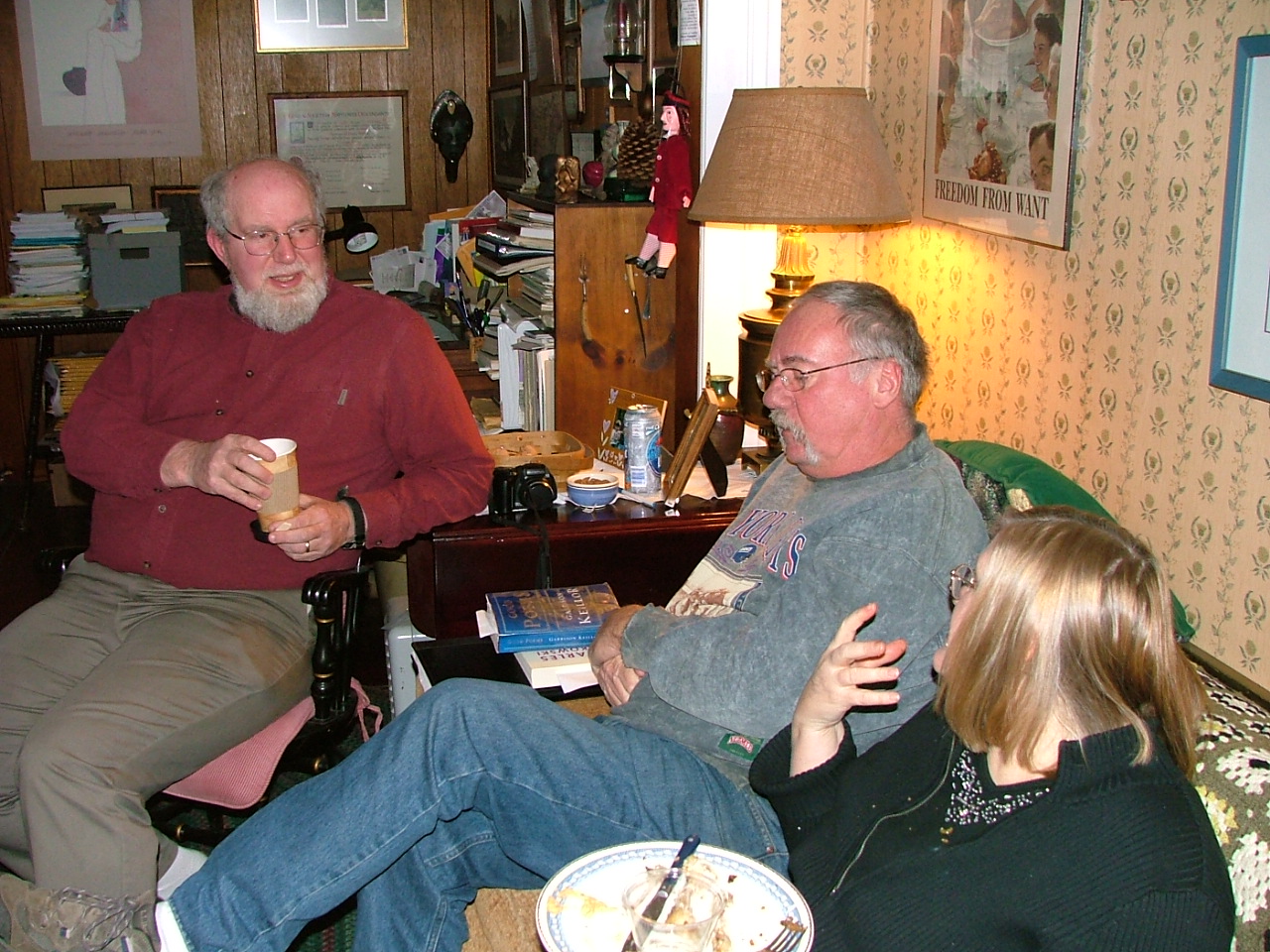
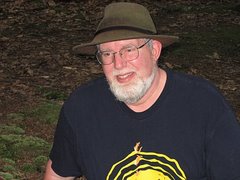
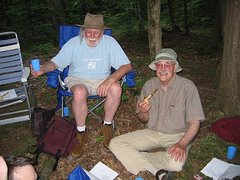
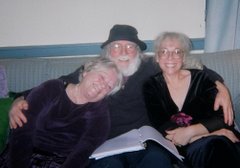
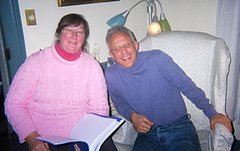
Dennis Sullivan, Beverly Osborne, Tom Corrado, Edie Abrams, Art Willis, Alan Casline (all seated); Paul Amidon, Mike Burke, Tim Verhaegen, Mark O'Brien, Barbara Vink, Philomena Moriarty
Wednesday, July 15, 2009


Tuesday, July 14, 2009
Monday, July 13, 2009
THE DOLLAR STORE SUMMER TOUR
An email from Dan Wilcox led me to suggest a writing exercise which everyone seemed to like. So, you have an assignment for the next meeting: Bring an object from home to lend to another writer for a month's inspiration. We will exchange items at the next meeting and write about them. You can include it in a poem or devote a whole poem to it. Try and be creative when picking the object to bring in, and don't bring something you will need before the month is up.
I didn't take many notes at the last meeting, so this blog will be skimpy. I passed out new member lists. The mistake on this one is that Rachael's email needs an "e" added after rach. Please add it. I also passed around an article from the Schen Gazette about Art Willis (not as poet, but town historian). Nice photo.
Alan says there is still available space at the Aery for Obie's scheduled reading on July 13.
Call Alan at 475-7781.
I brought in a painting for Alan to take to the Pine Hollow arboretum art show. Several of us will be there on July 19 between 2 - 5. Stop by.
We welcomed absent Joyce who appeared with a poem dedicated to her mom and grandmother. It was accompanied by a great quote from Adrienne Rich: Until a strong line of love, confirmation and example stretches from mother to daughter, from woman to woman across the generations, women will still be wandering in the wilderness. Joyce did some re-writing on her poem with Alan's guidance.
Sticking with the women, Edie's poem told a wonderful story about a woman liberated by the death of her husband. Most of us were confused by the title "I met my mother at 42", but that is easily fixed. Rachael's "Question With No Answer" left me still questioning, but everybody else got it. Duh.
My own personal ton of bricks fell on Mike Burke (instead of poor Bird, for a change). He wrote about the demise of a local roadhouse and our picnic at his camp. Great beginning but I thought the second stanza was a big disappointment.
Larry wrote a clever piece about STUPID SHEWS which I was trying to call dialect but others preferred to refer to as "word play". Obeeduid was his new self again with a descriptive (and aromatic) work about remembered childhood - "there being no hedge or fence 'round time".
A small argument ensued over Paul's poem "The Old Ones" about be able to see a negative, which I couldn't see (is that a pun?). I guess I lost.
Tim was a big success for his couplets and the accompanying photo which totally made the whole poem. Not for the children, as it was of an adult nature, but effectively so.
I was happy with my "Felling The Willow" (no, not the willow at the pond, one of several others. Did you know that you could stick a willow twig in the ground and it will grow into a monstrous tree with only nature's assistance? ) - "they wrapped the giant in chains and beheaded it". Paul didn't like my semi-colons. (Paul just corrected me via comments: it was Alan who didn't like the semi-colons and Paul gave me a nice compliment on the poem. Thanks, Paul)
There follows this blog a rather lengthy guest post from Dennis, preceded by an intro to it. It was prompted by recent comments about the value of self-publishing. I have a much shorter answer, which I will keep to myself. Please respond to Dennis' article in the comments so we can all hear them. He has obviously given this serious thought.
I didn't take many notes at the last meeting, so this blog will be skimpy. I passed out new member lists. The mistake on this one is that Rachael's email needs an "e" added after rach. Please add it. I also passed around an article from the Schen Gazette about Art Willis (not as poet, but town historian). Nice photo.
Alan says there is still available space at the Aery for Obie's scheduled reading on July 13.
Call Alan at 475-7781.
I brought in a painting for Alan to take to the Pine Hollow arboretum art show. Several of us will be there on July 19 between 2 - 5. Stop by.
We welcomed absent Joyce who appeared with a poem dedicated to her mom and grandmother. It was accompanied by a great quote from Adrienne Rich: Until a strong line of love, confirmation and example stretches from mother to daughter, from woman to woman across the generations, women will still be wandering in the wilderness. Joyce did some re-writing on her poem with Alan's guidance.
Sticking with the women, Edie's poem told a wonderful story about a woman liberated by the death of her husband. Most of us were confused by the title "I met my mother at 42", but that is easily fixed. Rachael's "Question With No Answer" left me still questioning, but everybody else got it. Duh.
My own personal ton of bricks fell on Mike Burke (instead of poor Bird, for a change). He wrote about the demise of a local roadhouse and our picnic at his camp. Great beginning but I thought the second stanza was a big disappointment.
Larry wrote a clever piece about STUPID SHEWS which I was trying to call dialect but others preferred to refer to as "word play". Obeeduid was his new self again with a descriptive (and aromatic) work about remembered childhood - "there being no hedge or fence 'round time".
A small argument ensued over Paul's poem "The Old Ones" about be able to see a negative, which I couldn't see (is that a pun?). I guess I lost.
Tim was a big success for his couplets and the accompanying photo which totally made the whole poem. Not for the children, as it was of an adult nature, but effectively so.
I was happy with my "Felling The Willow" (no, not the willow at the pond, one of several others. Did you know that you could stick a willow twig in the ground and it will grow into a monstrous tree with only nature's assistance? ) - "they wrapped the giant in chains and beheaded it". Paul didn't like my semi-colons. (Paul just corrected me via comments: it was Alan who didn't like the semi-colons and Paul gave me a nice compliment on the poem. Thanks, Paul)
There follows this blog a rather lengthy guest post from Dennis, preceded by an intro to it. It was prompted by recent comments about the value of self-publishing. I have a much shorter answer, which I will keep to myself. Please respond to Dennis' article in the comments so we can all hear them. He has obviously given this serious thought.
Dear Poe-ettes,
For the past several years, at our Thursday group, open mics, and at social gatherings of poets in our region, I have heard a sizable number of poets speak about
the value of self-published work or work published by local publishers.
In private and in public some folks have been quite vocal about this matter, remarking on the large number of such publications some poets in the area have. I even heard several people raise questions about the little confab of local publishers held at UAG [I think it was] last year, where local presses “showed off” their work.
In response to questions, statements sent my way directly or indirectly, I told some folks in our Thursday group and elswhere that I wanted to think about the matter a bit. When I was in Ireland last March I sat down one day and wrote the following notes.
These notes address not only this matter but also the qualities of some small poetry groups and, maybe more importantly, what it means to be a poet, what the poem is [its purpose], and several other items of interest—or disinterest depending on one’s own interests. The nature of the poem, its purpose, and limitations and who or what a poet is I think are worthy of discussion.
Anyway, I share what I wrote, having just finished typing it up a few days ago. The Irish in me!
I put the essay into a little booklet as well, a very, very limited edition with a picture of the beautiful Sneem River on the cover; it runs through one of my home towns. Hopefully the notes will facilitate some reflection about the ideas, if they are of any value to anyone other than myself. I am happy with my part in the process regardless.
I will not discuss the matter through e-mail if there are responses to the thoughts here—I just cannot type that much in response—but will be happy to read what folks add to the blog and to discuss such matters face-to-face when I meet poets in the future.
I hope the writing of everyone progresses well.
Sincerely,
Dennis
For the past several years, at our Thursday group, open mics, and at social gatherings of poets in our region, I have heard a sizable number of poets speak about
the value of self-published work or work published by local publishers.
In private and in public some folks have been quite vocal about this matter, remarking on the large number of such publications some poets in the area have. I even heard several people raise questions about the little confab of local publishers held at UAG [I think it was] last year, where local presses “showed off” their work.
In response to questions, statements sent my way directly or indirectly, I told some folks in our Thursday group and elswhere that I wanted to think about the matter a bit. When I was in Ireland last March I sat down one day and wrote the following notes.
These notes address not only this matter but also the qualities of some small poetry groups and, maybe more importantly, what it means to be a poet, what the poem is [its purpose], and several other items of interest—or disinterest depending on one’s own interests. The nature of the poem, its purpose, and limitations and who or what a poet is I think are worthy of discussion.
Anyway, I share what I wrote, having just finished typing it up a few days ago. The Irish in me!
I put the essay into a little booklet as well, a very, very limited edition with a picture of the beautiful Sneem River on the cover; it runs through one of my home towns. Hopefully the notes will facilitate some reflection about the ideas, if they are of any value to anyone other than myself. I am happy with my part in the process regardless.
I will not discuss the matter through e-mail if there are responses to the thoughts here—I just cannot type that much in response—but will be happy to read what folks add to the blog and to discuss such matters face-to-face when I meet poets in the future.
I hope the writing of everyone progresses well.
Sincerely,
Dennis
Giving Voice to the Vatic:
The Poet and Locality
by
Dennis Sullivan
The poetic tradition is vatic, a tradition of vision and prophesy, and thus a practice of the body beginning with but not ending in death.
Poetry begins with the breakdown of boundaries, with cracks in the wall, where light pours in, filling the soul to overflowing. The poet is born in the person who sings ecstatic: “Rock o'my soul in de bosom of Abraham!”
While prose may be poetic, it is comprised of the leftovers of vatic chants, the construction of stories about before, during, and after, and is essentially, in construction of the flood—the how we fare, hope to fare, and fear we may not fare—narrative, though of course there is narrative poetry, poetry at its weakest link. This despite the assessment that all poetry is at heart narrative.
Regardless, not because of the poet’s intentions (poetry has no ax to grind) but because of how the light (lightening) strikes, the poem is a shared space in which all comers can speak about their dreams, every ilk and permutation. The poem, even though poets personally are not necessarily so, is truly democratic, anarchic, an oracle with structure but not necessarily logic, the farthest thing from linear, hence the remarks about narrative.
Poets do not choose to speak but are carried away by the flow or flash of light, a bacchanalian rite, the value of the poet and any particular poem being her/his/its drawing attention to the unsettling of the old and the creation of the new thereby engendering appreciation for life, the expressional joy of being alive, followed by steps to create, re-create that life anew. The poet is a personal demonstration project; look at Denise Levertov shining her light within a cave.
The publication of the poem then is not the poem (like you see in the store); the poem is the felt-expressed experience of new light, life, but the handing down of vatic praise, chant, warning, ecstatic babble, is made sense of only with great difficulty. There are some who worry about the audience of a poem which is foolishness at its core because the poet is the audience, the taker-in of the experience; the written-down or orally-transmitted expression of that experience is the after-thought of the poetic-act or after-act of poetic-thought, if you like.
There are some creatures who worry about the means by which the felt-expressed finds the light of day, its market value and distribution properties—it is a frame of mind—and thus are drawn from entering the sacred (I use this term with great trepidation and all due apology to anarchists, i. e., poets) and thus are drawn away from entering into the sacred space of the published poem and discovering or discovering anew their own life within it, life within.
How many poems did Emily Dickerson see published in her (bodily) lifetime but she was the living presence of poetry throughout it. In the early Christian church bishops (επίσκοποi) rose out of the commons; the community recognized what they had to say as vatic, prophetic, as having to do with the continuing life of community, the conditions of life and took the liberty to make that life public.
Vates were selected to minister, serve, the needs of community, to help the community understand and identify those needs and steps to take to meet them, acts that violated neither the individual nor collective will, through which the community of persons expressed its commitment to mutual aid, cooperation, love, selflessness, reconciliation, any quality or practice (both means and ends) that fostered the survival and enjoyable well-being of life.
Within the context of the poetic community—which is a contradiction in terms because the poet is a person of the whole community—vatic souls join together to understand the vatic experience and ways to keep it pure as possible, the least self-seeking. But a community that refuses to hieraticize itself (despite hieratic involvement) tends to lord it over the larger community thereby creating a rabblish poloi—the poet, the poem is there to dismantle, eradicate disable distinctions, not an aim but as a result of felt-lightening.
There arises at times within the community (large or small) individuals who give their lives to making public, giving voice to, the words, expressions, experiences regarding the lifeline-light (sometimes at the most local of local levels, where this all starts) giving voice to the vatic experience. Those who jump into this stream are not eagle eyes but eagle hearts and ears, “Look, the light! I will tell it on the mountain!” When John Work penned "Go tell it on the mountain, over the hills and everywhere" he was telling how the community had been struck by lightening anew.
The publisher, the making public-er, becomes a mountain (socialist soapbox) from which the vatic experience can be expressed and heard—a benevolent act—leaving it to the listener to decide: life-affirming or not? Those who go to the mountain to give voice, though connected to the market, sell wares of collectivity. The manufacture, sale, and distribution of poems are tied to the interests, needs, concerns, hopes, and fears of the community. Poets, like life itself, want life to continue and so aspire to mountaintops from which to speak the delight of experience, Rilke’s under any circumstances, “I praise!”
Big book little book, pamphlet, broadside tacked to the side of a bare-wood barn—no difference, the format immaterial to the felt-experienced-expressed word/poet of life. Essential is what the reader/listener/other-feeler experiences. Are they alive to the life-force, maybe moved to build a mountain to proclaim life from a peak themselves, become poets themselves.
Little poetry groups, workgroups, and the like, exist ad infinitum and, regardless of stated aims and purposes, sometimes stand in the way of life, ordaining themselves with rites that are solely self-directed. Their interest may be seeing poems published—with which there is no intrinsic problem—but sometimes (I’d like to see a study) the group stands in the way of the light seen.
There is nothing wrong with having a night out—who’s to say?—in the interest of sociality (a good 19th century moniker) and conviviality with seemingly like-minded persons (however measured) that is, persons interested in words, human expression, the appreciation of read and published poems and the implications of same for, well, we already said for what, but the “aim” is well worth exploring.
That is, the question persists: to what extent is a person in a work/study group and the group as a whole (its stated and practiced purpose) committed to understanding and appreciating (valuing) the vatic enterprise, which includes making known other vatic experiences that tell the truth (of life, of life’s requirements, human needs, survival, joy at the realization of the gift of life, etc.).
As stated, there are indeed judges and assessors of the truthful experience high and low. A publisher works with works regarded as reflecting the true vatic experience and fostering vividness in others. Who’s to say that person should not engage in joy, gratitude, and appreciation? Who’s to say only corporate/market-certified work is the truest or true reflection of life-engendering vatic experience, that capital credentials bolster the validity of the felt-experience?
While assessment of the vatic experience that leads to publication is welcome at all levels—welcomed or not it will take place—it is the community, the individuals within the community who are the ultimate and paradoxically the first-level assessors. Do we worry less, issue wistful sighs, covet relaxation? By reading, listening to, studying, explicating, divining, digging into, even with a pick ax, the experimenter is more alive, more connected, feels driven to share life with others or, at the very least, not deprive others of that experience—which includes slamming non-market-certified publishers from engaging in publicizing.
I might add that, while the vatic experience is ecstatic in nature, over which one, the poet, has no control (being hit with lightening is as good as any definition of being called) the poet has techniques, methods, structures, which clear away the debris which inserts itself into the light, so poems can remain as clear as first experienced. There is no such thing as “polishing” a poem—God forbid!—only opening up—whatever that is, that is a treatise in itself—to the originally-experienced inspiration, breath, light, spirit, from which the words, chant, poem, song, arose.
This is a process in which the poet tries to get out of the way of the prophetic experience. The felt-joy of the experience is too great to compromise through meddling, joined by a rabid fear that dissembling will lead to a loss of joy. Cynics will say the poet is engaging in a kind of hexing, in magical skullduggery—“The bard of Thrace drew the trees, held beasts enthralled and constrained stones to follow him” Metamorphoses XI, 1-2—but such statements are a projection of ill-seated paranoia and hucksterism, a disbelief in one’s own essential light to make an informed assessment of: am I alive? Let me count the ways. Is your math the same?
Thus the vates, called, chosen, wishes to be true to the vatic/prophetic. Of course the poet wishes her or his work known and when self-interest plays a role in the enterprise, we speak of true vates and false vates, true prophets and false prophets. The Greek Scriptures say it all: by our poetry we know our true selves; the effects of the practices preached tell the magicians, hucksters, tricksters from the healers, those who stack the deck versus those who bandage wounds.
In the construction of self, the construction of life in the form of the poem, the poet . . . well, is it too much to ask a poet to bandage wounds, does that not lame art at the outset—more than likely—but poetry is not about bandaging anything, it’s about preventing before the thought of a blow is struck.
The Poet and Locality
by
Dennis Sullivan
The poetic tradition is vatic, a tradition of vision and prophesy, and thus a practice of the body beginning with but not ending in death.
Poetry begins with the breakdown of boundaries, with cracks in the wall, where light pours in, filling the soul to overflowing. The poet is born in the person who sings ecstatic: “Rock o'my soul in de bosom of Abraham!”
While prose may be poetic, it is comprised of the leftovers of vatic chants, the construction of stories about before, during, and after, and is essentially, in construction of the flood—the how we fare, hope to fare, and fear we may not fare—narrative, though of course there is narrative poetry, poetry at its weakest link. This despite the assessment that all poetry is at heart narrative.
Regardless, not because of the poet’s intentions (poetry has no ax to grind) but because of how the light (lightening) strikes, the poem is a shared space in which all comers can speak about their dreams, every ilk and permutation. The poem, even though poets personally are not necessarily so, is truly democratic, anarchic, an oracle with structure but not necessarily logic, the farthest thing from linear, hence the remarks about narrative.
Poets do not choose to speak but are carried away by the flow or flash of light, a bacchanalian rite, the value of the poet and any particular poem being her/his/its drawing attention to the unsettling of the old and the creation of the new thereby engendering appreciation for life, the expressional joy of being alive, followed by steps to create, re-create that life anew. The poet is a personal demonstration project; look at Denise Levertov shining her light within a cave.
The publication of the poem then is not the poem (like you see in the store); the poem is the felt-expressed experience of new light, life, but the handing down of vatic praise, chant, warning, ecstatic babble, is made sense of only with great difficulty. There are some who worry about the audience of a poem which is foolishness at its core because the poet is the audience, the taker-in of the experience; the written-down or orally-transmitted expression of that experience is the after-thought of the poetic-act or after-act of poetic-thought, if you like.
There are some creatures who worry about the means by which the felt-expressed finds the light of day, its market value and distribution properties—it is a frame of mind—and thus are drawn from entering the sacred (I use this term with great trepidation and all due apology to anarchists, i. e., poets) and thus are drawn away from entering into the sacred space of the published poem and discovering or discovering anew their own life within it, life within.
How many poems did Emily Dickerson see published in her (bodily) lifetime but she was the living presence of poetry throughout it. In the early Christian church bishops (επίσκοποi) rose out of the commons; the community recognized what they had to say as vatic, prophetic, as having to do with the continuing life of community, the conditions of life and took the liberty to make that life public.
Vates were selected to minister, serve, the needs of community, to help the community understand and identify those needs and steps to take to meet them, acts that violated neither the individual nor collective will, through which the community of persons expressed its commitment to mutual aid, cooperation, love, selflessness, reconciliation, any quality or practice (both means and ends) that fostered the survival and enjoyable well-being of life.
Within the context of the poetic community—which is a contradiction in terms because the poet is a person of the whole community—vatic souls join together to understand the vatic experience and ways to keep it pure as possible, the least self-seeking. But a community that refuses to hieraticize itself (despite hieratic involvement) tends to lord it over the larger community thereby creating a rabblish poloi—the poet, the poem is there to dismantle, eradicate disable distinctions, not an aim but as a result of felt-lightening.
There arises at times within the community (large or small) individuals who give their lives to making public, giving voice to, the words, expressions, experiences regarding the lifeline-light (sometimes at the most local of local levels, where this all starts) giving voice to the vatic experience. Those who jump into this stream are not eagle eyes but eagle hearts and ears, “Look, the light! I will tell it on the mountain!” When John Work penned "Go tell it on the mountain, over the hills and everywhere" he was telling how the community had been struck by lightening anew.
The publisher, the making public-er, becomes a mountain (socialist soapbox) from which the vatic experience can be expressed and heard—a benevolent act—leaving it to the listener to decide: life-affirming or not? Those who go to the mountain to give voice, though connected to the market, sell wares of collectivity. The manufacture, sale, and distribution of poems are tied to the interests, needs, concerns, hopes, and fears of the community. Poets, like life itself, want life to continue and so aspire to mountaintops from which to speak the delight of experience, Rilke’s under any circumstances, “I praise!”
Big book little book, pamphlet, broadside tacked to the side of a bare-wood barn—no difference, the format immaterial to the felt-experienced-expressed word/poet of life. Essential is what the reader/listener/other-feeler experiences. Are they alive to the life-force, maybe moved to build a mountain to proclaim life from a peak themselves, become poets themselves.
Little poetry groups, workgroups, and the like, exist ad infinitum and, regardless of stated aims and purposes, sometimes stand in the way of life, ordaining themselves with rites that are solely self-directed. Their interest may be seeing poems published—with which there is no intrinsic problem—but sometimes (I’d like to see a study) the group stands in the way of the light seen.
There is nothing wrong with having a night out—who’s to say?—in the interest of sociality (a good 19th century moniker) and conviviality with seemingly like-minded persons (however measured) that is, persons interested in words, human expression, the appreciation of read and published poems and the implications of same for, well, we already said for what, but the “aim” is well worth exploring.
That is, the question persists: to what extent is a person in a work/study group and the group as a whole (its stated and practiced purpose) committed to understanding and appreciating (valuing) the vatic enterprise, which includes making known other vatic experiences that tell the truth (of life, of life’s requirements, human needs, survival, joy at the realization of the gift of life, etc.).
As stated, there are indeed judges and assessors of the truthful experience high and low. A publisher works with works regarded as reflecting the true vatic experience and fostering vividness in others. Who’s to say that person should not engage in joy, gratitude, and appreciation? Who’s to say only corporate/market-certified work is the truest or true reflection of life-engendering vatic experience, that capital credentials bolster the validity of the felt-experience?
While assessment of the vatic experience that leads to publication is welcome at all levels—welcomed or not it will take place—it is the community, the individuals within the community who are the ultimate and paradoxically the first-level assessors. Do we worry less, issue wistful sighs, covet relaxation? By reading, listening to, studying, explicating, divining, digging into, even with a pick ax, the experimenter is more alive, more connected, feels driven to share life with others or, at the very least, not deprive others of that experience—which includes slamming non-market-certified publishers from engaging in publicizing.
I might add that, while the vatic experience is ecstatic in nature, over which one, the poet, has no control (being hit with lightening is as good as any definition of being called) the poet has techniques, methods, structures, which clear away the debris which inserts itself into the light, so poems can remain as clear as first experienced. There is no such thing as “polishing” a poem—God forbid!—only opening up—whatever that is, that is a treatise in itself—to the originally-experienced inspiration, breath, light, spirit, from which the words, chant, poem, song, arose.
This is a process in which the poet tries to get out of the way of the prophetic experience. The felt-joy of the experience is too great to compromise through meddling, joined by a rabid fear that dissembling will lead to a loss of joy. Cynics will say the poet is engaging in a kind of hexing, in magical skullduggery—“The bard of Thrace drew the trees, held beasts enthralled and constrained stones to follow him” Metamorphoses XI, 1-2—but such statements are a projection of ill-seated paranoia and hucksterism, a disbelief in one’s own essential light to make an informed assessment of: am I alive? Let me count the ways. Is your math the same?
Thus the vates, called, chosen, wishes to be true to the vatic/prophetic. Of course the poet wishes her or his work known and when self-interest plays a role in the enterprise, we speak of true vates and false vates, true prophets and false prophets. The Greek Scriptures say it all: by our poetry we know our true selves; the effects of the practices preached tell the magicians, hucksters, tricksters from the healers, those who stack the deck versus those who bandage wounds.
In the construction of self, the construction of life in the form of the poem, the poet . . . well, is it too much to ask a poet to bandage wounds, does that not lame art at the outset—more than likely—but poetry is not about bandaging anything, it’s about preventing before the thought of a blow is struck.
Friday, June 26, 2009
An Oatmeal Named Jonah
A very personal observation from me: it felt good to have Larry Rapant join us last night. Larry has been a huge part of my poetry life. He and Tom and I "toured" the open mics in the 1990s, performing as a group, sometimes with Brian Kennedy and Tom's musical accompaniment. I doubt how good my poetry was then, but I had fun. It felt like old times to have him with us, and at my age, old times are very meaningful. I am not going to attempt to critique Larry's poem or Tom's today. They have been my teachers and mentors and frankly, I consider them perfect in every way. The blog title is my favorite phrase from Larry's poem.
BTW, my research into Merovingian Dynasty shows it to be the Satanic Bloodline of the Antichrist or False Prophet. Or, a Frankish dynasty that ruled in Gaul and Germany circa 500 a.d. Your choice.
Couple of other poems received little or no critique. Everyone loved Mimi's Parked on Pavement. Great title. Amusing. Jim Williams, who slipped in at the last moment in his soccer ref's uniform (quite green) had us laughing with three versions of his Comely young woman from Wiesbaden, one in German, one French, final in English.
Paul (who was in charge of the gavel for a portion of the evening until he fell down on the job) was pretty much letter perfect as usual with Cookies and Cakes. Some quibbling over "dolls and bicycles". Paul had assisted Ally with a successful rewrite of Toxic Silence. I love it when people actually put into practice the advice they are given.
The Bird wrote a Perious Frink adventure with a surprise ending and a pretty good rhyme scheme, which could be made excellent with a little closer editing. Alan Other rhymed not quite so successfully but musically. I was proud of him, too, for revising last week's poem and bringing it for a return appearance. He is striving to become a good poet.
Rachael was back with another of her thoughtful works, with good tone and feeling. Someone suggested better lines breaks and relocating the first stanza. Several people were enlightened by the idea of a phone cradle. Ah, you babies.
Philomena equated true poetry to a juicy peach. It is hard to avoid cliches, I opine, when describing peaches, but here the addition of the ripe young woman and the heroin addict led it out of the realm of the mundane. To carotid or not to carotid.
Personally, I thought Tim's poem had transition problems. I liked both halves - the office crowd and the big ugly woman - but wanted the way smoothed or made into two poems. His characters sketches were right on, as always.
Saving Markle-Farkle until last as my favorite. Just great imagery. Interspersed with conversation. Nice font. Ditched the title. Whole last verse is dyn-o-mite.
Lots of events going on. Check out post-ettes.
Sunday Four is this weekend, with Mimi and her brother. 3 p.m. with food.
BTW, my research into Merovingian Dynasty shows it to be the Satanic Bloodline of the Antichrist or False Prophet. Or, a Frankish dynasty that ruled in Gaul and Germany circa 500 a.d. Your choice.
Couple of other poems received little or no critique. Everyone loved Mimi's Parked on Pavement. Great title. Amusing. Jim Williams, who slipped in at the last moment in his soccer ref's uniform (quite green) had us laughing with three versions of his Comely young woman from Wiesbaden, one in German, one French, final in English.
Paul (who was in charge of the gavel for a portion of the evening until he fell down on the job) was pretty much letter perfect as usual with Cookies and Cakes. Some quibbling over "dolls and bicycles". Paul had assisted Ally with a successful rewrite of Toxic Silence. I love it when people actually put into practice the advice they are given.
The Bird wrote a Perious Frink adventure with a surprise ending and a pretty good rhyme scheme, which could be made excellent with a little closer editing. Alan Other rhymed not quite so successfully but musically. I was proud of him, too, for revising last week's poem and bringing it for a return appearance. He is striving to become a good poet.
Rachael was back with another of her thoughtful works, with good tone and feeling. Someone suggested better lines breaks and relocating the first stanza. Several people were enlightened by the idea of a phone cradle. Ah, you babies.
Philomena equated true poetry to a juicy peach. It is hard to avoid cliches, I opine, when describing peaches, but here the addition of the ripe young woman and the heroin addict led it out of the realm of the mundane. To carotid or not to carotid.
Personally, I thought Tim's poem had transition problems. I liked both halves - the office crowd and the big ugly woman - but wanted the way smoothed or made into two poems. His characters sketches were right on, as always.
Saving Markle-Farkle until last as my favorite. Just great imagery. Interspersed with conversation. Nice font. Ditched the title. Whole last verse is dyn-o-mite.
Lots of events going on. Check out post-ettes.
Sunday Four is this weekend, with Mimi and her brother. 3 p.m. with food.
Monday, June 15, 2009
Sunday, June 14, 2009


SCREAM
Okay, I made a web album of yesterday's pics and succeeded in linking it to the blog. If you follow the link, however, it tells you it can't find it. Don't know what I'm doing. Mark tried to help me over the phone, but it obviously didn't work. I'll try again from the office. It is giving me a headache.
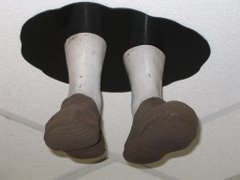
Yesterday was lovely and wet. The food was great. Everyone was jolly. Mike and Donna were good hosts. I forgot to take a photo of the parrot plates. I brought Tony. Significant others were present (Ginny Rapant, Dr. Jennifer, Dan M., Steve Schreiber, Georgia, Donna and her dog Annie) - about 20 of us, and some dogs, including Susie The Summer Dog. I ate a lot, got soaked, was particularly happy to see Dee and Larry who make rare appearances. Georgia took pictures of feet. Ron and Edie and Tim and Ally Cat were no-shows. Dennis ate a lot, Mark made Black and Tans with his turtle thingy - there's a photo if you ever get to see them. Mike made good burgers, sausage, hot dogs. I shared with Susie.
It was a trip down Memory Lane for those of us who used to frequent Lil and Bill's in our youth, including Dan Moriarty. Sad to see it in disrepair. Fun times there. Made me want to dance. Jack, the owner, hauled out old photos and we saw young Mikey Burke.
I left before any poetry happened. Don't know if it did. Wasn't in a poetic mood and felt bad that Eli was home alone most of the day.
Also, half drowned.
Yesterday was lovely and wet. The food was great. Everyone was jolly. Mike and Donna were good hosts. I forgot to take a photo of the parrot plates. I brought Tony. Significant others were present (Ginny Rapant, Dr. Jennifer, Dan M., Steve Schreiber, Georgia, Donna and her dog Annie) - about 20 of us, and some dogs, including Susie The Summer Dog. I ate a lot, got soaked, was particularly happy to see Dee and Larry who make rare appearances. Georgia took pictures of feet. Ron and Edie and Tim and Ally Cat were no-shows. Dennis ate a lot, Mark made Black and Tans with his turtle thingy - there's a photo if you ever get to see them. Mike made good burgers, sausage, hot dogs. I shared with Susie.

It was a trip down Memory Lane for those of us who used to frequent Lil and Bill's in our youth, including Dan Moriarty. Sad to see it in disrepair. Fun times there. Made me want to dance. Jack, the owner, hauled out old photos and we saw young Mikey Burke.
I left before any poetry happened. Don't know if it did. Wasn't in a poetic mood and felt bad that Eli was home alone most of the day.
Also, half drowned.
Friday, June 12, 2009
Another Oops
I was having a very hectic day and in my confusion, I forgot to blog Tim's wonderful poem. In fact it was my favorite of the night and I was saving it for last, ended up leaving it out altogether. I felt that it was kind of a breakthrough poem for Tim - no repetition. Great sea, fog imagery, a real lonely feeling. Everyone liked it. Only suggestion was to save the last few lines for another poem and he seemed receptive to that idea. My apologies.
Monday - I can't believe it. When I got to work this am I found Alan C.'s poem, forgotten, forlorn and unblogged. It was another favorite of mine. Called Surface Ice is Walkable, includes plunging a foot into the semi - frozen creek. Beautiful: "stone heads all found wearing imperfect icy halos". So, if there 's anyone else I need to apologize to, consider it done.
Monday - I can't believe it. When I got to work this am I found Alan C.'s poem, forgotten, forlorn and unblogged. It was another favorite of mine. Called Surface Ice is Walkable, includes plunging a foot into the semi - frozen creek. Beautiful: "stone heads all found wearing imperfect icy halos". So, if there 's anyone else I need to apologize to, consider it done.
Subscribe to:
Posts (Atom)