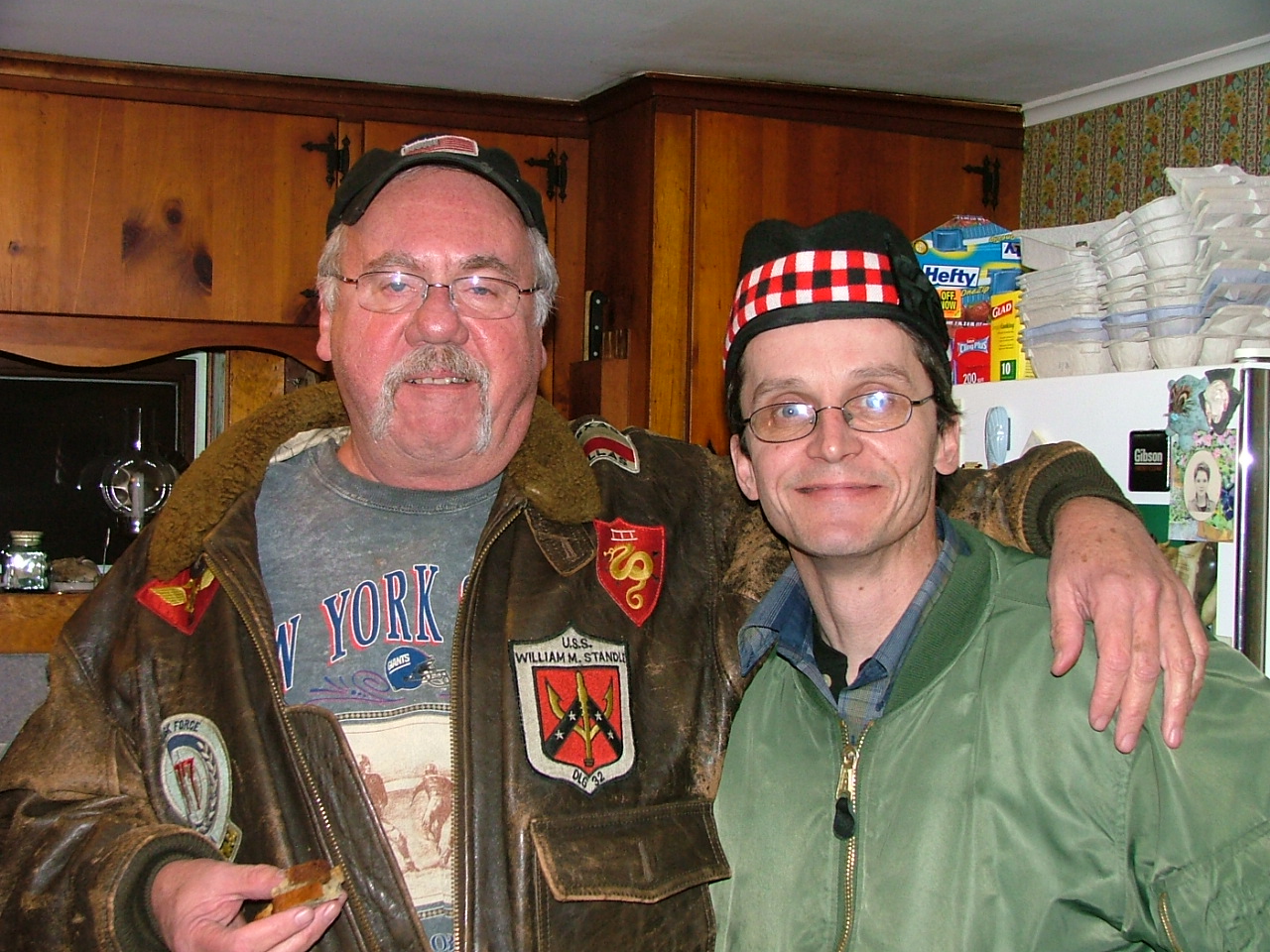
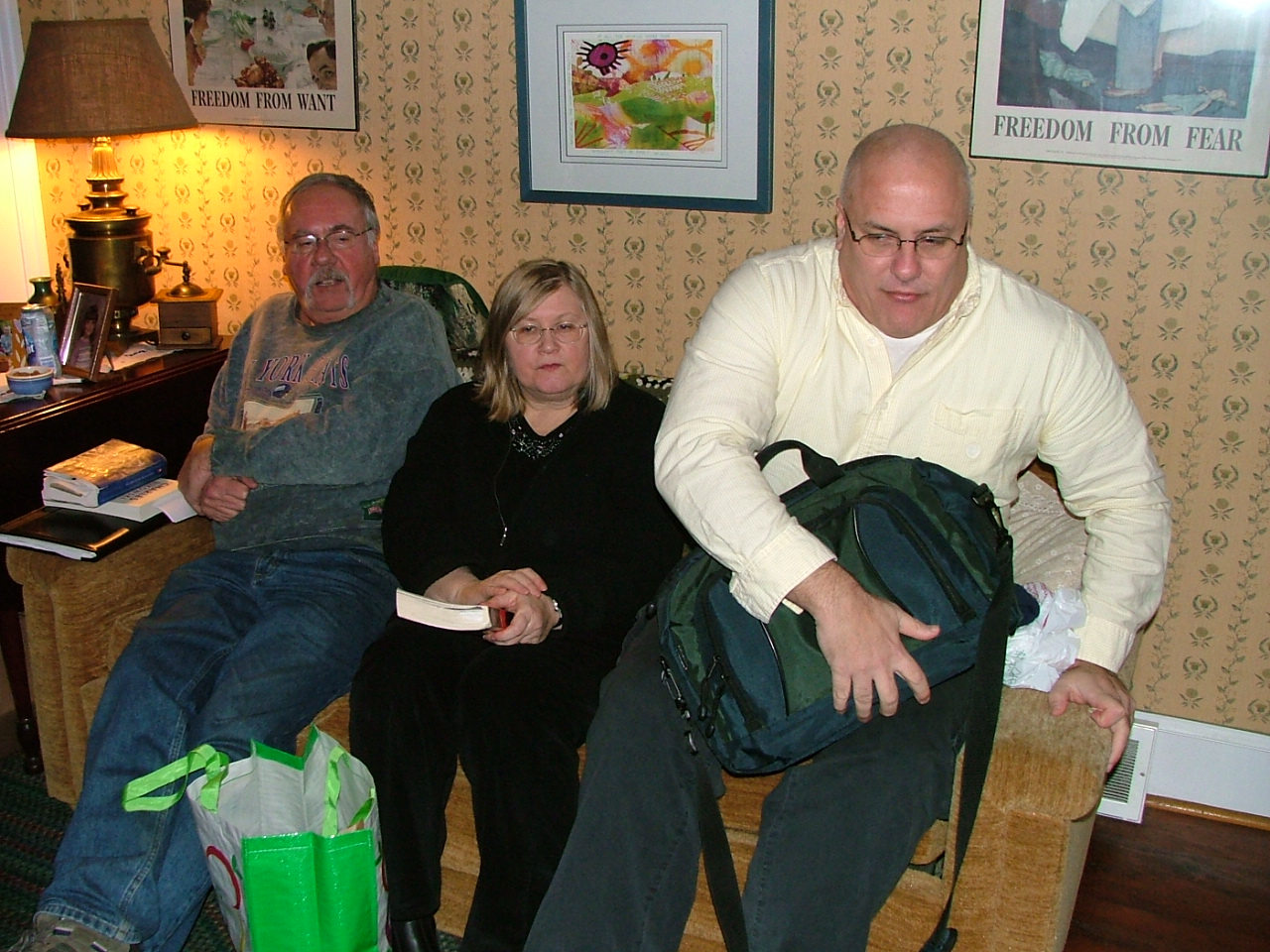
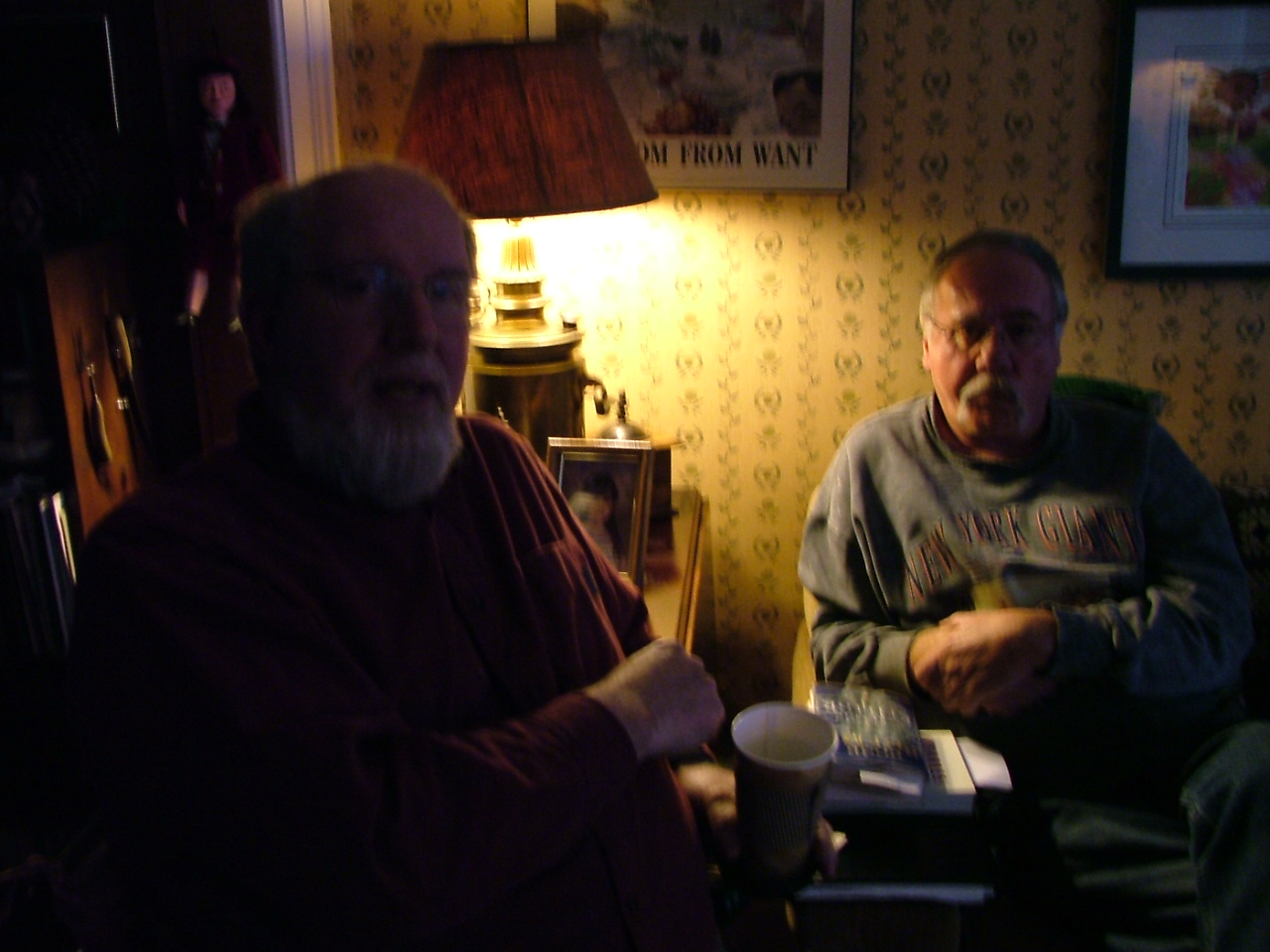
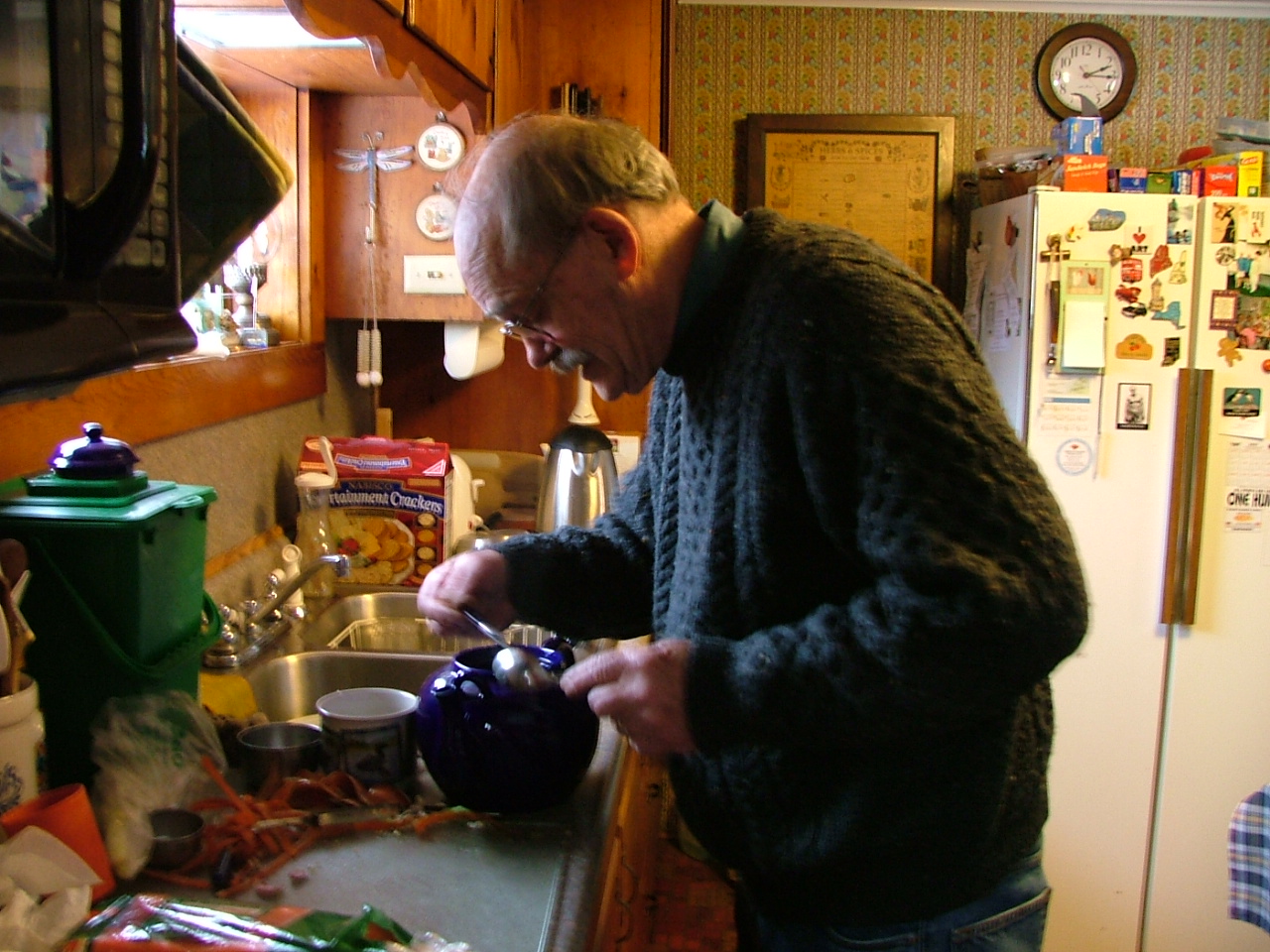
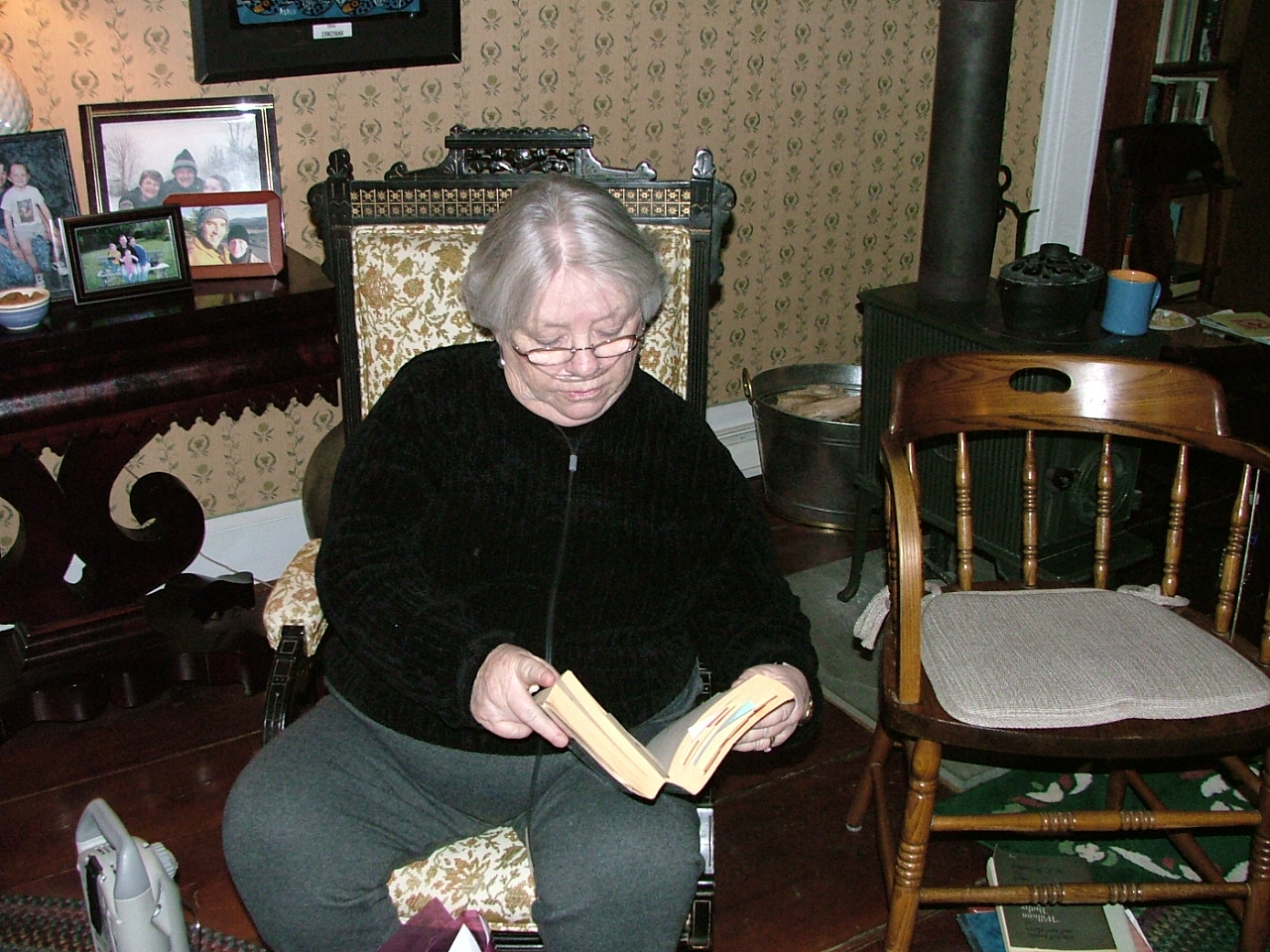
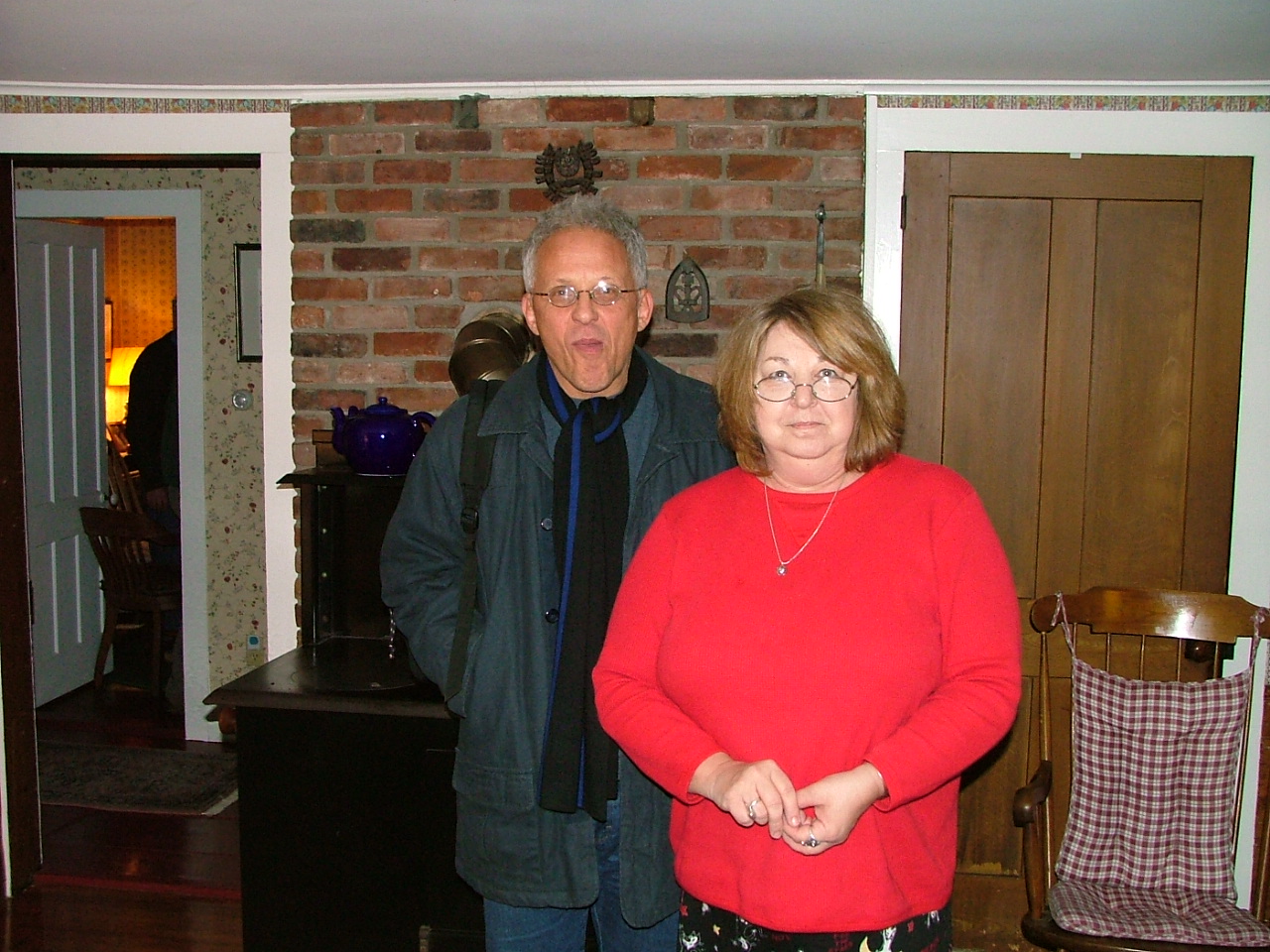
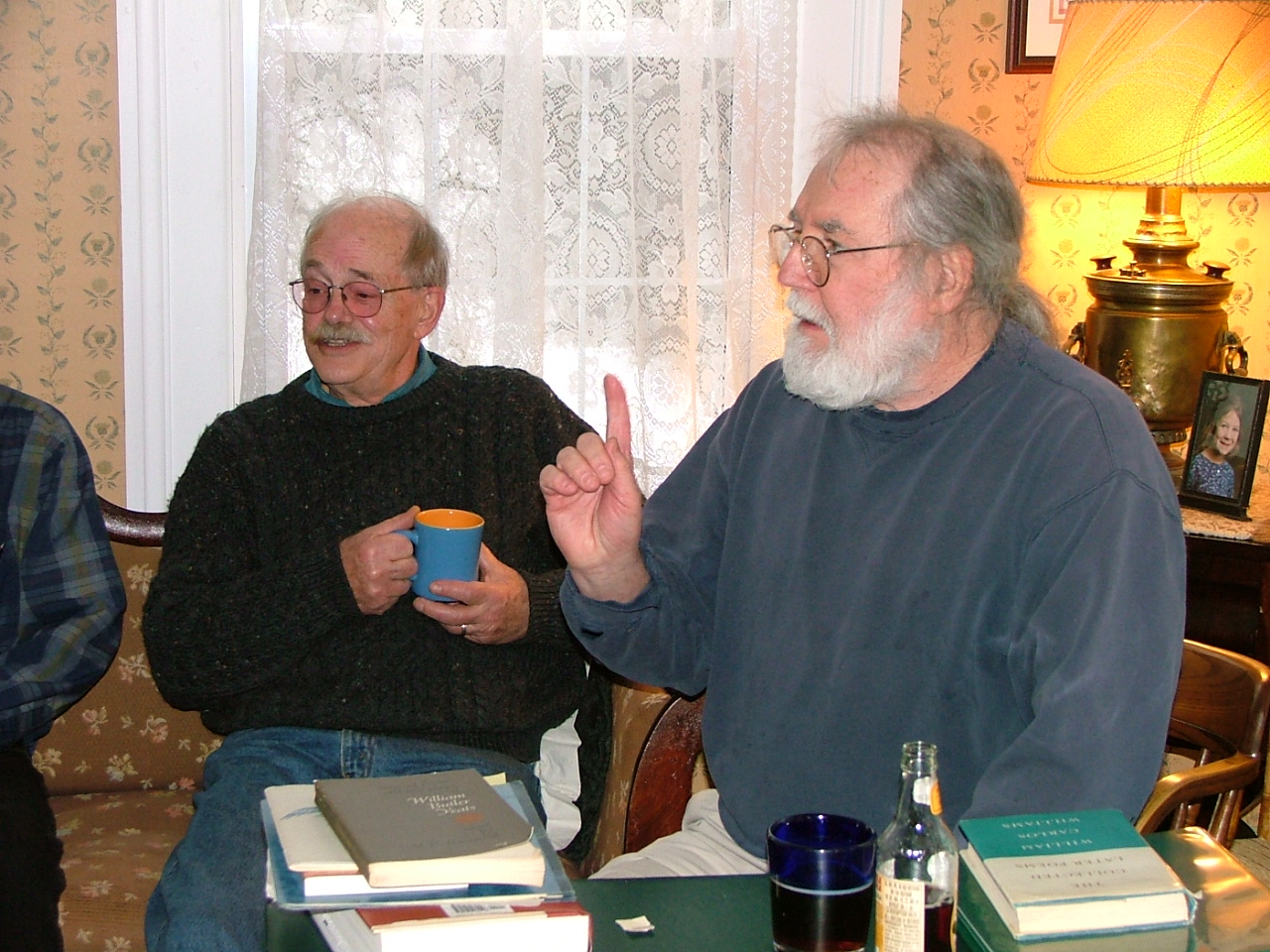
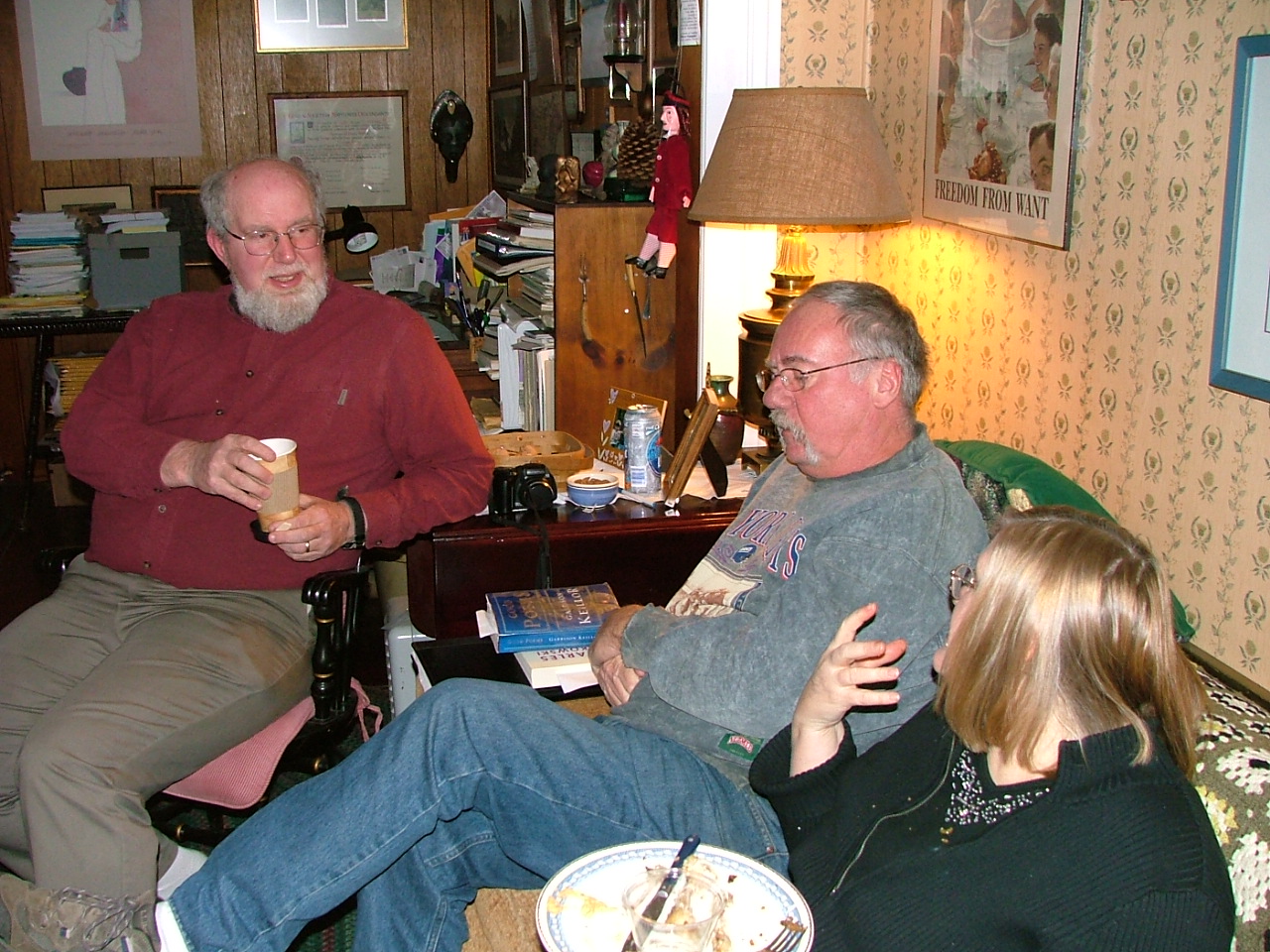
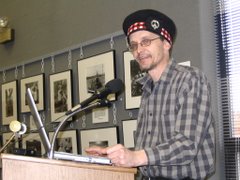
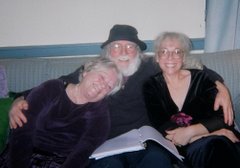
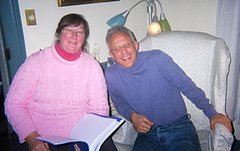
It was a good turnout yesterday and I was impressed with Tom's presentation. That voice was mesmerizing. Too bad you can't just talk that way, TC. My only problem was wanting to see the pictures while you were speaking. Dennis and Georgia, thanks for having us over. Dr. Jarus seemed to enjoy himself and the pumpkin pie was superb.
I want to remind you all about Steve Lewandowski being here at the lib on Sunday at 2 pm. I guess Alan will be emceeing that one.
Dan Lawlor sends goodbyes on his departure for FL.
My weekend was lovely in New York with Josh and Amy and the boys.
Peace.
bv
Some of Us

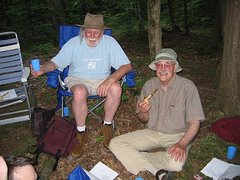
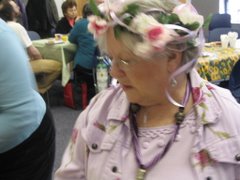
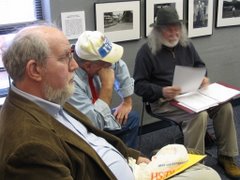
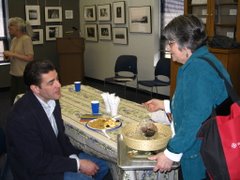
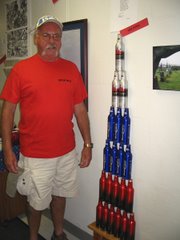
Dennis Sullivan, Beverly Osborne, Tom Corrado, Edie Abrams, Art Willis, Alan Casline (all seated); Paul Amidon, Mike Burke, Tim Verhaegen, Mark O'Brien, Barbara Vink, Philomena Moriarty
Monday, December 29, 2008


Monday, December 22, 2008
Holiday Miscellany
Yo, and ho-ho...it has been a long time since a meeting and will be longer still as things continue to interfere with our lives, weather, ersatz heart attacks, dinners at Ichiban and now, of all things, those darned holidays. I cannot come up with a date to reschedule our lost meeting(s), so the next time we will be together is on January 8.
I remind you that our Tom is the featured reader at Sunday Four, here at the Old Songs venue in V'ville this Sunday the 28th at 3 pm. I will be there (if the creek don't rise, and so forth) and hope to see lots of you then. Nots lots of you, but many of you, although I wouldn't mind seeing more of you if the weather was warmer. I was hoping Dennis would arrange a little snow-trudging carol singing, but I haven't heard anything along those lines. Oh well, sing to yourselves.
Dan Wilcox's annual open house is on New Year's Day. You can probably check his blog for details.
A friend of Alan's named Steve Lewandowski is giving a poetry reading here at VPL on January 4 (Sunday) at 2 p.m. if you would like to put that on your calendars. Probably AC will be reminding us. Alan's January party sounds good and I hope to be there.
BTW, in case any of you are new digital camera owners, VPL is having two camera programs that might interest you - one in January on the basics of the settings, operations, et al. and a second on options for processing and saving the photos. I plan to attend them, too. More about all of these programs will be in the Jan/Feb Bookworm which comes out next week. Ya gotta sign up for these.
Well, my shopping is done, my wrapping is done, my body is bruised and sticky from a short hospital stay which turned out to be a not-heart-attack-only-a-separated-shoulder. I am asking the Great Claus to bring me a lime green dog stroller, a pedometer, a Persian kitten and a 3-disc Rod Stewart collection, and I will try not to be disappointed when none of this arrives.
This time of year leaves me melancholy, lonely, sad, repentent, weepy, nostalgic and ruminating on Life. To say nothing of grumpy because my arm hurts.
So, have a touch o' the grape for me, hope for peace and toast to poetry.
And don't forget to sing.
MC,
Barbara
I remind you that our Tom is the featured reader at Sunday Four, here at the Old Songs venue in V'ville this Sunday the 28th at 3 pm. I will be there (if the creek don't rise, and so forth) and hope to see lots of you then. Nots lots of you, but many of you, although I wouldn't mind seeing more of you if the weather was warmer. I was hoping Dennis would arrange a little snow-trudging carol singing, but I haven't heard anything along those lines. Oh well, sing to yourselves.
Dan Wilcox's annual open house is on New Year's Day. You can probably check his blog for details.
A friend of Alan's named Steve Lewandowski is giving a poetry reading here at VPL on January 4 (Sunday) at 2 p.m. if you would like to put that on your calendars. Probably AC will be reminding us. Alan's January party sounds good and I hope to be there.
BTW, in case any of you are new digital camera owners, VPL is having two camera programs that might interest you - one in January on the basics of the settings, operations, et al. and a second on options for processing and saving the photos. I plan to attend them, too. More about all of these programs will be in the Jan/Feb Bookworm which comes out next week. Ya gotta sign up for these.
Well, my shopping is done, my wrapping is done, my body is bruised and sticky from a short hospital stay which turned out to be a not-heart-attack-only-a-separated-shoulder. I am asking the Great Claus to bring me a lime green dog stroller, a pedometer, a Persian kitten and a 3-disc Rod Stewart collection, and I will try not to be disappointed when none of this arrives.
This time of year leaves me melancholy, lonely, sad, repentent, weepy, nostalgic and ruminating on Life. To say nothing of grumpy because my arm hurts.
So, have a touch o' the grape for me, hope for peace and toast to poetry.
And don't forget to sing.
MC,
Barbara
Monday, December 1, 2008
ADVENTURES IN COLONIE (from Paul)
Three EOTNP poets entered the annual poetry competition at the Colonie Town Library, an event sponsored, conducted, and judged by William Robert Foltin. He also conducts the monthly Poets’ Corner at the library, where poets read and discuss their own and others work without critical commentary. The Day of Poet, as the competition is known, was well run, fairly well attended, and had more good poetry than I expected. My expectations were based on thin air, however, as I’d never attended the event before. Only after the event was over did it occur to me to submit a write-up about it, so I must limit myself to observations and impressions. A listing of poems read would be a long list, too long.
Contest Rules: Each poet pays a $3 entry fee (which all gets handed back to poets as prizes), and reads or speaks for two minutes. The reading periods are timed, and if the poet goes over the limit by 15 seconds the judge yells “time” and the poet must stop speaking immediately. After all the competitors read for two minutes, they all repeat the process for a three-minute period. Same rules. After the three-minute readings, there is an intermission. With eleven poets competing, a break is a good thing. Next, all the contenders go back up to the podium for the last round of four minutes. Poets are scored on the basis of presentation, content, and how close they come to the limits of two, three, and four minutes. The watch starts the minute the poet starts talking, whether making introductory remarks, reading poems, or plugging a book or upcoming event. Poets can use only their own work, making this a writing as well as performance contest.
Another rule is that anyone who wins the top prize ($200) is not eligible to ever win first, second, or third place money in this contest again. This rule probably insures that more people who don’t win will keep trying, and encourages new competitors to give it a try. Other poets can win token sums as determined by the judge and the amount of money taken in by entry fees, and this year W.R. Foltin chose to give every entrant a token prize if they were not in the top three.
Alan , having won the event last year and knowing he was ineligible for any of the top prizes, gave a less-than-inspired performance and ended up in tenth place (out of eleven contenders). We all know he can do better, much better; he proved it by winning last year. Tim Verhaegen (Tim Lake was also there) and Dennis were also entered, and read good selections from poems many of us have heard at our group’s meetings. I noticed that both Tim and Dennis had fine-tuned some of the poems I recognized, and that their presentation ability was above one or more poets who ended up higher in the final standings than they did. (Dennis placed sixth, and Tim placed eighth.)
A comment about the winners: that’s first, second, and third place. All were excellent, far above most of the people who show up at open mics around the region. Tim Lake (fourth place, couldn’t place higher by rule as a previous winner) is also a very polished poet and reader. First place went to Miriam Axel-Lute, whose level of presentation can honestly be described as professional. She probably has competed and placed highly in poetry slams, no doubt other events as well. She did all of her work from memory, and if she missed on anything it didn’t show. Everyone else in the contest read their work. Second place Michael Hare, from Saratoga, read from his book “Saratoga Lives.” A very strong reader. I’ve seen him at Café Lena. Third place Will Nixon, who hauled up from Woodstock to compete, read effectively from his own book (but I failed to get the title. A pen and a pair of dollar-store glasses are never around when I need them.) He was also a very practiced reader.
The whole thing ran from 10:00 to about 1:15, but was worth staying for because the upper end of the poetry and presentations was so good. There is no admission fee, only the $3 fee to enter. Anyone can watch it. The room at the Colonie Town Library is a fine venue for events like this.
William Robert Foltin has created a fine event. I expect to be there next year.
Paul Amidon
Contest Rules: Each poet pays a $3 entry fee (which all gets handed back to poets as prizes), and reads or speaks for two minutes. The reading periods are timed, and if the poet goes over the limit by 15 seconds the judge yells “time” and the poet must stop speaking immediately. After all the competitors read for two minutes, they all repeat the process for a three-minute period. Same rules. After the three-minute readings, there is an intermission. With eleven poets competing, a break is a good thing. Next, all the contenders go back up to the podium for the last round of four minutes. Poets are scored on the basis of presentation, content, and how close they come to the limits of two, three, and four minutes. The watch starts the minute the poet starts talking, whether making introductory remarks, reading poems, or plugging a book or upcoming event. Poets can use only their own work, making this a writing as well as performance contest.
Another rule is that anyone who wins the top prize ($200) is not eligible to ever win first, second, or third place money in this contest again. This rule probably insures that more people who don’t win will keep trying, and encourages new competitors to give it a try. Other poets can win token sums as determined by the judge and the amount of money taken in by entry fees, and this year W.R. Foltin chose to give every entrant a token prize if they were not in the top three.
Alan , having won the event last year and knowing he was ineligible for any of the top prizes, gave a less-than-inspired performance and ended up in tenth place (out of eleven contenders). We all know he can do better, much better; he proved it by winning last year. Tim Verhaegen (Tim Lake was also there) and Dennis were also entered, and read good selections from poems many of us have heard at our group’s meetings. I noticed that both Tim and Dennis had fine-tuned some of the poems I recognized, and that their presentation ability was above one or more poets who ended up higher in the final standings than they did. (Dennis placed sixth, and Tim placed eighth.)
A comment about the winners: that’s first, second, and third place. All were excellent, far above most of the people who show up at open mics around the region. Tim Lake (fourth place, couldn’t place higher by rule as a previous winner) is also a very polished poet and reader. First place went to Miriam Axel-Lute, whose level of presentation can honestly be described as professional. She probably has competed and placed highly in poetry slams, no doubt other events as well. She did all of her work from memory, and if she missed on anything it didn’t show. Everyone else in the contest read their work. Second place Michael Hare, from Saratoga, read from his book “Saratoga Lives.” A very strong reader. I’ve seen him at Café Lena. Third place Will Nixon, who hauled up from Woodstock to compete, read effectively from his own book (but I failed to get the title. A pen and a pair of dollar-store glasses are never around when I need them.) He was also a very practiced reader.
The whole thing ran from 10:00 to about 1:15, but was worth staying for because the upper end of the poetry and presentations was so good. There is no admission fee, only the $3 fee to enter. Anyone can watch it. The room at the Colonie Town Library is a fine venue for events like this.
William Robert Foltin has created a fine event. I expect to be there next year.
Paul Amidon
Monday, November 24, 2008
Notes from Dennis
Dear Fellow Poets,
Just a note to remind folks of two upcoming events, the dates for which you might want to jot down in your calendar with the intent of joining in them in the ways they allow.
First of all, Benevolent Bird will be reading at the Social Justice Center in Albany on Thursday, December 18 at 7:30 I think it is. He gave out reminders to that end yesterday at the Sunday Four open mic. What dine poems all around, really.
To share in Bird?s reading, several of us are going to get together for dinner at circa 5:30 at Ichiban on Central Avenue for eats and a few laughs. Mark suggested last even another nearby place, Thai [?]? if folks want to go there and MO?B wishes to organize that, I will go anywhere. We would like a little room or outlet or inlet, however which we were able to get the last time we went for such an event, when I read or was it Barb?s gig? Perhaps this could be one of our convivial social events?we do try so hard sometimes and occasionally succeed in being so.
Then on December 28th, the Sunday after Christmas, for those who celebrate that event, there will be an even greater birth, if you will: the esteemed and venerable Tom᳠Corrado will be the featured poet at the Sunday Four Poetry Open Mic at Old Songs. For one of the founders of the Thursday group and inveterate veterans of vetting?oh sweet redundancies!!?perhaps you might consider coming out?to support Tom and to read as well. He says he has some interesting dings in mind; he gave me some ideas re: that yesterday but has sworn me to secrecy. That is at 3 pm. We have been getting a pretty good showing; I am surprises that so many people who call themselves poets do not appear to be interested in presenting their work aloud in such venues. But there was Wallace Stevens and The Belle of Amherst, was that her name?
Also in January of February I am thinking of having an event at Ga?s and my domicile, a 2nd Willis Farm Syndrome. Let folks speak up if they are interested informally. I have a small agenda, spelled a-g-e-n-d-a?sometimes I do use that word?for the event that will require some work. The idea is for us to be better poets by extending our boundaries, no? That was rhetorical.
If Barb gets this up for Thursday, I wish everyone a fruitful Thanksgiving amidst the ever-changing definitions of family this 21st century continues to wreak. DCS
==================================================
Just a note to remind folks of two upcoming events, the dates for which you might want to jot down in your calendar with the intent of joining in them in the ways they allow.
First of all, Benevolent Bird will be reading at the Social Justice Center in Albany on Thursday, December 18 at 7:30 I think it is. He gave out reminders to that end yesterday at the Sunday Four open mic. What dine poems all around, really.
To share in Bird?s reading, several of us are going to get together for dinner at circa 5:30 at Ichiban on Central Avenue for eats and a few laughs. Mark suggested last even another nearby place, Thai [?]? if folks want to go there and MO?B wishes to organize that, I will go anywhere. We would like a little room or outlet or inlet, however which we were able to get the last time we went for such an event, when I read or was it Barb?s gig? Perhaps this could be one of our convivial social events?we do try so hard sometimes and occasionally succeed in being so.
Then on December 28th, the Sunday after Christmas, for those who celebrate that event, there will be an even greater birth, if you will: the esteemed and venerable Tom᳠Corrado will be the featured poet at the Sunday Four Poetry Open Mic at Old Songs. For one of the founders of the Thursday group and inveterate veterans of vetting?oh sweet redundancies!!?perhaps you might consider coming out?to support Tom and to read as well. He says he has some interesting dings in mind; he gave me some ideas re: that yesterday but has sworn me to secrecy. That is at 3 pm. We have been getting a pretty good showing; I am surprises that so many people who call themselves poets do not appear to be interested in presenting their work aloud in such venues. But there was Wallace Stevens and The Belle of Amherst, was that her name?
Also in January of February I am thinking of having an event at Ga?s and my domicile, a 2nd Willis Farm Syndrome. Let folks speak up if they are interested informally. I have a small agenda, spelled a-g-e-n-d-a?sometimes I do use that word?for the event that will require some work. The idea is for us to be better poets by extending our boundaries, no? That was rhetorical.
If Barb gets this up for Thursday, I wish everyone a fruitful Thanksgiving amidst the ever-changing definitions of family this 21st century continues to wreak. DCS
==================================================
Friday, November 21, 2008
Lily Alys weighs in
I am hoping that the first commenter on the last blog was not serious as the attitude expressed shows a lack of understanding, both of poetry and human nature. Having an agenda is an intrinsic part of each one of us, making us who we are. How foolish to think that we could write a poem without it being colored by our own personality. It is fun for me to be able to identify the writer by the style and subject matter of the poem. It means that we are developing our own "voice", which is a good thing.
Thank you all for commenting, whoever you may be. I wish that we could get that kind of response after every meeting. I will take the suggestion that I should post anon comments, as long as I approve the tenor of the remarks. In plain English, if you want to say something critical, it's okay with me as long as you put your name on it. If it is nasty and unsigned, of course, I will ditch it.
Barbara
Thank you all for commenting, whoever you may be. I wish that we could get that kind of response after every meeting. I will take the suggestion that I should post anon comments, as long as I approve the tenor of the remarks. In plain English, if you want to say something critical, it's okay with me as long as you put your name on it. If it is nasty and unsigned, of course, I will ditch it.
Barbara
Friday, November 14, 2008
Alan Jumped the Line
Dan was #1, Dennis was #2, Alan was #3...HOWEVER, Alan wanted to go first and did so, which confused Dennis by bumping him down to #3 when he thought he was going second; Dan didn't seem to care as he didn't know where he was on the list anyway. Gosh.
I don't have a lot of time today, so this will be short.
Kathy McCabe bravely returned and brought a poem about daughters-in-law which I particularly related to. It was "powerful", "universal", "accessible." Excellent theme and some great phrasing. The "but" is that it sounded like a poem a prose writer might write and the group suggested trimming. I hope she does that and returns with it, as it has great potential.
Dan did a terrific job on his Orpheus poem. Excellent rhyming and cadence. We all seemed to like Philomena's Inadequacies (Anxieties?) - tribulations of one person in the dark, all is failing, geraniums dying. Interesting. Stacie's poem was, well...short. Mimi made a good point about the efficacy of one word sometimes, in this case "that". In Art's poem it was "here" in the line that hung the poem together "I'm the king of this here stump!" One word makes all the difference.
Tim's California Burnings... was distinguished by its compactness, lack of usual repetition. Of course it also almost started WWIII when I opined that I did not see a logical transition (in the text) from racial to sexual discrimination and everyone went off the deep end. Talk about hot buttons. Fortunately Alan was able to interpret for me before I was crucified by the mob.
There were a couple of election related works: Edie's was a jubilant rant and Mimi's very thoughtful - how the click of the lever resounded though America, bringing tears as well as elation. Speaking of elation, this is the time to mention that one of our dear Quakers (who shall remain nameless at his request) was not only euphoric, but downright inebriated on election night. As were we all, I think, on one spirit or another.
Tom numbered his lines, which I considered an excellent trick, and Edie observed was like a Senate bill. Very handy tool for critiquing, although not much critique was forthcoming. Good poem. Tom, btw, I see that you responded to some of the suggestions about Ars Poetica. I like the revision.
I can't find Paul's poem, so I will not comment, except to say that he made sure not to sit to my right again.
I'm not forgetting Poet's #2(3)'s Sunday Morning Love Poem, of which I have no criticism. Liked every line of it - "who will walk with me when no one's left to walk" begins the last verse - "what will i sing then, soiled and breathless?" Good stuff, even the loo line. Also loved Art's remark about the monkey mind getting in the way of the heart.
Mark and I did not have poems and we winged through the other 10 of us at such a good clip we were comfortably finished by 9. I glimpsed Saul Abrams arriving at the end of the meeting, but whether all went eating and drinking I have no idea as I went home.
We will not meet again until December 11. Anyone for a turkey poem?
I don't have a lot of time today, so this will be short.
Kathy McCabe bravely returned and brought a poem about daughters-in-law which I particularly related to. It was "powerful", "universal", "accessible." Excellent theme and some great phrasing. The "but" is that it sounded like a poem a prose writer might write and the group suggested trimming. I hope she does that and returns with it, as it has great potential.
Dan did a terrific job on his Orpheus poem. Excellent rhyming and cadence. We all seemed to like Philomena's Inadequacies (Anxieties?) - tribulations of one person in the dark, all is failing, geraniums dying. Interesting. Stacie's poem was, well...short. Mimi made a good point about the efficacy of one word sometimes, in this case "that". In Art's poem it was "here" in the line that hung the poem together "I'm the king of this here stump!" One word makes all the difference.
Tim's California Burnings... was distinguished by its compactness, lack of usual repetition. Of course it also almost started WWIII when I opined that I did not see a logical transition (in the text) from racial to sexual discrimination and everyone went off the deep end. Talk about hot buttons. Fortunately Alan was able to interpret for me before I was crucified by the mob.
There were a couple of election related works: Edie's was a jubilant rant and Mimi's very thoughtful - how the click of the lever resounded though America, bringing tears as well as elation. Speaking of elation, this is the time to mention that one of our dear Quakers (who shall remain nameless at his request) was not only euphoric, but downright inebriated on election night. As were we all, I think, on one spirit or another.
Tom numbered his lines, which I considered an excellent trick, and Edie observed was like a Senate bill. Very handy tool for critiquing, although not much critique was forthcoming. Good poem. Tom, btw, I see that you responded to some of the suggestions about Ars Poetica. I like the revision.
I can't find Paul's poem, so I will not comment, except to say that he made sure not to sit to my right again.
I'm not forgetting Poet's #2(3)'s Sunday Morning Love Poem, of which I have no criticism. Liked every line of it - "who will walk with me when no one's left to walk" begins the last verse - "what will i sing then, soiled and breathless?" Good stuff, even the loo line. Also loved Art's remark about the monkey mind getting in the way of the heart.
Mark and I did not have poems and we winged through the other 10 of us at such a good clip we were comfortably finished by 9. I glimpsed Saul Abrams arriving at the end of the meeting, but whether all went eating and drinking I have no idea as I went home.
We will not meet again until December 11. Anyone for a turkey poem?
Tuesday, November 11, 2008
Notes on our day in The City
Notes on our day in The City
at the
Academy of American Poets’
“POETS FORUM ON CONTEMPORARY POETRY”
Written in Haste to Meet an Imaginary Deadline
by
Dennis Sullivan
of
Every Other Thursday Night Poets
On Saturday, November 8, the esteemed and venerable Doctor Burke and I headed by train to New York for one of the grand sessions on poetry and poetics sponsored by the Academy of American Poets over the weekend. There were readings and awards and ceremonies and social gatherings.
I have been a member of this group and encourage others to become members as well. The AAP website offers great information on poets and nearly every aspect of poetry. Check it out at: http://www.poets.org/
Bird and I had planned to go but Bird found out, post his ticket-purchase, that this weekend was family day, or whatver it is called, for his son’s school in Philly, Drexel.
Qué lastima! for the Bird that he could not go—but he and Doc got to see their kid, I presume—pero qué bueno for Burkey who was delighted to accept the free-will offering of Bird, $60 worth, if I might be so crass to refer to such a measurement. Just another example of Bird’s generosity.
Overall, Burkey and I had a blast, from the wonderful train ride down, to our walk from Penn Station to NYU’s Eisner & Lubin Auditorium on Washington Square South, to the four wonderful sessions, to the great lunch at Freshco Burrito Taco [?] on Sullivan Street, in my honor. Burkey can correct me on the restaurant. He was yumming about the steak quesadilla for the entire day and me about the two wonderful soft-shell tacos I had.
After the event we headed over to the famed McSorley’s on East Seventh but since it was filled with rowdy drunkards and those about-to-be so, we left after a “pint” and headed up to my new favorite—I have been there twice—oh the lovely Irish lass who tends bar!!—Mustang Harry’s on 30th Street—not to be confused with Mustang Sally’s two blocks, or thereabouts, south.
In case you go to the city and want a nice and very long and atmospheric bar, here is its URL http://www.mustangharrys.com/— and close to Amtrak so should you get a buzz on, why the walk is a piece of cake. Of course Burkey and I had the piece of cake!!
With respect to the wonderful sessions at NYU, there were four, each lasting an hour and ten minutes, just the right amount of time. Each session began with each panelist speaking for circa five minutes about the topic at hand, then the three or four involved in the session engaged the ideas of the session’s topic in very interesting and provocatively thoughtful ways. There were questions from the audience which were collected toward the end of each session and brought up front to the moderator who read one or all and the panelists responded in ways they thought appropriate.
I thought this part of the session was sorta’ a waste in part because the wording of the questions sounded very academic and esoteric—and because one question I asked on an index card was not read aloud, alas!! I asked later if there were some kind of screening and was told no.
I asked the panelists to comment on Kenneth Koch’s statement that “the poet is the natural enemy of the state” and what the ethical implications of that were for one’s livelihood and safety. I asked it during the “Danger and Difficulty” panel. Anyway, back to the show.
SESSION ONE
The first session—10:00 to 11:10 am—was titled “Poems in Place” and concerned itself with how poems grow out of place, how they affect a sense of place, how the poet, grounded in place, cannot not escape place in her or his work.
Moderated by Tree Swensen, its panelists included: Victor Hernandez Cruz; Lyn Hejinian, and Gary Snyder (with whom I had a very mini run-in with later asking for his autograph for the Bird). Bird, I do have the autograph in my notebook; please remind me to surrender it.
Cruz who came from Morocco to New York in 1954 spoke of “city shock” when he moved from one culture to another and that he lived in many cultures simultaneously. He said, however, that he did not feel totally part of one in particular. For him, life and poetry was like a cubist painting, dealing with the fragmentation of life, his experienced life. He said that “poets have to be in the place to feel the place and to image and invent” otherwise the poetry is abstracted and not real.
[By the bye, even though I have quotation marks around what some folks said during the sessions, I took these notes sans shorthand and as quickly as possible—so let us not hold the poets to my quotes totally and not hold the messenger responsible for more than a very accurate paraphrasing—even though in some cases the quotes are dead–on.]
Lyn Hejinian said she was “interested in the radical unsettling of places.” She added that to feel in place, one must feel or be out of place. The overall place of a work of writing—its typography, its textual landscape—was to see everything as in—or “as if” in—equal focus, as in a photograph where a viewer can enter the scene at any time and place and yet all other places remain in focus. To achieve this, or experience this kind of equal world required “unadministrable terrains of the imagination,” to counteract the control of global economics that many succumb to. She was the arch-anarchist on the panel, to be oxymoronic.
Gary Snyder addressed the “practice of place” which is possible on any scale. He said, in terms of places, “I belong to the ancient world . . . I measure everything by physical experience.” Having lived in a Zen monastery for an extended period of time, in terms of place and terrain, he said he got to know the inside terrain of his body.
Speaking about kids in our U.S.-American culture being driven everywhere today, he said they are no longer given a chance to explore their landscape, leaving them devoid of the tools of self-subsistence; he quoted the great (and one of my great teachers) Ivan Illich here.
Later Snyder queried: how do we know the art of a plant, of a cedar tree, for example? He spoke about how the landscape of California allowed natives there to produce some of the best baskets ever made because of the sedge, rush, roots, stalks, and various grasses that peopled the environment of the indigenous people there.
He noted that in antiquity it was a sign of bad manners not to know the plants in one’s environment, not to know them as neighbors, to say hello to them as well as to birds and other animals about. Science, not having good etiquette or manners has not helped in a production of knowledge in this regard. I could hear Ginsberg in his voice.
SESSION TWO
The second session which ran from 11:20 to 12:30 was titled “Twisting and Turning” and included panelists, Ron Padgett, Robert Pinsky, Kay Ryan, and Susan Stewart. It was moderated by Maureen McLane.
This panel was riddled with jest and jocularity due in large part to the quips of Pinsky and Ryan. One could see that the poets were having a good time being together, bedeviled with such solitary work otherwise.
Padgett said “I like to look at the way a poem dances” —sorta’ like the way the Greek chorus dances the poem” and [at] “all the different ways a poem can shift and not shift.” He said a one-word poem cannot have any shifts or turns as opposed to longer forms that have many shifts throughout, some startling to the ear.
The poet said that there were still great sonnets being written and were written in the recent past by poets such as Edwin Denby and Ted Berrigan. For an interview with Padgett on Denby see http://jacketmagazine.com/21/denb-smith-padg.html.
I should mention that there was considerable discussion passim about the value of the sonnet, Kay Ryan saying that any form that forced the writer to submit to end-rhymes is worthless or next to it—Susan Stewart taking great exception to that. The difference between the two poets on the relative merits of the different forms of poems could have made for a magnificent session in itself.
Pinsky said that when it comes to twists and turns, poetry has second, third, and even fourth thoughts. I was not sure whether he was contradicting the dictum of Ginsberg “first thought best thought” here but he went on to say that even poems that offered no new information or words could, by their twists and turns—refrains, e. g.—produce meaningful poetry. He mentioned specifically a recent poem of Ashbery called “Infomercial 2” which was published in The Times November 4th. Those wishing to view the poem can check out http://www.nytimes.com/2008/11/05/opinion/05ashbery.html.
Kay Ryan, our current poet laureate read several poems she thought exemplified twists and turns in spades, for example, “This is Just To Say” by WCW, especially its great juxtaposition in the last stanza.
She pointed to the poems of British poet Stevie Smith 9/20/02-3/7/71) especially her “Thoughts about the Person from Porlock” which pleaded for interruptions: /I am hungry to be interrupted / Forever and ever amen / O Person from Porlock come quickly / And bring my thoughts to an end./
She also said that the shortest twist and turn in any poem can be found in Merwin’s “Elegy” with its one line “Who would I show it to.” Some of the poets chose to address ideas about the subject while others, like Ryan, perhaps in particular, offered poems of others to illustrate the subject matter of the panel. That I found very fruitful.
Susan Stewart said that turning seems to be everywhere, that by nature we are heliotropic: we turn to the light but, when we turn to the sun, it blinds us so there are contradictions, if you will, that must be contended with. She said that the poet has to attend to her or his peripheral vision to take all in, must turn away from life in order to do art, yet the poem is an anchor that steadies the voice in the midst of twists and turns.
SESSION THREE
Session Three, moderated by James Longenbach, began after lunch and ran from 1:30-2:40 and was titled “Danger and Difficulty.” The panelists were Louise Gluck, Carl Phillips, Ellen Bryant Voight, and C. K. Williams.
First on tap, Louise Gluck [pronounced Glick it seems] queried “how are poems that are so clear so difficult to account for?” She said that the poet must believe that what she or he is doing is a miraculous evidence that makes writing a continued venture.
Carl Phillips said that “danger” might be what we learn about human nature, that the poem teaches us how to read ourselves as people. He added that the making of art gets us out of dailiness, dutifulness, and that to make good art, or perhaps art at all, one must get out of out regular coping mechanisms.
Voigt, who I did not like the looks of at first and her tone, grew on me rapidly. Indeed, she might have been my favorite of the day and I will look into her more. I wanted to hear more from her, thinking she was Gary Snyder’s equal with respect to depth of levels of consciousness.
Voigt, once a serious musician, said she stopped her music for poetry because poetry seems to have more opportunities for depth, she sorta’ said that, saying she meant no offense to musicians.
W/r/t to difficulty, she said it shows up in many ways and offered a mini typology for all present. She said difficulty might show up in a variety of ways, for example, in: (1) density [e.g. Hart Crane]; (2) reference; (3) cultural differentiation [e.g. Pope]; (4) protean form [e.g. Rilke]; (5) erasure; (6) indirection (obliquity); (7) derangement of senses [Susan Howe]; and (8) tonal complexity. I hope these types are common-sensical such that I do not have to expound on each.
C.K. Williams spoke about music and language, pointing out that music and language come from two different parts of the brain. He said Blake’s prophetic books were pure music, as is the work of Hopkins, and that there are many examples in 10th-century poetry of such pure music.
He added that in terms of free verse he worries sometimes that the information being conveyed is thought to be so compelling that the poetry loses its music, that the poetry becomes essentially “broken prose.”
He asked: what is the music and speech of the heart of our time?; how do poets hear the music of our time differently from, say, the poetry of other times?; what are the essential elements of poetic music that endure? what are the dangers of a poetry that does not take these questions into account? He said that the difficulty in writing poetry of course is that the poet has to wait for the music of the poetry to show up first, the rhythm that underlies the whole thing.
SESSION FOUR
Session Four, the last of the day, was moderated by Timothy Donnelly. It was called “The Aesthetic Self or the Anxiety of I” and ran from 2:50-4:00. The panelists were: Frank Bidart, Sharon Olds, and Gerald Stern.
Bidart began by pointing out that it is a task to get beyond the “I” and to speak about things that are fundamental. He read Frank O’Hara’s wonderful “A Step Away From Them” examining the different forms that the “I” can come in, or manifest itself in. I thought he missed the point in the last sentence of this poem when O’Hara says: My heart is in my/ pocket . . ./
Here I might have called attention to the primitive practice or the practice of so-called “primitives,” people living in archaic economies, digging a hole and putting their soul in it so that it would remain safe from death and any other ailments that life brings our way.
Sharon Olds said that, poetically-speaking, metaphor was scary to her because it required such a great statement about life, which she could not make but that she could at least work on the level of similes. She noted that for years she refused to accept that she was an autobiographical poet but now has come out of that closet.
She said her problem is that she has no imagination, that she just writes things as they are, “that the “I” am writing about is some kind of fiction.” She told of how she learned from Neruda’s Odes to Common Things—citing examples such as his "Ode to My Socks" ("Oda a los calcetines")—and thus had written poems such as “Ode to My Composting Toilet,” "Ode to the Tampon," and "Ode to the Hymen," having read the final poem before the group. I liked it as poetry but am still not sure of the grounding of its person. I felt least comfortable with her all day, not a woman thing—I do not think so, because I was so taken with Voigt. Anyway, I have much to ponder in that regard.
The last person on the last session was not the least by far. Gerald Stern, who is an octogenarian and trooper par excellence, queried about the speaker in poems being an “I” or a “you” or a “one.” He offered some examples of how other words exist as substitutes for the “I” which bring a whole new and expanded dimension to poems, to the “scriptor” who is doing the work.
He read Merwin’s poem “Into The Cloud” three times, at different speeds and with different intonations showing different forms of “I” and how this “I” relates to the rest of the world. He asked several times about the veracity of the “I,” the scriptor, wondering: “how do I know what you say is true? how do we know your narration of events is true? what does the poet know?”
In sum, what a wonderful day to be among so many great and interesting poets. If there is some such event next year, and it appears that there will be, I suggest that those most interested in poetry in our Thursday group go down to the city to experience the event as Burkey and I did. Perhaps there will be four or five who would find such sessions interesting and invaluable for improving their work, perhaps getting them out of the ruts they sometimes find themselves in.
I might announce at this time that sometime in January I will have a Willis Farm Syndrome II at our house here in The Ville—that is what “we” or some of us call it now, fondly I might add. I will prepare an agenda of four items; anyone interested in coming is welcome of course—partners/spouses/significant others can come later for food and drink—but it is my hope that we will want to jack up our efforts a bit more for this one. Comprende?
at the
Academy of American Poets’
“POETS FORUM ON CONTEMPORARY POETRY”
Written in Haste to Meet an Imaginary Deadline
by
Dennis Sullivan
of
Every Other Thursday Night Poets
On Saturday, November 8, the esteemed and venerable Doctor Burke and I headed by train to New York for one of the grand sessions on poetry and poetics sponsored by the Academy of American Poets over the weekend. There were readings and awards and ceremonies and social gatherings.
I have been a member of this group and encourage others to become members as well. The AAP website offers great information on poets and nearly every aspect of poetry. Check it out at: http://www.poets.org/
Bird and I had planned to go but Bird found out, post his ticket-purchase, that this weekend was family day, or whatver it is called, for his son’s school in Philly, Drexel.
Qué lastima! for the Bird that he could not go—but he and Doc got to see their kid, I presume—pero qué bueno for Burkey who was delighted to accept the free-will offering of Bird, $60 worth, if I might be so crass to refer to such a measurement. Just another example of Bird’s generosity.
Overall, Burkey and I had a blast, from the wonderful train ride down, to our walk from Penn Station to NYU’s Eisner & Lubin Auditorium on Washington Square South, to the four wonderful sessions, to the great lunch at Freshco Burrito Taco [?] on Sullivan Street, in my honor. Burkey can correct me on the restaurant. He was yumming about the steak quesadilla for the entire day and me about the two wonderful soft-shell tacos I had.
After the event we headed over to the famed McSorley’s on East Seventh but since it was filled with rowdy drunkards and those about-to-be so, we left after a “pint” and headed up to my new favorite—I have been there twice—oh the lovely Irish lass who tends bar!!—Mustang Harry’s on 30th Street—not to be confused with Mustang Sally’s two blocks, or thereabouts, south.
In case you go to the city and want a nice and very long and atmospheric bar, here is its URL http://www.mustangharrys.com/— and close to Amtrak so should you get a buzz on, why the walk is a piece of cake. Of course Burkey and I had the piece of cake!!
With respect to the wonderful sessions at NYU, there were four, each lasting an hour and ten minutes, just the right amount of time. Each session began with each panelist speaking for circa five minutes about the topic at hand, then the three or four involved in the session engaged the ideas of the session’s topic in very interesting and provocatively thoughtful ways. There were questions from the audience which were collected toward the end of each session and brought up front to the moderator who read one or all and the panelists responded in ways they thought appropriate.
I thought this part of the session was sorta’ a waste in part because the wording of the questions sounded very academic and esoteric—and because one question I asked on an index card was not read aloud, alas!! I asked later if there were some kind of screening and was told no.
I asked the panelists to comment on Kenneth Koch’s statement that “the poet is the natural enemy of the state” and what the ethical implications of that were for one’s livelihood and safety. I asked it during the “Danger and Difficulty” panel. Anyway, back to the show.
SESSION ONE
The first session—10:00 to 11:10 am—was titled “Poems in Place” and concerned itself with how poems grow out of place, how they affect a sense of place, how the poet, grounded in place, cannot not escape place in her or his work.
Moderated by Tree Swensen, its panelists included: Victor Hernandez Cruz; Lyn Hejinian, and Gary Snyder (with whom I had a very mini run-in with later asking for his autograph for the Bird). Bird, I do have the autograph in my notebook; please remind me to surrender it.
Cruz who came from Morocco to New York in 1954 spoke of “city shock” when he moved from one culture to another and that he lived in many cultures simultaneously. He said, however, that he did not feel totally part of one in particular. For him, life and poetry was like a cubist painting, dealing with the fragmentation of life, his experienced life. He said that “poets have to be in the place to feel the place and to image and invent” otherwise the poetry is abstracted and not real.
[By the bye, even though I have quotation marks around what some folks said during the sessions, I took these notes sans shorthand and as quickly as possible—so let us not hold the poets to my quotes totally and not hold the messenger responsible for more than a very accurate paraphrasing—even though in some cases the quotes are dead–on.]
Lyn Hejinian said she was “interested in the radical unsettling of places.” She added that to feel in place, one must feel or be out of place. The overall place of a work of writing—its typography, its textual landscape—was to see everything as in—or “as if” in—equal focus, as in a photograph where a viewer can enter the scene at any time and place and yet all other places remain in focus. To achieve this, or experience this kind of equal world required “unadministrable terrains of the imagination,” to counteract the control of global economics that many succumb to. She was the arch-anarchist on the panel, to be oxymoronic.
Gary Snyder addressed the “practice of place” which is possible on any scale. He said, in terms of places, “I belong to the ancient world . . . I measure everything by physical experience.” Having lived in a Zen monastery for an extended period of time, in terms of place and terrain, he said he got to know the inside terrain of his body.
Speaking about kids in our U.S.-American culture being driven everywhere today, he said they are no longer given a chance to explore their landscape, leaving them devoid of the tools of self-subsistence; he quoted the great (and one of my great teachers) Ivan Illich here.
Later Snyder queried: how do we know the art of a plant, of a cedar tree, for example? He spoke about how the landscape of California allowed natives there to produce some of the best baskets ever made because of the sedge, rush, roots, stalks, and various grasses that peopled the environment of the indigenous people there.
He noted that in antiquity it was a sign of bad manners not to know the plants in one’s environment, not to know them as neighbors, to say hello to them as well as to birds and other animals about. Science, not having good etiquette or manners has not helped in a production of knowledge in this regard. I could hear Ginsberg in his voice.
SESSION TWO
The second session which ran from 11:20 to 12:30 was titled “Twisting and Turning” and included panelists, Ron Padgett, Robert Pinsky, Kay Ryan, and Susan Stewart. It was moderated by Maureen McLane.
This panel was riddled with jest and jocularity due in large part to the quips of Pinsky and Ryan. One could see that the poets were having a good time being together, bedeviled with such solitary work otherwise.
Padgett said “I like to look at the way a poem dances” —sorta’ like the way the Greek chorus dances the poem” and [at] “all the different ways a poem can shift and not shift.” He said a one-word poem cannot have any shifts or turns as opposed to longer forms that have many shifts throughout, some startling to the ear.
The poet said that there were still great sonnets being written and were written in the recent past by poets such as Edwin Denby and Ted Berrigan. For an interview with Padgett on Denby see http://jacketmagazine.com/21/denb-smith-padg.html.
I should mention that there was considerable discussion passim about the value of the sonnet, Kay Ryan saying that any form that forced the writer to submit to end-rhymes is worthless or next to it—Susan Stewart taking great exception to that. The difference between the two poets on the relative merits of the different forms of poems could have made for a magnificent session in itself.
Pinsky said that when it comes to twists and turns, poetry has second, third, and even fourth thoughts. I was not sure whether he was contradicting the dictum of Ginsberg “first thought best thought” here but he went on to say that even poems that offered no new information or words could, by their twists and turns—refrains, e. g.—produce meaningful poetry. He mentioned specifically a recent poem of Ashbery called “Infomercial 2” which was published in The Times November 4th. Those wishing to view the poem can check out http://www.nytimes.com/2008/11/05/opinion/05ashbery.html.
Kay Ryan, our current poet laureate read several poems she thought exemplified twists and turns in spades, for example, “This is Just To Say” by WCW, especially its great juxtaposition in the last stanza.
She pointed to the poems of British poet Stevie Smith 9/20/02-3/7/71) especially her “Thoughts about the Person from Porlock” which pleaded for interruptions: /I am hungry to be interrupted / Forever and ever amen / O Person from Porlock come quickly / And bring my thoughts to an end./
She also said that the shortest twist and turn in any poem can be found in Merwin’s “Elegy” with its one line “Who would I show it to.” Some of the poets chose to address ideas about the subject while others, like Ryan, perhaps in particular, offered poems of others to illustrate the subject matter of the panel. That I found very fruitful.
Susan Stewart said that turning seems to be everywhere, that by nature we are heliotropic: we turn to the light but, when we turn to the sun, it blinds us so there are contradictions, if you will, that must be contended with. She said that the poet has to attend to her or his peripheral vision to take all in, must turn away from life in order to do art, yet the poem is an anchor that steadies the voice in the midst of twists and turns.
SESSION THREE
Session Three, moderated by James Longenbach, began after lunch and ran from 1:30-2:40 and was titled “Danger and Difficulty.” The panelists were Louise Gluck, Carl Phillips, Ellen Bryant Voight, and C. K. Williams.
First on tap, Louise Gluck [pronounced Glick it seems] queried “how are poems that are so clear so difficult to account for?” She said that the poet must believe that what she or he is doing is a miraculous evidence that makes writing a continued venture.
Carl Phillips said that “danger” might be what we learn about human nature, that the poem teaches us how to read ourselves as people. He added that the making of art gets us out of dailiness, dutifulness, and that to make good art, or perhaps art at all, one must get out of out regular coping mechanisms.
Voigt, who I did not like the looks of at first and her tone, grew on me rapidly. Indeed, she might have been my favorite of the day and I will look into her more. I wanted to hear more from her, thinking she was Gary Snyder’s equal with respect to depth of levels of consciousness.
Voigt, once a serious musician, said she stopped her music for poetry because poetry seems to have more opportunities for depth, she sorta’ said that, saying she meant no offense to musicians.
W/r/t to difficulty, she said it shows up in many ways and offered a mini typology for all present. She said difficulty might show up in a variety of ways, for example, in: (1) density [e.g. Hart Crane]; (2) reference; (3) cultural differentiation [e.g. Pope]; (4) protean form [e.g. Rilke]; (5) erasure; (6) indirection (obliquity); (7) derangement of senses [Susan Howe]; and (8) tonal complexity. I hope these types are common-sensical such that I do not have to expound on each.
C.K. Williams spoke about music and language, pointing out that music and language come from two different parts of the brain. He said Blake’s prophetic books were pure music, as is the work of Hopkins, and that there are many examples in 10th-century poetry of such pure music.
He added that in terms of free verse he worries sometimes that the information being conveyed is thought to be so compelling that the poetry loses its music, that the poetry becomes essentially “broken prose.”
He asked: what is the music and speech of the heart of our time?; how do poets hear the music of our time differently from, say, the poetry of other times?; what are the essential elements of poetic music that endure? what are the dangers of a poetry that does not take these questions into account? He said that the difficulty in writing poetry of course is that the poet has to wait for the music of the poetry to show up first, the rhythm that underlies the whole thing.
SESSION FOUR
Session Four, the last of the day, was moderated by Timothy Donnelly. It was called “The Aesthetic Self or the Anxiety of I” and ran from 2:50-4:00. The panelists were: Frank Bidart, Sharon Olds, and Gerald Stern.
Bidart began by pointing out that it is a task to get beyond the “I” and to speak about things that are fundamental. He read Frank O’Hara’s wonderful “A Step Away From Them” examining the different forms that the “I” can come in, or manifest itself in. I thought he missed the point in the last sentence of this poem when O’Hara says: My heart is in my/ pocket . . ./
Here I might have called attention to the primitive practice or the practice of so-called “primitives,” people living in archaic economies, digging a hole and putting their soul in it so that it would remain safe from death and any other ailments that life brings our way.
Sharon Olds said that, poetically-speaking, metaphor was scary to her because it required such a great statement about life, which she could not make but that she could at least work on the level of similes. She noted that for years she refused to accept that she was an autobiographical poet but now has come out of that closet.
She said her problem is that she has no imagination, that she just writes things as they are, “that the “I” am writing about is some kind of fiction.” She told of how she learned from Neruda’s Odes to Common Things—citing examples such as his "Ode to My Socks" ("Oda a los calcetines")—and thus had written poems such as “Ode to My Composting Toilet,” "Ode to the Tampon," and "Ode to the Hymen," having read the final poem before the group. I liked it as poetry but am still not sure of the grounding of its person. I felt least comfortable with her all day, not a woman thing—I do not think so, because I was so taken with Voigt. Anyway, I have much to ponder in that regard.
The last person on the last session was not the least by far. Gerald Stern, who is an octogenarian and trooper par excellence, queried about the speaker in poems being an “I” or a “you” or a “one.” He offered some examples of how other words exist as substitutes for the “I” which bring a whole new and expanded dimension to poems, to the “scriptor” who is doing the work.
He read Merwin’s poem “Into The Cloud” three times, at different speeds and with different intonations showing different forms of “I” and how this “I” relates to the rest of the world. He asked several times about the veracity of the “I,” the scriptor, wondering: “how do I know what you say is true? how do we know your narration of events is true? what does the poet know?”
In sum, what a wonderful day to be among so many great and interesting poets. If there is some such event next year, and it appears that there will be, I suggest that those most interested in poetry in our Thursday group go down to the city to experience the event as Burkey and I did. Perhaps there will be four or five who would find such sessions interesting and invaluable for improving their work, perhaps getting them out of the ruts they sometimes find themselves in.
I might announce at this time that sometime in January I will have a Willis Farm Syndrome II at our house here in The Ville—that is what “we” or some of us call it now, fondly I might add. I will prepare an agenda of four items; anyone interested in coming is welcome of course—partners/spouses/significant others can come later for food and drink—but it is my hope that we will want to jack up our efforts a bit more for this one. Comprende?
Tuesday, November 4, 2008
Commentary from Mimi
Barb - I wanted to make a comment to the group about last Thursday
night's blog, but my cranky dial-up doesn't want to cooperate with the
blog site comments....
so if you don't mind posting this.
I want to thank Paul for his compliments about my work. I enjoyed the
smaller group and the thoughtful responses, and was happy to be
there. BUT....when I got home, my husband was waiting for me at the
door with a telephone in his hands. He had just received a panic call
from good friends who were sitting in a restaurant in Greenville
wondering where the heck we were!! I completely forgot that we had
made dinner plans (I even confirmed them the day before via e-mail)
with good friends. They jokingly told me later that they need younger
friends who can actually remember dinner dates.....
Anyway, it might give you a chuckle to think of me sitting in the
Voorheesville Library blithely critiquing poetry, and missing a very
nice dinner date.
Mimi
night's blog, but my cranky dial-up doesn't want to cooperate with the
blog site comments....
so if you don't mind posting this.
I want to thank Paul for his compliments about my work. I enjoyed the
smaller group and the thoughtful responses, and was happy to be
there. BUT....when I got home, my husband was waiting for me at the
door with a telephone in his hands. He had just received a panic call
from good friends who were sitting in a restaurant in Greenville
wondering where the heck we were!! I completely forgot that we had
made dinner plans (I even confirmed them the day before via e-mail)
with good friends. They jokingly told me later that they need younger
friends who can actually remember dinner dates.....
Anyway, it might give you a chuckle to think of me sitting in the
Voorheesville Library blithely critiquing poetry, and missing a very
nice dinner date.
Mimi
Friday, October 31, 2008
AMATEUR NIGHT BEHIND THE GAVEL
The lean months of November and December loom before us, offering only one meeting each this year, but other fun is afoot as the calorie-packed, well-toasted holiday season approaches. Beyond the festivities, the possibility floats unseen through the air that the season may yield a few poems as well to see us through the cold of winter.
As for October, seven diehard poets availed themselves of it's last EOTNP meeting. With plenty of time and the collection of prime poems read, the amateur behind the gavel had an easy time of it.
Leading off was Alan, whose "Around A Public House Table" captured the warmth of friends gathered in a tavern for conversation and a raised glass. The poem deals with the gathering of friends without specific reference to a given group, but most of us associated it with our post-meeting gatherings at Smitty's anyway.
Cathy's "New Girl" effectively addressed the silent unhappiness of the schoolyard outcast, for whom friends are fewer and more valuable than for other students. Childhood is a gold mine of poetic material, but the material is wrapped in such ordinary days that it is often surprisingly hard to dig out a nugget, as Cathy has done.
My offering, "Capitalist Running Dogs," was a venture into a past more recent than I usually deal with, but who am I to question what the muses bring. The muse that brought this one started with the end of the Cold War, moved on to the recent chaos in the financial markets, then ended with a commentary on greed. I'm thinking of having hundreds of thousands of copies printed and distributed, but first I have to find out what companies manufacture toilet paper.
No question about it, Mimi's poem "Axe Murderer" was an instant hit, a gem of facetious humor about family members who could do more to make Mom happy. The fabulous ending brings to mind the endings Mike Burke is known for, and on reading the poem over, it also brongs to mind the poems of Billy Collins. When I read things like this I think of the pompous professors in English departments of universities who publish each others' inscrutable poetry in literary journals and say to myself: "Who needs you?!"
Tom gave us "Ars Poetica," a highly entertaining internal monologue that I thought turned into a highly entertaining dialog somewhere in the middle. I console myself with the fact that anything that is "an attempt to explain poetry by writing poetry" is going to lose a few of the slower types as it goes along.
At this point Barbara voiced the idea that maybe "we should not criticize each others' poetry." The thought occurred to me that if we adopted that philosophy, our poetry group would turn into a series of open mic events with the same readers and audience. The group would lose its cutting edge, the edge that provides the food for thought that poets use to improve their work. On the upside, it sounded like a facetious suggestion when she made it.
As for Barbara's untitled poem, it needs nothing more than a title if it's going any further than the framed piece of art it lives in now. I suggest "Peanut Butter," since that's what it's about. I also suggest exact copies be made of its current layout, complete with skillfully-done pictures of a Skippy jar on one side and a Smuckers jar on the other. It's art and a poem in one work; surely there are customers for that.
Tim's descriptive poem "Louise" brings many images to mind, at the same time accommodates his inclination to put in a few lines that can have more than one meaning. More clarification would help the reader in one or two places, a good thing, as the reader ends the poem wanting to know more about Louise. Everyone spotted the poem's most fascinating lines, which read, for all of you who should have been there to hear them in person: "Once a man chased her over the rainbow." Makes you want to see the whole poem, doesn't it.
The one and only November meeting is on the 13th. Opportunity knocks.
As for October, seven diehard poets availed themselves of it's last EOTNP meeting. With plenty of time and the collection of prime poems read, the amateur behind the gavel had an easy time of it.
Leading off was Alan, whose "Around A Public House Table" captured the warmth of friends gathered in a tavern for conversation and a raised glass. The poem deals with the gathering of friends without specific reference to a given group, but most of us associated it with our post-meeting gatherings at Smitty's anyway.
Cathy's "New Girl" effectively addressed the silent unhappiness of the schoolyard outcast, for whom friends are fewer and more valuable than for other students. Childhood is a gold mine of poetic material, but the material is wrapped in such ordinary days that it is often surprisingly hard to dig out a nugget, as Cathy has done.
My offering, "Capitalist Running Dogs," was a venture into a past more recent than I usually deal with, but who am I to question what the muses bring. The muse that brought this one started with the end of the Cold War, moved on to the recent chaos in the financial markets, then ended with a commentary on greed. I'm thinking of having hundreds of thousands of copies printed and distributed, but first I have to find out what companies manufacture toilet paper.
No question about it, Mimi's poem "Axe Murderer" was an instant hit, a gem of facetious humor about family members who could do more to make Mom happy. The fabulous ending brings to mind the endings Mike Burke is known for, and on reading the poem over, it also brongs to mind the poems of Billy Collins. When I read things like this I think of the pompous professors in English departments of universities who publish each others' inscrutable poetry in literary journals and say to myself: "Who needs you?!"
Tom gave us "Ars Poetica," a highly entertaining internal monologue that I thought turned into a highly entertaining dialog somewhere in the middle. I console myself with the fact that anything that is "an attempt to explain poetry by writing poetry" is going to lose a few of the slower types as it goes along.
At this point Barbara voiced the idea that maybe "we should not criticize each others' poetry." The thought occurred to me that if we adopted that philosophy, our poetry group would turn into a series of open mic events with the same readers and audience. The group would lose its cutting edge, the edge that provides the food for thought that poets use to improve their work. On the upside, it sounded like a facetious suggestion when she made it.
As for Barbara's untitled poem, it needs nothing more than a title if it's going any further than the framed piece of art it lives in now. I suggest "Peanut Butter," since that's what it's about. I also suggest exact copies be made of its current layout, complete with skillfully-done pictures of a Skippy jar on one side and a Smuckers jar on the other. It's art and a poem in one work; surely there are customers for that.
Tim's descriptive poem "Louise" brings many images to mind, at the same time accommodates his inclination to put in a few lines that can have more than one meaning. More clarification would help the reader in one or two places, a good thing, as the reader ends the poem wanting to know more about Louise. Everyone spotted the poem's most fascinating lines, which read, for all of you who should have been there to hear them in person: "Once a man chased her over the rainbow." Makes you want to see the whole poem, doesn't it.
The one and only November meeting is on the 13th. Opportunity knocks.
Waiting for Paul
Paul was guest host last night for a fifth Thursday meeting, so I am waiting for him to send me his synopsis and I will post him.
I did drag myself here and brought a "show and tell" of my peanut butter poem and picture. There were eight of us, Mimi was sniffling and we had another guest. Welcome Kathy with a K.
My vote (and everyone's, I think) goes to Tom, although Mimi ran a close second.
I did drag myself here and brought a "show and tell" of my peanut butter poem and picture. There were eight of us, Mimi was sniffling and we had another guest. Welcome Kathy with a K.
My vote (and everyone's, I think) goes to Tom, although Mimi ran a close second.
Subscribe to:
Posts (Atom)