I hope you all took the time to read Self Portrait IV which Dennis passed out at the end of the evening and we did not have time to read together. It is a wonderful work and worthy of conversation. Dennis graciously gave his time spot to Philomena who came late with paradoxical poem with a fascinating title (Schrodinger's cat?).
Obeeduid's visuals put a real kiss on Dad was right you had great gams about his mother and his daughter. "in the archway ...at the window...to a kitchen...I was never in". Good stuff.
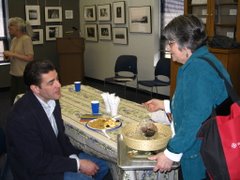
Dennis compared my Orphan Chronicles, part 1, to a Greek chorus, a two-voice effort about, what else, the parents. Our guest Rod Cornell, who I have not yet mentioned, did a nice reading of it and I forgot to compliment him. Rod is (was?) a teacher at the high school who wants to do some writing and came at Dennis' urging.
I questioned people about any experiences with the fairly new Troy Bookmaker; contemplating self-publishing a book of my Alzheimer poems.
I am afraid I went a little off the rails over Alan's Bee Buzz Before the Winter. Sorry, Alan. The following comments are mine alone: the poem was floating along in a lovely lyrical manner - "flowers drip desire...who will drink our nectar?..." when, whammy, he dropped in a textbook excerpt on how many pesticides are found in the human body, intestinal flora, herbicides, chemicals, percentages, organisms,and more,then abruptly began to wax poetic again at the end. No, I do not consider scientific data poetic. Informative, enlightening, maybe activist, but not poetic. It gave me an abrupt, stabbing pain in my head.
Larry did not delight me either but his collection of 87 (yes, Alan counted them) one-liners did inspire quite a bit of discussion, beginning with way to pronounce the title Seraglio (meaning a harem, pretend there's no "g"). General consensus: too long, not cohesive, no taproot, possible haikus. Mark went to the bathroom and said he missed nothing.
Tim delighted all of us with Mister Figgerwigger's Sister, a poem in "constant motion" which O'B said had a rhyming Cat-in-the-Hat feel. It included a love poem to Dennis, who proclaimed it a "great step forward, a liberation poem" for Tim. I just took it for a great, amusing character sketch. The shower curtain joke is pretty funny.
This poem also led to Dennis' speculative question on whether an adjective ever takes away from the force of a noun. Good question to ponder, maybe talk about. That leads me to announce the change of 5th Night Poetry discussions to 1st Night poetry discussions, still on Thursdays, still nicely alliterative. For those interested, we meet next Thursday at 7 p.m. in the director's office to talk. Everyone is welcome, last time was fun.
Israel's musicality (how Paula Abdul of me) was evident in Coppertop (an energizing drone in the movie The Matrix )who dreams of a more utopic world as he works. With a few syllabic adjustments it would be a perfect rap.
Catherine's Wheels led to talk of similes and metaphors, with Dennis giving pertinent examples in a very effective relationship poem, tightly focused and universal.
Dan's blossoming artistry shone through in The Dead Soul, a rather dark railroad journey through dreams. "haphazard tunes on broken silk....infuse the silence of the night...dream a dream of no demand".
I am an old woman and I reached for the Websters to look up dactyl, a word that came up in our discussion of Paul's Carousel Horses. The poem received mixed reviews. Catherine pointed out that it was a little unsettling, as clowns can be, and it revived creepy, puking memories in Mark. Someone asked "what is the message?" in the poem, and I wanted some color.
The dictionary on dactyl, btw, says a prosodic foot of three syllables, one long followed by two short in quantitative meter. So, I looked up prosodic, the appropriate meaning of which seems to be the stress and intonation patterns of an utterance. Fortunately I knew what utterance is, so I went back to quantitative and got pertaining to or based on the relative duration of syllables. I am getting a little discouraged. This seems too much like work.
Dennis reiterated his invitation to a memorial poetry/food fest in honor of Arthur, to occur the day after Thanksgiving. You should all have rec'd an email. EOTNP (and s.o.s) only.
Eight of us, who seemed to be starving, went to Smit's for sustenance and were briefly joined there by Jim who had been referee-ing. Gosh, I have no clue how to spell that. And I don't intend to look it up.
Hope to see some of you next Thursday. Larry, Tim and I are definites. I am heading to Dobb's Ferry today for Hallo with some of my kids. I'm psyched.
Some of Us

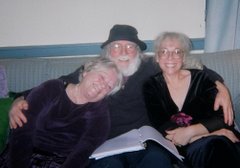
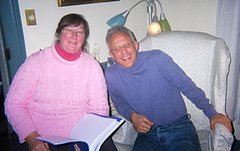
Dennis Sullivan, Beverly Osborne, Tom Corrado, Edie Abrams, Art Willis, Alan Casline (all seated); Paul Amidon, Mike Burke, Tim Verhaegen, Mark O'Brien, Barbara Vink, Philomena Moriarty
Friday, October 29, 2010


Friday, October 15, 2010
No Difference Between Living and Dying
The last man in will be the first man up: Dan Lawlor brought The Child Inside, which he dedicated to Dennis. It proposed a thought provoking concept that at death we are greeted by the child we were born as and he presented it well. Mike B. commented that it was a beautiful idea, filled with peace.
Mike, back from his Saratoga sabbatical, brought an appropriately titled piece which put the finger on the track and it's patrons accurately. Most of us agreed that the first verse which described the physical surroundings was unneccesary (boring?) and could be incorporated into the next verses with the use of adjectives.
Philomena, back from the unknown, who snuck in even later than Dan, offered a nice small poem with a great title Only two elevators left about the enforced intimacy of elevator rides. Susan was expounding on love with wonderful imagery that was cluttered and in need of trimming. Larry suggested she try to make a story from the scattered list.
Susan was "dancing with joy" over Dark Water, brought by Michael Nardacci. Mike freelances for the Altamont Enterprise and heard about EOTNP from Jill (our poetry "groupie" from Smitty's). Mike is a spelunker who is probably full of exciting tales of caves. It was quite obvious that he was no fledgling writer from the quality of his poem, a dense and descriptive adventure that produced strong emotional reactions in many: "powerful presence, tapestry of cold, chill, black, sense of mystery" were some of the remarks. I hope he continues to join us as I'd like to hear more.
My own Waiting for the Water to Get Hot struck a chord with at least a couple of people. Tim said it was devastating. Reflective of the dark quality of my thoughts lately.
Tim Norman Verhaegen was my hero last night, appearing with a gift that took my breath away (okay, maybe I'm easily impressed). I'm not telling what it is but if you want to see it, it is sitting on the counter in my office until I can make room for it at my house. Tim Norman also brought a successful poem about art and loneliness, which put a voice to the strong internal struggle most artists and writers experiece.
Larry evoked the smells of autumn, which included some that were less than desirable (Susan objected strongly). "it's all piano out today, fingers reaching out for peak colors" - that's my kind of autumn poem. None of the schmaltzy rhyming rhapsodies which too many people churn out.
Mark was vacillating between several versions of a work in progress that shows good promise. I loved the phrase "lipless mouth" and everyone agree the final line of "endless ways of being held Prisoner" was a winner.
Mr. Amidon fielded a little critism this week over tightening up Hawk Shadow, a bird revenge poem with a kick at the end. Paul also brought an announcement of a Veterans Poetry Open Mic Night at Sage on November 10.
True to form, the Math Guy had written a sonnet, teaching (me, anyway) that sonnets consist of 10 syllables per line, what cachexive means and what a volta is (an emotional or dramatic turning). Susan remarked that it was a beautiful form for a terrible subject (Jim's cancer).
Dennis, the new Cosmic Poet, was in fine form about the relationship between biology and the psyche, called My Torah, dedicated to Edie. Dennis also offered some very helpful critiques tonight.
Tim and Larry in particular seem eager to continue the "5th Night" poetry discussions. We all had a great time at the last one and are considering the possibility of meeting more frequently. Any joiners? Any opinions?
We missed Catherine, Anne and Ally Cat, Israel and Alan and Boondocks Tom, but still had a full house.
Mike, back from his Saratoga sabbatical, brought an appropriately titled piece which put the finger on the track and it's patrons accurately. Most of us agreed that the first verse which described the physical surroundings was unneccesary (boring?) and could be incorporated into the next verses with the use of adjectives.
Philomena, back from the unknown, who snuck in even later than Dan, offered a nice small poem with a great title Only two elevators left about the enforced intimacy of elevator rides. Susan was expounding on love with wonderful imagery that was cluttered and in need of trimming. Larry suggested she try to make a story from the scattered list.
Susan was "dancing with joy" over Dark Water, brought by Michael Nardacci. Mike freelances for the Altamont Enterprise and heard about EOTNP from Jill (our poetry "groupie" from Smitty's). Mike is a spelunker who is probably full of exciting tales of caves. It was quite obvious that he was no fledgling writer from the quality of his poem, a dense and descriptive adventure that produced strong emotional reactions in many: "powerful presence, tapestry of cold, chill, black, sense of mystery" were some of the remarks. I hope he continues to join us as I'd like to hear more.
My own Waiting for the Water to Get Hot struck a chord with at least a couple of people. Tim said it was devastating. Reflective of the dark quality of my thoughts lately.
Tim Norman Verhaegen was my hero last night, appearing with a gift that took my breath away (okay, maybe I'm easily impressed). I'm not telling what it is but if you want to see it, it is sitting on the counter in my office until I can make room for it at my house. Tim Norman also brought a successful poem about art and loneliness, which put a voice to the strong internal struggle most artists and writers experiece.
Larry evoked the smells of autumn, which included some that were less than desirable (Susan objected strongly). "it's all piano out today, fingers reaching out for peak colors" - that's my kind of autumn poem. None of the schmaltzy rhyming rhapsodies which too many people churn out.
Mark was vacillating between several versions of a work in progress that shows good promise. I loved the phrase "lipless mouth" and everyone agree the final line of "endless ways of being held Prisoner" was a winner.
Mr. Amidon fielded a little critism this week over tightening up Hawk Shadow, a bird revenge poem with a kick at the end. Paul also brought an announcement of a Veterans Poetry Open Mic Night at Sage on November 10.
True to form, the Math Guy had written a sonnet, teaching (me, anyway) that sonnets consist of 10 syllables per line, what cachexive means and what a volta is (an emotional or dramatic turning). Susan remarked that it was a beautiful form for a terrible subject (Jim's cancer).
Dennis, the new Cosmic Poet, was in fine form about the relationship between biology and the psyche, called My Torah, dedicated to Edie. Dennis also offered some very helpful critiques tonight.
Tim and Larry in particular seem eager to continue the "5th Night" poetry discussions. We all had a great time at the last one and are considering the possibility of meeting more frequently. Any joiners? Any opinions?
We missed Catherine, Anne and Ally Cat, Israel and Alan and Boondocks Tom, but still had a full house.
Monday, October 4, 2010
5th Night
Ah...those of you who did not grace us with your presence missed a great deal of inspired discussion. There were eight of us, each of whom offered their response to the question "Why do you write?" Not only did we get to know each other better, but the answers led to other questions and we covered a good deal of territory. It was definitely a good session, leaving us to lament the fact that there is not another 5th Thursday for several months.
There follows some "Ramblings" from El Rapant, the titular head (did I say that?) of the philosophers, exhorting your attendance and...well, generally rambling.
Tis a shame that many of the folks on this list were not around for our grand discussion of the 30th when many of these topics were either spoken about or hinted at. Tis also to be regretted that they do not ever attend philosophy club meetings. If they are so concerned with the below issues...
I will repeat my off-the-cuff remark from last week: I am all the time amazed by the general and scientifically caused belief that, despite our obvious and pronounced differences and uniqueness or quirkiness as individuals, we are all of the same species. Whether or not our dissimilarities are at least in part caused by the emphasis on humanism and individuality in Western cultures, the rift between what we want and need for ourSELVES and what the community needs in order to survive cannot be patched up by simply ignoring or repressing one side of ourselves for the sake of the IMAGINED OTHER, i.e., the image that holds the community together. The flaws in both the individual and the community make both imperfect, make all shoes fit uncomfortably, and prick us on to ceaseless strife. Conflict resolution is a hoax, or a temporary fix to a permanent problem built right into the creature of various species mixed, also referred to imperfectly as the human being.
And conflict resolution, with a decidedly mystical tone to which all of the faithful sing the same tired old song together, is another name for religion. All it takes is one original voice, aka the gorgeous angel named Lucifer, or the poet, to return the entire congregation to its conflicted reality. Please remember that there could be no Lucifer unless we all had an emphatic luciferousness about us.
This conflicted angel would like to ask all the smoothies out there: Are any of you into numismatics per chance?
We are all going to try to stuff all this nonsense in one little room again on the first Thursday of October at VPL at 7:00 p.m. Please come and be another trapezoid in the confines.
There follows some "Ramblings" from El Rapant, the titular head (did I say that?) of the philosophers, exhorting your attendance and...well, generally rambling.
Tis a shame that many of the folks on this list were not around for our grand discussion of the 30th when many of these topics were either spoken about or hinted at. Tis also to be regretted that they do not ever attend philosophy club meetings. If they are so concerned with the below issues...
I will repeat my off-the-cuff remark from last week: I am all the time amazed by the general and scientifically caused belief that, despite our obvious and pronounced differences and uniqueness or quirkiness as individuals, we are all of the same species. Whether or not our dissimilarities are at least in part caused by the emphasis on humanism and individuality in Western cultures, the rift between what we want and need for ourSELVES and what the community needs in order to survive cannot be patched up by simply ignoring or repressing one side of ourselves for the sake of the IMAGINED OTHER, i.e., the image that holds the community together. The flaws in both the individual and the community make both imperfect, make all shoes fit uncomfortably, and prick us on to ceaseless strife. Conflict resolution is a hoax, or a temporary fix to a permanent problem built right into the creature of various species mixed, also referred to imperfectly as the human being.
And conflict resolution, with a decidedly mystical tone to which all of the faithful sing the same tired old song together, is another name for religion. All it takes is one original voice, aka the gorgeous angel named Lucifer, or the poet, to return the entire congregation to its conflicted reality. Please remember that there could be no Lucifer unless we all had an emphatic luciferousness about us.
This conflicted angel would like to ask all the smoothies out there: Are any of you into numismatics per chance?
We are all going to try to stuff all this nonsense in one little room again on the first Thursday of October at VPL at 7:00 p.m. Please come and be another trapezoid in the confines.
Friday, September 24, 2010

 September 24, 2010
I TUCKED MY FRIEND IN BED TODAY
I am finding it hard to describe Dennis' tribute to Art. It was eloquent, flowing, accessible, touching. I quote:
In the eyes
of a man whose soul
sits aside the Stygian shore
I see a boy skate wild
across the frozen floor of Russia...
For me it was a throat-tightening, eye-blurring experience. Thank you.
My own poem (yes, I had one) dims by comparison, although I was fairly happy with it when I wrote it. Belling The Cat was inspired by my new Hell's Kitten, Moses, but actually tried to relate the act of a small pain letting loose the floodgates to all the pain in the universe. Mixed reviews.
Tim brought us a work in progress which is off to a good start. I, too, am fascinated by cemeteries and Tim included a visual of an old one. I believe Mark suggested that the poem ended on the first page and it could, but there was good stuff on page two that deserves to live. Not, however, "widdle tikes".
We were happy (and a little surprised?) to see Israel and Catherine again. We don't always have good luck with return visits from the people we initially attract. We might need to address this problem. In any case, they still seem to like us, and although Israel had not written, Catherine brought a wonderfully fresh Sylvia Plath poem which we all liked.
Ann drifted off the beaten path with her Two People which totaled nine alliterative words, written with her calligraphy pen, prompted ideas of the words floating around the page.
Mark, who seemed determined to chop everyone's poem off at the knees tonight, had a great title - This Foul Act - for his couplets re living life in obscurity.
Acorn shrapnel was raining down on Edie who experienced a horrible summer and was now facing the hailstorm of autumn. Edie had wisely removed a sappy verse before presenting it to the group. Dan was also into the autumn cycle with a rhyming "summer's gone" poem. Appropriately he told us how he often hears music while writing poetry. Susan compared his work to a book of timeless poems she has that was published in 1913. That was a compliment.
Susan's own Words was thought provoking and led to discussion of line breaks. It was a poem that needs several readings to absorb. Alan's list poem of the contents of his college desk in 1973 was much more on the surface, and gave us some tells into his personality. General consensus was too many books listed, poem needed weeding. Paul's First Communion started off better than it ended up, with great detail about the "uncles with knives in their boots on Saturday night". There was controversy regarding the final three lines, whether to keep or ditch.
Larry delighted me, despite his clothes clashing, the sight of his hairy legs made up for his clothing delinquency. "Exploding soapy sponges". What a concept.
All 13 of us were a little rowdy and the gavel was wielded on a number of occasions. I forgot to mention that Mike Burke left me a note assuring us of his imminent return now that the track season is over. No, Mildred Kerr is not dead but I think Tom Corrado is.
And, forgive me, God, for joking - I just got a phone call that our Mr. W. is gone.
In the eyes
of a man whose soul
sits aside the Stygian shore
I see a boy skate wild
across the frozen floor of Russia...
For me it was a throat-tightening, eye-blurring experience. Thank you.
My own poem (yes, I had one) dims by comparison, although I was fairly happy with it when I wrote it. Belling The Cat was inspired by my new Hell's Kitten, Moses, but actually tried to relate the act of a small pain letting loose the floodgates to all the pain in the universe. Mixed reviews.
Tim brought us a work in progress which is off to a good start. I, too, am fascinated by cemeteries and Tim included a visual of an old one. I believe Mark suggested that the poem ended on the first page and it could, but there was good stuff on page two that deserves to live. Not, however, "widdle tikes".
We were happy (and a little surprised?) to see Israel and Catherine again. We don't always have good luck with return visits from the people we initially attract. We might need to address this problem. In any case, they still seem to like us, and although Israel had not written, Catherine brought a wonderfully fresh Sylvia Plath poem which we all liked.
Ann drifted off the beaten path with her Two People which totaled nine alliterative words, written with her calligraphy pen, prompted ideas of the words floating around the page.
Mark, who seemed determined to chop everyone's poem off at the knees tonight, had a great title - This Foul Act - for his couplets re living life in obscurity.
Acorn shrapnel was raining down on Edie who experienced a horrible summer and was now facing the hailstorm of autumn. Edie had wisely removed a sappy verse before presenting it to the group. Dan was also into the autumn cycle with a rhyming "summer's gone" poem. Appropriately he told us how he often hears music while writing poetry. Susan compared his work to a book of timeless poems she has that was published in 1913. That was a compliment.
Susan's own Words was thought provoking and led to discussion of line breaks. It was a poem that needs several readings to absorb. Alan's list poem of the contents of his college desk in 1973 was much more on the surface, and gave us some tells into his personality. General consensus was too many books listed, poem needed weeding. Paul's First Communion started off better than it ended up, with great detail about the "uncles with knives in their boots on Saturday night". There was controversy regarding the final three lines, whether to keep or ditch.
Larry delighted me, despite his clothes clashing, the sight of his hairy legs made up for his clothing delinquency. "Exploding soapy sponges". What a concept.
All 13 of us were a little rowdy and the gavel was wielded on a number of occasions. I forgot to mention that Mike Burke left me a note assuring us of his imminent return now that the track season is over. No, Mildred Kerr is not dead but I think Tom Corrado is.
And, forgive me, God, for joking - I just got a phone call that our Mr. W. is gone.
Tuesday, September 21, 2010
Sexaholic Pajamas
O-kay, so I'm really late with this blog. I had other things to do.
Let's skip the poem recaps and hit the high spots, the highest of which was the presence of Catherine Connolly and Israel Stark, who not only came to check things out but bravely came with poems. We gave them kudos for courage and hoped not to frighten them away, as has been known to happen. I have their emails, addition to the list pending.
There were a dozen of us filling the tables; Jim Triolet bouncing up and sitting down guitarless, Tim chortling and dialing his phone over and over, Alan back at Black Mountain. While debating a title for Catherine's Waves Dan got pretty mad at me. Larry sprawled around in those ugly pj's. I was enamored with Israel's hand printing, Dennis arty scrawl and Obee's font and believe that acceptance or rejection of a poem is so related to its presentation. I always appreciate Tim including photos. And doodles. Doodles would be good.
I am barren of poems. Gushing tattoos.
Let's skip the poem recaps and hit the high spots, the highest of which was the presence of Catherine Connolly and Israel Stark, who not only came to check things out but bravely came with poems. We gave them kudos for courage and hoped not to frighten them away, as has been known to happen. I have their emails, addition to the list pending.
There were a dozen of us filling the tables; Jim Triolet bouncing up and sitting down guitarless, Tim chortling and dialing his phone over and over, Alan back at Black Mountain. While debating a title for Catherine's Waves Dan got pretty mad at me. Larry sprawled around in those ugly pj's. I was enamored with Israel's hand printing, Dennis arty scrawl and Obee's font and believe that acceptance or rejection of a poem is so related to its presentation. I always appreciate Tim including photos. And doodles. Doodles would be good.
I am barren of poems. Gushing tattoos.
Tuesday, September 7, 2010
DIDGERIDOO from Dennis
Dear Poe-ettes,
As probably all are aware, a few weeks ago Arthur's [Arthur Willis] TO THE TUNE OF A DIDGERIDOO AND STICKS came out under the auspices of Benevolent Bird Press, very nicely done as we might expect from what we have seen from that press already. And done with great dispatch to accommodate the reality of the hour.
Arthur [Willis] had wanted to read that poem accompanied by a didgeridoo and sticks as advertised and plans were made for him to do so but they got scotched somehow. When the Bird [Alan Casline], poet and publisher of the Benevolent Bird imprint series, saw this to be the case he went to the Willis Farm in Quaker Street, New York on Tuesday August 24 to record Arthur reading his long poem. He accompanied Arthur with his hand-held skin drum.
[Incidentally, the next day, Arthur's wife Judy, told me the reading had taken such an emotional toll that the poem went to bed to rest, toll as in healthy catharsis.]
Later in his studio Tom Corrado, using dubbing measures and the like, added the didgeridoo and mbira [an African musical instrument consisting of a hollow gourd or wooden resonator and a number of usually metal strips that vibrate when plucked] to the recorded reading.
Also a part of the performance were the sweet girglings of Gaia, a bird perched on a tree-branch at the Willis farm who seemed to be sent by the gods to add nature?s trills to the event.
Yesterday, Saturday September 4 [my mother's birthday] the Bird, Edie [Abrams], and I headed to the Willis Farm to visit Arthur and play for him the recording of his latest and most beautiful poem.
What was most stunning to see at first, was the beautiful jewel case Bird had created for the CD, linen-like cover stock measuring 5 1/2 x 8 1/2 with a slit in the top to access the CD.
The front of the case sports a most extraordinary color design of SUN, MEETING PLACE, STAR, AND TWO CONNECTED SPRINGS, water color paintings in fact, in greens and blues and yellows and reds. They look like four Buddhist prayer flags two on top of two.
A note about this: anytime you go to a music store and buy a CD in a plastic-captioned jewel case in the future, after seeing this production, you will once again see reasons why the globalizing mercantile economy is such a sham. Bird has once again produced a great work of art.
And w/r/t the CD itself, its contents, Arthur's reading is a tour de force. He sounds like a mixture of Ginsberg, Ferlinghetti, Snyder, and Corso reading Beat poetry from a San Francisco loft. His voice has a rasp and urgency to it that is compelling.
Anyone who is a fan of Arthur's poetry or of good poetry or even feigns such, or who perhaps regards Arthur as a mensch of grand proportions, will want to get this CD as quickly as possible. Bird plans to make 100 with 30 already done.
And Tom Corrado's musical input is no icing on an already-delicious cake but an integral part of making the performance the tour de force I mentioned. His perfectly-timed and proportioned crescendos fit in perfectly and will get you.
And while Bird's drumming, when he performed with the Metamorphosis Trio, left much to be desired, here his contribution adds considerably as well. It too fits perfectly. This piece could have been done live in the basement of a Village coffeehouse in the late 1950s it is so good.
Before went into the house to listen to the recording, Bird read two beautiful poems he had written for Arthur, poems of deep feeling, expressing deep appreciation for his grand master of a friend. Hopefully we will get to hear them again sometime.
On the way out to Quaker Street, Edie remarked that she thought the last time we visited Arthur he did not remember her name. I was not sure he remembered mine.
I brought with me his earlier book of poems POET IN A FLYING SUIT (1986)?for which incidentally I set up a reading in St. Matthew's Church, Voorheesville, at which several hundred showed up to listen, a great afternoon with Arthur reading from the pulpit which I took out of my bag to show him, asking him what these were. He gave his attention to something else.
I then said: Arthur, what is my name? Do you know who I am? It was clear he was struggling to come up with something and then slyly he added, You are the maestro. I laughed heartily and said, what a trouble-maker you are and he laughed as heartily or nearly so.
Once again, like a simple bodhisattva, he spoke in aphorisms as if quoted from some religious scripture. He talked about the importance of sharing, that that is the essence of being human and that anyone who does not take that upon him- or herself hardly qualifies for the title of ser humano.
He spoke as well of the importance of meeting human needs at all levels in society, that that is the purpose of being together, and that that is our mission in life. Later he spoke about poetry, that is how he had responded to someone earlier about poetry, with: it is very hard to write a poem.
I told him while the four of us sat there, that there are people who play baseball, who hit the ball, catch a few fly balls, and then there are baseball players. And the latter in the sports world would be mighty careful to qualify themselves among the latter. I said the same is true for poets, there are those who write poems and read them and there are poets, yet the former speak of themselves as if poets, as if . . .
Finally, weeks ago Arthur's doctor told him that tea is good for cleansing the system so, once again he said yesterday?as he had told me many times?that the tea is beating the cancer and that that is a good sign. Yet later he did allude to the fact that he is dying. I felt for the first time yesterday he had found the words to tell what was going on in his heart?a start to a finish with dignity perhaps. I keep thinking of the end of Aldous Huxley and how his wife Laura cared for him with such dignity, meeting his needs at every step of the way. [See Mrs. Huxley?s memoir, THIS TIMELESS MOMENT: A PERSONAL VIEW OF ALDOUS HUXLEY? (Farrar, Straus & Giroux, 1968)].
Art singled out the poetry of Tom Corrado, saying he is a real poet, and spoke of Jim Williams with such enthusiasm, how Jim has been a model for him, a mensch among menches.
Last night, laying in bed, I felt like I was dying too, a piece of me was drifting off to some place I had never known nor seen before. And it did not concern me. We will all be there and not in tune with actuarial statistics.
I will end by noting how this grand maestro of a teacher, Arthur, has had the courage to allow students to speak their hears and minds in his class, always capable of relating any curriculum-related materials to what they had to say at the moment, a quality of very rare and great teachers. His word was so respected that letters of recommendation greased the skids for many students to get into the most prestigious of colleges and universities. I saw it happen.
Several weeks ago, when the head of the Meeting House in Quaker Street asked Arthur what he would like the younger Quakers to know about being a Quaker, Arthur said, as I mentioned here before, how essential it is for a person to pay attention to the silence in her- or himself so that when a person speaks, she or he will not make an ass of her- or himself, not as in the person being concerned about being a fool, but as in not having taken the opportunity to be a contributor to the great venture we call life in community with something profound to say and be.
La Paz,
Dennis
Dennis Sullivan
September 5, 2010
8:20 am
Voorheesville, New York
As probably all are aware, a few weeks ago Arthur's [Arthur Willis] TO THE TUNE OF A DIDGERIDOO AND STICKS came out under the auspices of Benevolent Bird Press, very nicely done as we might expect from what we have seen from that press already. And done with great dispatch to accommodate the reality of the hour.
Arthur [Willis] had wanted to read that poem accompanied by a didgeridoo and sticks as advertised and plans were made for him to do so but they got scotched somehow. When the Bird [Alan Casline], poet and publisher of the Benevolent Bird imprint series, saw this to be the case he went to the Willis Farm in Quaker Street, New York on Tuesday August 24 to record Arthur reading his long poem. He accompanied Arthur with his hand-held skin drum.
[Incidentally, the next day, Arthur's wife Judy, told me the reading had taken such an emotional toll that the poem went to bed to rest, toll as in healthy catharsis.]
Later in his studio Tom Corrado, using dubbing measures and the like, added the didgeridoo and mbira [an African musical instrument consisting of a hollow gourd or wooden resonator and a number of usually metal strips that vibrate when plucked] to the recorded reading.
Also a part of the performance were the sweet girglings of Gaia, a bird perched on a tree-branch at the Willis farm who seemed to be sent by the gods to add nature?s trills to the event.
Yesterday, Saturday September 4 [my mother's birthday] the Bird, Edie [Abrams], and I headed to the Willis Farm to visit Arthur and play for him the recording of his latest and most beautiful poem.
What was most stunning to see at first, was the beautiful jewel case Bird had created for the CD, linen-like cover stock measuring 5 1/2 x 8 1/2 with a slit in the top to access the CD.
The front of the case sports a most extraordinary color design of SUN, MEETING PLACE, STAR, AND TWO CONNECTED SPRINGS, water color paintings in fact, in greens and blues and yellows and reds. They look like four Buddhist prayer flags two on top of two.
A note about this: anytime you go to a music store and buy a CD in a plastic-captioned jewel case in the future, after seeing this production, you will once again see reasons why the globalizing mercantile economy is such a sham. Bird has once again produced a great work of art.
And w/r/t the CD itself, its contents, Arthur's reading is a tour de force. He sounds like a mixture of Ginsberg, Ferlinghetti, Snyder, and Corso reading Beat poetry from a San Francisco loft. His voice has a rasp and urgency to it that is compelling.
Anyone who is a fan of Arthur's poetry or of good poetry or even feigns such, or who perhaps regards Arthur as a mensch of grand proportions, will want to get this CD as quickly as possible. Bird plans to make 100 with 30 already done.
And Tom Corrado's musical input is no icing on an already-delicious cake but an integral part of making the performance the tour de force I mentioned. His perfectly-timed and proportioned crescendos fit in perfectly and will get you.
And while Bird's drumming, when he performed with the Metamorphosis Trio, left much to be desired, here his contribution adds considerably as well. It too fits perfectly. This piece could have been done live in the basement of a Village coffeehouse in the late 1950s it is so good.
Before went into the house to listen to the recording, Bird read two beautiful poems he had written for Arthur, poems of deep feeling, expressing deep appreciation for his grand master of a friend. Hopefully we will get to hear them again sometime.
On the way out to Quaker Street, Edie remarked that she thought the last time we visited Arthur he did not remember her name. I was not sure he remembered mine.
I brought with me his earlier book of poems POET IN A FLYING SUIT (1986)?for which incidentally I set up a reading in St. Matthew's Church, Voorheesville, at which several hundred showed up to listen, a great afternoon with Arthur reading from the pulpit which I took out of my bag to show him, asking him what these were. He gave his attention to something else.
I then said: Arthur, what is my name? Do you know who I am? It was clear he was struggling to come up with something and then slyly he added, You are the maestro. I laughed heartily and said, what a trouble-maker you are and he laughed as heartily or nearly so.
Once again, like a simple bodhisattva, he spoke in aphorisms as if quoted from some religious scripture. He talked about the importance of sharing, that that is the essence of being human and that anyone who does not take that upon him- or herself hardly qualifies for the title of ser humano.
He spoke as well of the importance of meeting human needs at all levels in society, that that is the purpose of being together, and that that is our mission in life. Later he spoke about poetry, that is how he had responded to someone earlier about poetry, with: it is very hard to write a poem.
I told him while the four of us sat there, that there are people who play baseball, who hit the ball, catch a few fly balls, and then there are baseball players. And the latter in the sports world would be mighty careful to qualify themselves among the latter. I said the same is true for poets, there are those who write poems and read them and there are poets, yet the former speak of themselves as if poets, as if . . .
Finally, weeks ago Arthur's doctor told him that tea is good for cleansing the system so, once again he said yesterday?as he had told me many times?that the tea is beating the cancer and that that is a good sign. Yet later he did allude to the fact that he is dying. I felt for the first time yesterday he had found the words to tell what was going on in his heart?a start to a finish with dignity perhaps. I keep thinking of the end of Aldous Huxley and how his wife Laura cared for him with such dignity, meeting his needs at every step of the way. [See Mrs. Huxley?s memoir, THIS TIMELESS MOMENT: A PERSONAL VIEW OF ALDOUS HUXLEY? (Farrar, Straus & Giroux, 1968)].
Art singled out the poetry of Tom Corrado, saying he is a real poet, and spoke of Jim Williams with such enthusiasm, how Jim has been a model for him, a mensch among menches.
Last night, laying in bed, I felt like I was dying too, a piece of me was drifting off to some place I had never known nor seen before. And it did not concern me. We will all be there and not in tune with actuarial statistics.
I will end by noting how this grand maestro of a teacher, Arthur, has had the courage to allow students to speak their hears and minds in his class, always capable of relating any curriculum-related materials to what they had to say at the moment, a quality of very rare and great teachers. His word was so respected that letters of recommendation greased the skids for many students to get into the most prestigious of colleges and universities. I saw it happen.
Several weeks ago, when the head of the Meeting House in Quaker Street asked Arthur what he would like the younger Quakers to know about being a Quaker, Arthur said, as I mentioned here before, how essential it is for a person to pay attention to the silence in her- or himself so that when a person speaks, she or he will not make an ass of her- or himself, not as in the person being concerned about being a fool, but as in not having taken the opportunity to be a contributor to the great venture we call life in community with something profound to say and be.
La Paz,
Dennis
Dennis Sullivan
September 5, 2010
8:20 am
Voorheesville, New York
Friday, August 27, 2010
Stoneman Rocks
Edie started off the evening with one her best poems, about getting ready to present herself to the world in the tropical environment of her bathroom. There was some discussion about the end line "and smile" and about the trademarking of "Ecosphere", but nothing that detracted from the good poem. Dennis remarked that it was her best use of language ever.
Dennis and Tim were particularly on the money with their critiques last night, both offering valuable insights in several instances. Dennis' own poem "A Week After My Annual Eye Exam" extolled his visionary experiences and asked the question (unanswered)- is the poem a warning or a dream? Best line: I live at 26 Utopia Street... Best phrase: sorry song of night Dennis was taken aback it seemed because we pointed out two(!) typos.
Tim presented a wunnerful, wunnerful (my words) work called "Morning Mourning Meltdowns" dealing with death, obituaries, Kubler-Ross cycle, and a lot of other things. It included a marvelous quote by Tim's dad which I won't print because it had a BAD word in it.
The Stoneman rocks! That's from Obee, said because Paul's poem about chasing the sleep demons away did rock. They watched from the shore, helpless to reach me.... We applauded.
Dan caused some controversey with "A Poe-Try", a knockoff EAP poem. Dan tried to recreate the atmosphere of Poe's "The Bells" in a work that followed man's progress to the grave. Good rhymes, but maybe too much repetition? Dan, btw, is appearing in concert at Avila (Washington Ave Ext.) on September 22 at 7:30 p.m.
Socrapant did not delight me, except with his nom de plume. Larry, who always delights me, did not delight me with his "Philosophy Made Simple" - 35 "chapters" of one-liners, some inspired, some not so. Personal response only; everyone else seemed to like it.
Ann brought a rewrite of "Cardinal Flowers" (which I think is a lovely title). It was much more successful than the first version, tighter, with fewer abstract words. Some suggestions regarding changing the phrase "tied to Rome". I had to gavel when the talk sidetracked to priests and the Catholic church.
Obeedude brought a winner, which I loved, inspired by sardines. Who knew, fish in a can becoming obsolete along with much else in our world. Sad. He also used a great type face which I presumed was his handwriting and gave a short demo of his iPad for me (again). I am still pondering the purchase of a Kindle.
I will be looking up Anthony Trollope in response to a question by Tim near the end of the evening. Short post today; I am flooded with festival chores. Festival is coming up on 9/11.
Dennis and Tim were particularly on the money with their critiques last night, both offering valuable insights in several instances. Dennis' own poem "A Week After My Annual Eye Exam" extolled his visionary experiences and asked the question (unanswered)- is the poem a warning or a dream? Best line: I live at 26 Utopia Street... Best phrase: sorry song of night Dennis was taken aback it seemed because we pointed out two(!) typos.
Tim presented a wunnerful, wunnerful (my words) work called "Morning Mourning Meltdowns" dealing with death, obituaries, Kubler-Ross cycle, and a lot of other things. It included a marvelous quote by Tim's dad which I won't print because it had a BAD word in it.
The Stoneman rocks! That's from Obee, said because Paul's poem about chasing the sleep demons away did rock. They watched from the shore, helpless to reach me.... We applauded.
Dan caused some controversey with "A Poe-Try", a knockoff EAP poem. Dan tried to recreate the atmosphere of Poe's "The Bells" in a work that followed man's progress to the grave. Good rhymes, but maybe too much repetition? Dan, btw, is appearing in concert at Avila (Washington Ave Ext.) on September 22 at 7:30 p.m.
Socrapant did not delight me, except with his nom de plume. Larry, who always delights me, did not delight me with his "Philosophy Made Simple" - 35 "chapters" of one-liners, some inspired, some not so. Personal response only; everyone else seemed to like it.
Ann brought a rewrite of "Cardinal Flowers" (which I think is a lovely title). It was much more successful than the first version, tighter, with fewer abstract words. Some suggestions regarding changing the phrase "tied to Rome". I had to gavel when the talk sidetracked to priests and the Catholic church.
Obeedude brought a winner, which I loved, inspired by sardines. Who knew, fish in a can becoming obsolete along with much else in our world. Sad. He also used a great type face which I presumed was his handwriting and gave a short demo of his iPad for me (again). I am still pondering the purchase of a Kindle.
I will be looking up Anthony Trollope in response to a question by Tim near the end of the evening. Short post today; I am flooded with festival chores. Festival is coming up on 9/11.
Wednesday, August 18, 2010
from Dennis
DEAR POE-ETTES,
Tuesday August 17, 2010 6:40 am, The Ville
I see in this morning’s New York Times that Clint Eastwood has a new film “Hereafter” about to be shown at the New York Film Festival. In the film Eastwood tackles issues of death, near-death, and the so-called afterlife—a timely topic for many of us. For me in particular because I was going to recommend to you all this past week Helen Vendler’s newest book Last Looks, Last Books by Princeton University Press. I cannot recommend it strongly enough to poets interested in poetry.
The “last looks” part of the book refers to a supposed tradition of the Irish who, near death, go out amongst their favorite fields, etc. to get a last peek before they die. A kind of meet your maker. As in: this is who I was, this is who I am, this is the who who will shortly never be.
The “last books” part refers to poets who through their written work express their ideas, feelings, and general sentiments about their last looks. That is, what they say about death and how they try to make sense of their “passing” into whatever happens when we die. To say afterlife is to already have begged the question.
This grand dame of American letters at Harvard—she is as great one; Wikipedia reminds us that in 2004 the National Endowment for the Humanities selected her for the Jefferson Lecture, the highest honor for achievement in the humanities the United States government gives out—tackles the last books of Wallace Stevens, Sylvia Plath, Robert Lowell, Elizabeth Bishop, and James Merrill, five of my favorites. I mean how much has been said about Plath’s handing of her humanity and what death would do to enhance it.
Vendler says that poets—who work outside religious traditions such as Christianity and others religions which have packaged ideas about death and how to handle it in life—in effect have to create their own idioms and rituals through their making of poems. And those words are not icing on a cake, but a way a person/poet can pass into an unknown that is unimaginable, (or is it?) territory, a switch in consciousness, the off-switch. I could say more, let me just say I recommend it highly.
And, by the bye, I just got a note from Amazon that her Dickinson: Selected Poems and Commentaries which was scheduled to come out in September will be out next week. I cannot wait to see her take on Emily. I recommend this as well, one grand dame examining the work of another American great. This is fireside reading.
W/r/t the first book of hers I mentioned here on last looks, I was reminded of a piece that Peter Brown wrote in The New York Review of Books in 2008 “The Private Art of Early Christians” reviewing an exhibition at the Kimball Art Museum in Fort Worth, Texas. It made me want to live in Fort Worth for a day to see it. The exhibit lasted from November 2007 to March 2008.
Why I bring this piece up is that Brown points to the earliest remnants of Christian art from private homes which tell stories about life and dialectically death. There was a rather “secular” [not a word I use, not one that fits into my ideology, but I use it here because of this context] view of life and death. That is, the art did not reflect the theology and selling of Jesus as personal savior, especially when you die. See the Vendler connection? Poets do not sell anything, they try to figure out human dilemmas for the community, for the great collective.
Brown says one of the most “touching” pieces in the collection—and he sold me on it— was one “of the gold glass pieces (catalog pages 192–193) [showing] a classical shepherd surrounded by his sheep. Around the edge is written, “(Be) the pride of your friends. Drink. May you live! [in Greek] May you live! [added in Latin, just to be sure!]” A collective mentality, a carpe diem. Imagine being the pride of your friends, someone people have something nice to say about—and not after you die!
That is, there was a modestly human basis to the art that grew out of experience, not a superimposed theology as we think of today. Important Catholic art historians put a religious spin on every social event they examined in art, a woman praying had to be the first nun, a woman and child eating a picnic lunch had to be Many and Jesus with the Eucharist.
When my aunt died a few weeks ago and I went to Staten Island to attend her wake and funeral, at the funeral mass the priest said that through Jesus she will live forever, that she has been resurrected, that she had not died in Jesus. I thought: what a religion, you think he might have thrown her a few more months while she was alive! That I’d sign up for for it has a very human grounding.
Brown says in the Fort Worth exhibition, “Two rooms later, in the last part of the exhibition, [as the centuries have moved on] we see the ultimate symbol of Christ’s power at its fullest development—a fragment of the Cross itself placed in a cross of gold studded with gems, given to Rome by the emperor Justin II sometime between 568 and 574 (catalog pages 283–285; see illustration on page 49 of this article). Glowing in the dark with barbaric splendor, this was still a Cross of victory. As the inscription made clear, this was the Cross on which Christ had “subdued [death] the enemy of mankind.” It was also a Cross calculated to keep human enemies (of which there were all too many by that time) away from the walls of Rome.”
Here we have the superimposition of a Christian poetry if you will on life, dictating how things go down in death and who is big enough to handle that death—there is only one. How does that help people make sense of their life and death in human terms, terms that can be understood by others.
There is more I can say about this but you can see how Brown’s piece, the exhibit actually, fits in nicely with Vendler’s analysis of the poetic works of human beings through poetry trying to figure out how to be “victorious” in death, how to subdue it, and if not that, whatever. I have written any number or poems on death and life, all my poems reflecting the theology of Dennis Sullivan, with a foundation that I always hope others will see as valuable for them, in that they can develop a theology, a poetry that reflects their experience.
And to extend the analysis, how does poetry keep the enemies of self away from self so that one can achieve some level of peace of mind. This is what poetic consciousness does for me, a state of mind that is both creative and gratitudinously peaceful. How’s that for a start on a way to beat death? Poetic consciousness leads us out on a high note. For all the Snow Man Wallace Stevens is, I do not think he is bummed out, just weighed down by reality, but a reality that when understood brings a certain joy, one that helps face death sanely.
Finally, and to go back to Vendler again, her first subject in the last look books is Stevens, in particular his “The Plain Sense of Things,” pointing to Stevens saying that in a certain situation he is having a hard time picking an adjective to describe it—see the first line second stanza—to say what he wants to say “after the leaves have fallen,” hen one realizes that one’s time has come..
Here is his poem below. It is beautiful. I throw these things out today for your poetic enjoyment. Plus anyone who would like me to send them, via e-mail, a copy of the Brown piece—I do subscribe to The New York Review of Books, in print and online, my longest continuous subscription, over 30 years—I will be happy to do so.
Peace,
Dennis
================
Wallace Stevens (1879 –1955)
THE PLAIN SENSE OF THINGS
After the leaves have fallen, we return
To a plain sense of things. It is as if
We had come to an end of the imagination,
Inanimate in an inert savoir.
It is difficult even to choose the adjective
For this blank cold, this sadness without cause.
The great structure has become a minor house.
No turban walks across the lessened floors.
The greenhouse never so badly needed paint.
The chimney is fifty years old and slants to one side.
A fantastic effort has failed, a repetition
In a repetitiousness of men and flies.
Yet the absence of the imagination had
Itself to be imagined. The great pond,
The plain sense of it, without reflections, leaves,
Mud, water like dirty glass, expressing silence
Of a sort, silence of a rat come out to see,
The great pond and its waste of the lilies, all this
Had to be imagined as an inevitable knowledge,
Required, as necessity requires.
Tuesday August 17, 2010 6:40 am, The Ville
I see in this morning’s New York Times that Clint Eastwood has a new film “Hereafter” about to be shown at the New York Film Festival. In the film Eastwood tackles issues of death, near-death, and the so-called afterlife—a timely topic for many of us. For me in particular because I was going to recommend to you all this past week Helen Vendler’s newest book Last Looks, Last Books by Princeton University Press. I cannot recommend it strongly enough to poets interested in poetry.
The “last looks” part of the book refers to a supposed tradition of the Irish who, near death, go out amongst their favorite fields, etc. to get a last peek before they die. A kind of meet your maker. As in: this is who I was, this is who I am, this is the who who will shortly never be.
The “last books” part refers to poets who through their written work express their ideas, feelings, and general sentiments about their last looks. That is, what they say about death and how they try to make sense of their “passing” into whatever happens when we die. To say afterlife is to already have begged the question.
This grand dame of American letters at Harvard—she is as great one; Wikipedia reminds us that in 2004 the National Endowment for the Humanities selected her for the Jefferson Lecture, the highest honor for achievement in the humanities the United States government gives out—tackles the last books of Wallace Stevens, Sylvia Plath, Robert Lowell, Elizabeth Bishop, and James Merrill, five of my favorites. I mean how much has been said about Plath’s handing of her humanity and what death would do to enhance it.
Vendler says that poets—who work outside religious traditions such as Christianity and others religions which have packaged ideas about death and how to handle it in life—in effect have to create their own idioms and rituals through their making of poems. And those words are not icing on a cake, but a way a person/poet can pass into an unknown that is unimaginable, (or is it?) territory, a switch in consciousness, the off-switch. I could say more, let me just say I recommend it highly.
And, by the bye, I just got a note from Amazon that her Dickinson: Selected Poems and Commentaries which was scheduled to come out in September will be out next week. I cannot wait to see her take on Emily. I recommend this as well, one grand dame examining the work of another American great. This is fireside reading.
W/r/t the first book of hers I mentioned here on last looks, I was reminded of a piece that Peter Brown wrote in The New York Review of Books in 2008 “The Private Art of Early Christians” reviewing an exhibition at the Kimball Art Museum in Fort Worth, Texas. It made me want to live in Fort Worth for a day to see it. The exhibit lasted from November 2007 to March 2008.
Why I bring this piece up is that Brown points to the earliest remnants of Christian art from private homes which tell stories about life and dialectically death. There was a rather “secular” [not a word I use, not one that fits into my ideology, but I use it here because of this context] view of life and death. That is, the art did not reflect the theology and selling of Jesus as personal savior, especially when you die. See the Vendler connection? Poets do not sell anything, they try to figure out human dilemmas for the community, for the great collective.
Brown says one of the most “touching” pieces in the collection—and he sold me on it— was one “of the gold glass pieces (catalog pages 192–193) [showing] a classical shepherd surrounded by his sheep. Around the edge is written, “(Be) the pride of your friends. Drink. May you live! [in Greek] May you live! [added in Latin, just to be sure!]” A collective mentality, a carpe diem. Imagine being the pride of your friends, someone people have something nice to say about—and not after you die!
That is, there was a modestly human basis to the art that grew out of experience, not a superimposed theology as we think of today. Important Catholic art historians put a religious spin on every social event they examined in art, a woman praying had to be the first nun, a woman and child eating a picnic lunch had to be Many and Jesus with the Eucharist.
When my aunt died a few weeks ago and I went to Staten Island to attend her wake and funeral, at the funeral mass the priest said that through Jesus she will live forever, that she has been resurrected, that she had not died in Jesus. I thought: what a religion, you think he might have thrown her a few more months while she was alive! That I’d sign up for for it has a very human grounding.
Brown says in the Fort Worth exhibition, “Two rooms later, in the last part of the exhibition, [as the centuries have moved on] we see the ultimate symbol of Christ’s power at its fullest development—a fragment of the Cross itself placed in a cross of gold studded with gems, given to Rome by the emperor Justin II sometime between 568 and 574 (catalog pages 283–285; see illustration on page 49 of this article). Glowing in the dark with barbaric splendor, this was still a Cross of victory. As the inscription made clear, this was the Cross on which Christ had “subdued [death] the enemy of mankind.” It was also a Cross calculated to keep human enemies (of which there were all too many by that time) away from the walls of Rome.”
Here we have the superimposition of a Christian poetry if you will on life, dictating how things go down in death and who is big enough to handle that death—there is only one. How does that help people make sense of their life and death in human terms, terms that can be understood by others.
There is more I can say about this but you can see how Brown’s piece, the exhibit actually, fits in nicely with Vendler’s analysis of the poetic works of human beings through poetry trying to figure out how to be “victorious” in death, how to subdue it, and if not that, whatever. I have written any number or poems on death and life, all my poems reflecting the theology of Dennis Sullivan, with a foundation that I always hope others will see as valuable for them, in that they can develop a theology, a poetry that reflects their experience.
And to extend the analysis, how does poetry keep the enemies of self away from self so that one can achieve some level of peace of mind. This is what poetic consciousness does for me, a state of mind that is both creative and gratitudinously peaceful. How’s that for a start on a way to beat death? Poetic consciousness leads us out on a high note. For all the Snow Man Wallace Stevens is, I do not think he is bummed out, just weighed down by reality, but a reality that when understood brings a certain joy, one that helps face death sanely.
Finally, and to go back to Vendler again, her first subject in the last look books is Stevens, in particular his “The Plain Sense of Things,” pointing to Stevens saying that in a certain situation he is having a hard time picking an adjective to describe it—see the first line second stanza—to say what he wants to say “after the leaves have fallen,” hen one realizes that one’s time has come..
Here is his poem below. It is beautiful. I throw these things out today for your poetic enjoyment. Plus anyone who would like me to send them, via e-mail, a copy of the Brown piece—I do subscribe to The New York Review of Books, in print and online, my longest continuous subscription, over 30 years—I will be happy to do so.
Peace,
Dennis
================
Wallace Stevens (1879 –1955)
THE PLAIN SENSE OF THINGS
After the leaves have fallen, we return
To a plain sense of things. It is as if
We had come to an end of the imagination,
Inanimate in an inert savoir.
It is difficult even to choose the adjective
For this blank cold, this sadness without cause.
The great structure has become a minor house.
No turban walks across the lessened floors.
The greenhouse never so badly needed paint.
The chimney is fifty years old and slants to one side.
A fantastic effort has failed, a repetition
In a repetitiousness of men and flies.
Yet the absence of the imagination had
Itself to be imagined. The great pond,
The plain sense of it, without reflections, leaves,
Mud, water like dirty glass, expressing silence
Of a sort, silence of a rat come out to see,
The great pond and its waste of the lilies, all this
Had to be imagined as an inevitable knowledge,
Required, as necessity requires.
Subscribe to:
Posts (Atom)